K-004: Letters: Jonathan Kershners Tavern, 1982 to 1991
Kershner LettersSummary
K-004 Closing Summary — Letters_JonathanKershner'sTavern_1973-1991
Renumbered: this document was K-008 in the pre-merge archive. K-004 is its current ID. Document IDs cited in the text below were updated to current numbering on 2026-10-18.
Actual date range vs. file name
The file name reads "1973-1991," but the earliest dated document in these 10 pages is from 20 August 1982; nothing from the 1970s appears. Actual range: 20 August 1982 – 14 October 1991.
What the document reveals
This is a tightly focused, single-issue case file: Ruth Bownds Kershner's decade-long campaign to prevent a specific piece of local Hagerstown-area lore — that a stone building owned by Vincent Groh was "Jonathan Kershner's Tavern" — from being enshrined as fact in a historic-preservation survey and later in a book on the National Road by researcher H.H. Douglas. It's a genuinely entertaining window into RBK as a source-driven historian: she's polite but unyielding, repeatedly telling Douglas "let's not romanticize a weak, inept, and dishonest member of our family" and "Groh is a promoter, not a researcher." Her actual conclusion, built from deeds, tax lists, tombstones, and a single contemporary 1815 newspaper death notice, is more interesting than the myth: Jonathan Kershner (the alleged tavern owner) was the family's black sheep, who mortgaged the land, got sued for debt, and fled to Pennsylvania ahead of the sheriff in 1794 — while it was almost certainly his mother, the widowed Hannah Miller Kershner, and his younger brother Jacob who actually ran a documented tavern nearby (Jacob's 1815 estate inventory lists 3 dinner tables, 18 chairs, 11 slaves, and a multipage bar tab list).
Top facts and leads
- No tavern connected to Jonathan Kershner is documented; RBK's own research points instead to his brother Jacob (Jr.) as the real tavern-keeper, likely with his mother Hannah Miller Kershner having run it in the years right after her husband's 1776 death.
- Jacob Kershner Jr.'s birthdate is revisable from a previously assumed 1752 (per his gravestone, erected decades after death) to circa 1757, based on a contemporary 1815 Baltimore newspaper death notice giving his age as 58.
- Jacob Jr.'s children with Mary Ann (Rouch/Rouck) Kershner were retroactively legitimized by a special 1812 act of the Maryland Legislature — meaning Jacob and Mary Ann were very likely not formally married when their children were born, an unresolved and only lightly explored thread.
- Jonathan Kershner mortgaged the family land to Luther Martin, was sued for debt, and disappeared into Pennsylvania around 1794, never returning — the foreclosure and disappearance are documented via court and deed records, not family legend.
- This document reinforces RBK's role (also visible in K-000) as the family's most rigorous primary-source researcher — here specifically in dialogue with outside local historians (Douglas, the Washington Co. Historical Sites Survey) who had incentive to accept a more colorful, less accurate story.
- Family/reunion context: Stephen ("Steve") Kershner, Stuart's brother, made the family's original contact with Langenselbold, Germany on a business trip — corroborating and slightly extending the German-origins research thread already documented in K-000.
Verification notes
All 10 pages are typed and legible; confidence in transcription is high throughout. One page (10) is an apparent duplicate scan of page 9's letter, and the 27 August 1982 letter to Mary Maxwell appears to be scanned in two overlapping fragments (pages 4 and 8) — noted in the transcript rather than silently merged.
The originals
10 scanned pages. Click any one to view it large; use the arrow keys to move through them. Page numbers match the transcript.






People, places and dates
Show the genealogical index
K-004 Genealogical Index — Letters_JonathanKershner'sTavern_1973-1991
Renumbered: this document was K-008 in the pre-merge archive. K-004 is its current ID. Document IDs cited in the text below were updated to current numbering on 2026-10-18.
People
- Jacob Kershner (Sr.) — d. 1776, Washington Co., MD, intestate. Original patentee of Black Oak Levels (1764) and Hooks Neglect (1770). Father of Jonathan and Jacob Jr. via wife Hannah Miller.
- Hannah Miller Kershner — widow of Jacob Kershner (Sr.); lived until 1800; left a will of her own; RBK's strong candidate for the person who actually ran a tavern near the crossroads after her husband's death, "with the help of her two young sons."
- Jonathan Kershner — Jacob Sr.'s older son and heir (est. b. ca. 1734/35). Sold/repurchased/re-sold Black Oak Levels in 1793; mortgaged remaining land to Luther Martin, defaulted, and fled to Pennsylvania ca. 1794, never returning. RBK repeatedly and pointedly argues he did NOT run a tavern and was not a Revolutionary War veteran (only signed the 1778 Oath of Fidelity, as legally required).
- Jacob Kershner (Jr., "the tavern-keeper") — Hannah's younger son, b. ca. 1757 (revised from a previously published 1752, based on an 1815 death notice giving his age as 58, not 63 as his gravestone — placed decades after death — implies). Definitively ran a tavern per his own 1815 estate inventory (3 large dinner tables, 18 chairs, 11 slaves, 33 barrels of flour, 9 beds, multipage bar-tab list). Married Mary Ann/Mary (Rouch/Rouck?), daughter of Gustaphus Brewer. Will dated 5 Mar 1810, codicil 14 Mar 1814. Died 10 Feb 1815 per gravestone (St. Paul's Church).
- Mary Ann (Rouch/Rouck) Kershner — wife of Jacob Kershner Jr.; consistently called "daughter of Gustaphus Brewer" in records; named in Brewer's 1809 will; children with Jacob (Sarah, Elizabeth, Jacob, Mary, Gustavus, Hannah Caroline) legitimized by a special 1812 Act of the Maryland Legislature — suggesting Jacob and Mary were not formally/legally married when the children were born. RBK speculates "Rouch/Rouck" may be a misreading of "Rench."
- Peter Rouch and Eve Cassell — named in the same 1812 Legitimation Act as parents of three daughters retroactively legitimized; possibly related to Mary Ann Kershner's birth family.
- Gustaphus Brewer — father of Mary Ann Kershner; his 1809 will names her.
- Gustavus Kershner — b. 1802, son of Jacob Jr.; said to have grown up on the tavern-keeper's farm.
- Maj. Martin Kershner — b. 1743, d. 1818; built a house in 1804 for his second wife, the widow Magdalena Ankeny, who in turn built the couple a brick house in Hagerstown with her own money (per his will).
- George Kershner — owned the share of his parents' estate on which the "Burkholder house" sits (dating uncertain, possibly not as old as 1773).
- Cdr. Edward Kershner, M.D. — author of a family biography that RBK corrects: he mistakenly assumed Jacob (the tavern-keeper) was the son of a "Philip Kershner" based on a tombstone found across the Conococheague from Conquest Farm; RBK concludes Philip was likely buried at old St. Paul's cemetery and his stone "plowed up with the others" and relocated.
- Mr. Edward Kerschner — a descendant of Jacob Kershner the tavern-keeper; accepted RBK's debunking research "with good grace."
- Vincent Groh — owner/restorer of the disputed "Jonathan Kershner's Tavern" stone building; RBK explicitly distrusts his claims: "Groh is a promoter, not a researcher."
- Garland E. Groh — purchased the property (both sides of the National Turnpike) in 1928; presumably Vincent Groh's relative/predecessor in title.
- H. H. Douglas — of 115 W. Cameron Road, Falls Church, VA; author of a book-in-progress on the National Highway (the old National Road); primary recipient of RBK's most detailed corrective letters (20 Aug, 12 Sep 1982).
- Mary K. (Kershner) Maxwell — RBK's co-author/research partner (see also K-000); recipient of the 27 Aug 1982 letter; contacted by Steve Kershner re: Mr. Douglas.
- Stephen W. ("Steve") Kershner — Stuart Kershner's younger brother; retired from manufacturing side of his electronics consulting business; made the family's first Langenselbold, Germany contact on a business trip. Address: 6667 Van Winkle Drive, Falls Church, VA 22044.
- Bette (Millicent Hudson) Kershner — Steve's wife; baptismal name Millicent Hudson, of Chester, England; married Steve while he was stationed in England during WWII.
- Alma and Dan Kershner — recipients of the 13 Jul 1991 letter; gifted RBK a Kershner-crest T-shirt; new/recent contacts being welcomed "as one of the Kershner clan."
- Max Steinbauer — German genealogist who found the first Langenselbold connection for Dr. Ammon Kershner; reportedly remarked "haughtily" that the Kirschners had no connection to the local gentry/Schloss.
- Paula Stoner Dickey — professional historical researcher, Washington Co. Historical Sites Survey (grant-funded); told RBK in 1976 that county authorities didn't want her "to look too deeply into their tourist attractions"; privately confirmed Groh had misrepresented the tavern claim to the survey.
- Jeffrey (Jeff) Wyand — young attorney/researcher in Annapolis; obtained deed and Hall of Records copies for RBK; sent her the 1812 Legitimation Act research.
- Hilda Cushwa — Kershner descendant who worked in the Washington Co. Tax Office; family owned/owns a stone company (source of stonemason-dating expertise); RBK trusts her completely ("You can bank on anything she says"). Helped RBK and her husband plat colonial deeds onto modern tax maps.
- Bill Kershner — planning to attend the "East Coast Reunion" (as of 1991).
- Miss Edna Ridenour (deceased by 1991) — former USDA agricultural census taker; knew "everyone and every tract in the county"; guided RBK to the Burkholder house.
Places
- Black Oak Levels — 1764 land patent, Washington Co., MD; central property in the Kershner tavern dispute.
- Hooks Neglect — 1770 patent, adjacent tract.
- Kershner-Summers-Groh House — Route 40, west of Huyette, MD; the disputed "tavern" building; District 23, Map 36, Parcel 93.
- St. Paul's Church/cemetery — burial site of Jacob Kershner Jr. and (originally) Philip Kershner.
- Conquest Farm (aka "Hazard") — separate Kershner-owned tract, subject of boundary-history discussion.
- Route 40 / the National Road (National Turnpike/National Highway) — subject of H.H. Douglas's book project.
- Langenselbold, Germany — again referenced (see K-000/K-005) as the German ancestral town.
- Falls Church, VA — home of Steve & Bette Kershner and H.H. Douglas.
Dates / Events
- 1764 — Black Oak Levels patented by Jacob Kershner (Sr.).
- 1770 — Hooks Neglect patented.
- 1773 — Jacob Kershner (the tavern-keeper) buys vacancies from Martin Kershner Sr.'s estate.
- 1776 — Jacob Kershner (Sr.) dies intestate.
- 1778 — Jonathan Kershner signs the Oath of Fidelity (not proof of Revolutionary War service, per RBK).
- 1787 — Jacob (Jr.) pays Jonathan £350 for the whole Black Oak Levels tract.
- 1793 (2-3 May) — Jonathan sells back to Jacob, then Jacob sells to Jonathan again the next day, retaining the dower corner.
- 1793 — Jonathan sells the remainder to Nicholas Hebling.
- 1794 — Griffith map shows a tavern symbol labeled "Casner's" at the crossroads; Jonathan mortgages remaining land to Luther Martin and flees to Pennsylvania.
- 1800 — Hannah Miller Kershner dies, having retained her dower right until then.
- 1801 — Luther Martin forecloses; sheriff cannot locate Jonathan.
- 1802 — Gustavus Kershner (Jacob Jr.'s son) born.
- 1810 / 1814 — Jacob Kershner Jr.'s will drafted / codicil added.
- 1812 — Maryland Legislature passes a special act legitimizing Jacob Jr.'s children by Mary Ann (Rouch/Rouck) Kershner.
- 1815 (10 Feb) — Jacob Kershner Jr. dies; contemporary newspaper notice gives his age as 58 (not 63 as later inscribed on his gravestone).
- 1818 — Maj. Martin Kershner (b.1743) dies.
- 1835 — Ana Mariah Brewer, "wife of Jacob Kershner," dies (grave marker among a batch of identical Vermont-marble stones set decades later).
- 1839 — B&O Canal completed in Washington Co., explaining how Vermont marble gravestones were later ordered/delivered.
- 1928 — Garland E. Groh purchases the disputed property.
- 1976 — Paula Stoner Dickey shares her tavern research with RBK.
- 20 Aug / 27 Aug / 12 Sep 1982 — RBK's core corrective correspondence to Mary Maxwell and H.H. Douglas, debunking the "Jonathan Kershner's Tavern" claim.
- 13 Jul 1991 — RBK writes to new cousins Alma & Dan Kershner (T-shirt thank-you; reunion planning).
- 14 Oct 1991 — RBK's most detailed follow-up letter to Hilda Cushwa, with further deed/newspaper corrections (latest-dated document in this set).
Research Leads / Open Questions
- Was there ever an actual "Jonathan Kershner's Tavern"? RBK's firm conclusion across all these letters: no direct evidence Jonathan Kershner ever operated a tavern; the real tavern-keeper was his younger brother Jacob, and the building popularly labeled "Jonathan Kershner's Tavern" (Vincent Groh's stone house) is, in RBK's assessment, on the wrong tract entirely, "too far west and on the wrong corner of Black Oak Levels."
- Exact location of Hannah Miller Kershner's tavern — RBK believes it existed, nearer the actual crossroads, but has "disappeared" (no surviving structure identified).
- "Rouch" vs. "Rouck" vs. possibly "Rench" — surname of Jacob Jr.'s wife's birth family is inconsistently recorded across sources; unresolved whether it's a transcription variant of a different, unrelated surname (Rench).
- Why Jacob Kershner Jr.'s will doesn't devise anything directly to his wife (referring to her only via her maiden-name identity) — flagged by RBK as "strange," unexplained.
- Whether Mary Ann (Brewer) was previously married to a "Rouck"/"Rouch" before her relationship with Jacob Kershner Jr. — raised as an open question, unresolved.
- Exact age/birthdate of Jonathan Kershner — revised by RBK to "about 1734 or 1735" based on being the elder brother and heir, but not independently documented.
- Dating of the Burkholder house (p.74 reference) — RBK is "not so sure it dates back to 1773" despite published claims.
Full transcript
Typed from the scans, handwriting included. Unclear words are marked [?]. The original scans are kept in the family archive.
K-004 Full Transcript — Letters_JonathanKershner'sTavern_1973-1991
Renumbered: this document was K-008 in the pre-merge archive. K-004 is its current ID. Document IDs cited in the text below were updated to current numbering on 2026-10-18.
Source: Letters_JonathanKershner'sTavern_1973-1991.pdf (10 pages, scanned). All letters are from Ruth Bownds Kershner, chiefly concerning whether a stone building owned by Vincent Groh, west of Hagerstown, MD, was really "Jonathan Kershner's Tavern." Actual date range found in the document: 20 Aug 1982 – 14 Oct 1991 (no material from 1973 appears in these 10 pages, despite the filename).
Page 1 — 14 October 1991 (typed, Ruth Bownds Kershner to Hilda [Cushwa])
Letterhead: Ruth Bownds Kershner, 4100 Jackson #223, Austin TX 78731, 512-459-4890.
Dear Hilda:
Sunday afternoon, it was over 95 so I was happy to stay in and look through the records that made me think there could not have been any "Jonathan Kershner's Tavern" where Vincent Groh showed us the old building he was restoring.
If you'll get out your Vol. II, page 69 shows "the Great Road from Pennsylvania to Conococheague Mouth" as a dotted line. The beginning tree of Black Oak Levels, marked by a little circle at the bottom, is on the east side of the hill. Jacob Kershner patented it in 1764, and after his death intestate, heir Jonathan and relict Hannah sold it to the younger son Jacob Jr. (page 67). In 1793, Jacob let Jonathan have it back for 50 pounds less and kept the southeast corner and that part east of the Great Road. (pp 167-9) Jonathan sold the rest to Nicholas Hebling the next day. The 1794 Griffith map shows, on the northwest corner of the intersection of these north-south and east-west roads, a symbol for a tavern, labeled "Casner's." On Feb 10, 1794, Jonathan mortgaged all of his remaining land to Luther Martin, and left for Pennsylvania. Martin foreclosed in 1801, the sheriff being unable to locate Jonathan. In 1928, Garland E. Groh bought property on both sides of the National Turnpike, begins at beginning of Black Oak Level.
Paula Stoner Dickey, consultant to the Washington Co. Historical Sites Survey, provided me with data on "Jonathan Kershner's Tavern" in 1976. District 23, Map 36, Parcel 93, Survey #4107, Annapolis MD 21401. Garland E. Groh, owner of Kershner-Summers-Groh House, Route #40, west of Huyette. Legal description: Liber 179 Folio S21. Classification: Buildings - Private - Work in Progress - not accessible - present use agriculture. Condition: good - ruins - altered 50% - original site - Two story stone built in three stages during 18th & 19th centuries, partially destroyed by fire in recent years.
Deeds H:283, 1793 Jonathan Kershner to Nicholas Hebling, 373 acres, 778 pounds. Will of Nicholas Hebling (L__/402) probated 1798 left "plantation" to son John who sold 151 1/2 ac (T:96) including this property to Andrew Summer for 1464 pounds including parts of Black Oak Level, Hooks Neglect, Amendment on Trouble with Contentment, Rocky Spring, and Security. Farm descended through the Summer family until 1887 when Soloman Summers sold 94 ac to Mary C. Bowers (90:617, 80:641, 77:93). In 1900 George W and Mary C Bowers conveyed it to David M Rideour (112:293), to Victor D. Neikirk $4668, to Garland E Groh 1928.
On that visit to Hagerstown, we met Vincent Groh at the house, and I asked him where the Beginning Tree of Black Oak Levels was. With his back to the house, he pointed across Highway 40 slightly east of south, and indicated an area about 300 yards away. The roadway had been cut down, probably to ease the grade, but I didn't see any sign of an old road in the direction he pointed. I suspect this Beginning Tree could be located on one of your invaluable old tax maps.
Hannah Miller Kershner was an interesting character (pp 70-74), quite able to look after her own interests. If Jonathan Kershner had a tavern, it would have to have been before 1794, and on the only land he could not sell, namely his mother's dower land at the northwest corner of the intersection of the road to Pennsylvania and the road that became the National Highway, as shown on the 1794 Griffith map.
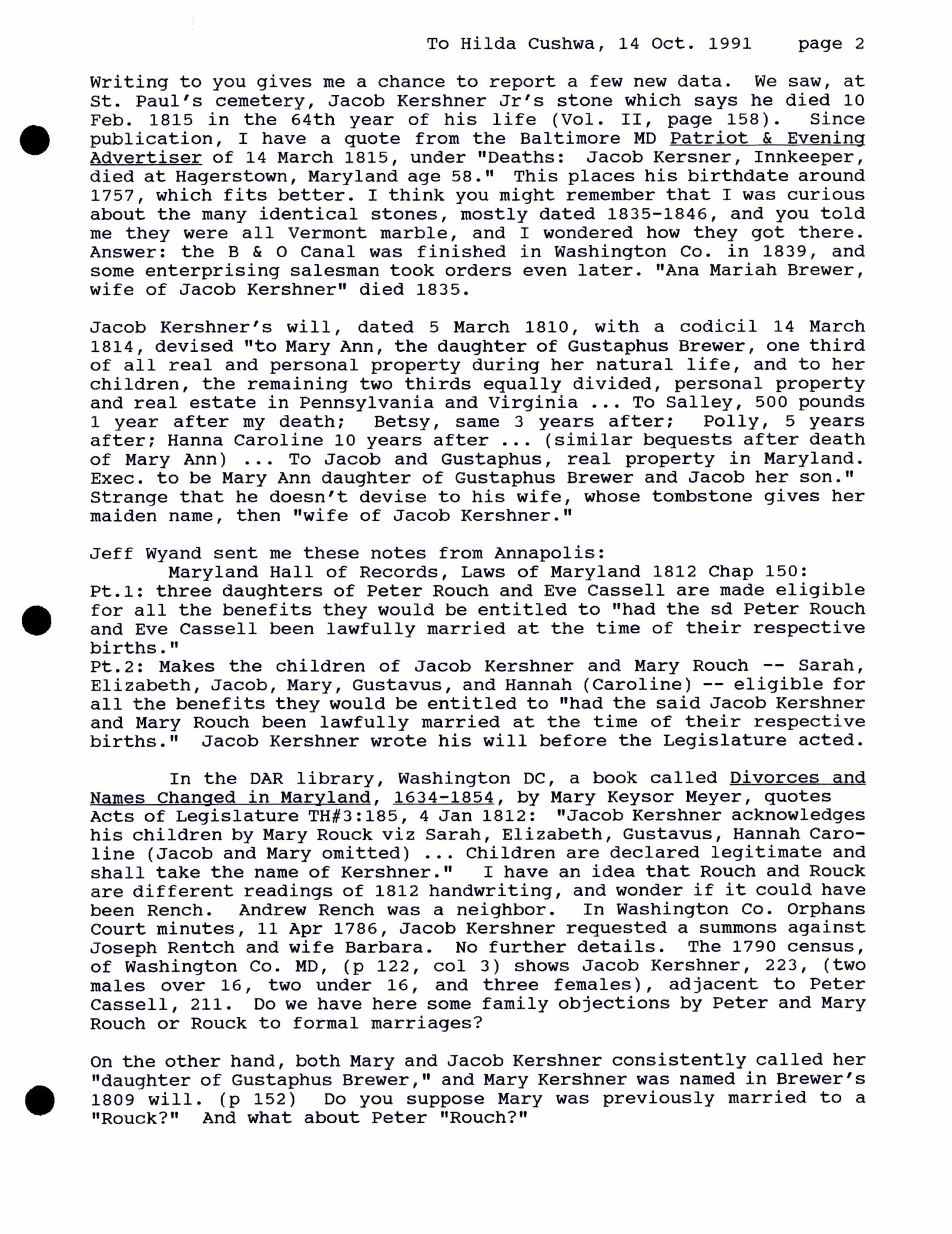
Page 2 — 14 October 1991 continued (typed, Ruth to Hilda Cushwa)
Heading: "To Hilda Cushwa, 14 Oct. 1991 page 2"
Writing to you gives me a chance to report a few new data. We saw, at St. Paul's cemetery, Jacob Kershner Jr's stone which says he died 10 Feb. 1815 in the 64th year of his life (Vol. II, page 158). Since publication, I have a quote from the Baltimore MD Patriot & Evening Advertiser of 14 March 1815, under "Deaths: Jacob Kersner, Innkeeper, died at Hagerstown, Maryland age 58." This places his birthdate around 1757, which fits better. I think you might remember that I was curious about the many identical stones, mostly dated 1835-1846, and you told me they were all Vermont marble, and I wondered how they got there. Answer: the B & O Canal was finished in Washington Co. in 1839, and some enterprising salesman took orders even later. "Ana Mariah Brewer, wife of Jacob Kershner" died 1835.
Jacob Kershner's will, dated 5 March 1810, with a codicil 14 March 1814, devised "to Mary Ann, the daughter of Gustaphus Brewer, one third of all real and personal property during her natural life, and to her children, the remaining two thirds equally divided, personal property and real estate in Pennsylvania and Virginia ... To Salley, 500 pounds 1 year after my death; Betsy, same 3 years after; Polly, 5 years after; Hanna Caroline 10 years after ... (similar bequests after death of Mary Ann) ... To Jacob and Gustaphus, real property in Maryland. Exec. to be Mary Ann daughter of Gustaphus Brewer and Jacob her son." Strange that he doesn't devise to his wife, whose tombstone gives her maiden name, then "wife of Jacob Kershner."
Jeff Wyand sent me these notes from Annapolis: Maryland Hall of Records, Laws of Maryland 1812 Chap 150: Pt.1: three daughters of Peter Rouch and Eve Cassell are made eligible for all the benefits they would be entitled to "had the sd Peter Rouch and Eve Cassell been lawfully married at the time of their respective births." Pt.2: Makes the children of Jacob Kershner and Mary Rouch -- Sarah, Elizabeth, Jacob, Mary, Gustavus, and Hannah (Caroline) -- eligible for all the benefits they would be entitled to "had the said Jacob Kershner and Mary Rouch been lawfully married at the time of their respective births." Jacob Kershner wrote his will before the Legislature acted.
In the DAR library, Washington DC, a book called Divorces and Names Changed in Maryland, 1634-1854, by Mary Keysor Meyer, quotes Acts of Legislature TH#3:185, 4 Jan 1812: "Jacob Kershner acknowledges his children by Mary Rouck viz Sarah, Elizabeth, Gustavus, Hannah Caroline (Jacob and Mary omitted) ... Children are declared legitimate and shall take the name of Kershner." I have an idea that Rouch and Rouck are different readings of 1812 handwriting, and wonder if it could have been Rench. Andrew Rench was a neighbor. In Washington Co. Orphans Court minutes, 11 Apr 1786, Jacob Kershner requested a summons against Joseph Rentch and wife Barbara. No further details. The 1790 census, of Washington Co. MD, (p 122, col 3) shows Jacob Kershner, 223, (two males over 16, two under 16, and three females), adjacent to Peter Cassell, 211. Do we have here some family objections by Peter and Mary Rouch or Rouck to formal marriages?
On the other hand, both Mary and Jacob Kershner consistently called her "daughter of Gustaphus Brewer," and Mary Kershner was named in Brewer's 1809 will. (p 152) Do you suppose Mary was previously married to a "Rouck?" And what about Peter "Rouch?"
Page 3 — 13 July 1991 (typed, Ruth Bownds Kershner to "Alma and Dan")
Letterhead: Ruth Bownds Kershner, 4100 Jackson #223, Austin TX 78731, 512-459-4890.
Dear Alma and Dan:
Thank you so much for the handsome Kershner T-shirt! I've seen them around, but never knew where they came from. Germany, perhaps? I'd like to know more about the coat of arms. I think it was genealogist Max Steinbauer, who had found the first connection at Langenselbold for Dr. Ammon Kershner, who remarked rather haughtily that the Kirschners had no connection with the gentry of the local Schloss.
Bill Kershner has said he hopes to make the East Coast Reunion, but it sounded like Mary Maxwell isn't planning to go. I'm working on Steve Kershner, and have sent a copy of your informational letter. He calls every week or two, and it sounded like he might have something on just before or just after the Labor Day weekend date. Steve is Stuart's younger brother, and has retired from the manufacturing end of his consulting electronics business. However, he has retained the consulting function, and travels all over the world. He made our first contact with Langenselbold while on a business trip to Germany.
They live so near, Falls Church, VA, that I'd like to combine a trip to the Reunion and a visit with them. We call Steve's wife "Bette" but her baptismal name was Millicent Hudson, of Chester, England, married while he was stationed in England during WWII. They're just back from a two weeks' visit there. I suggested one of the motels on the Dual Highway, so they'd have time to see some of the historic spots. But they are almost close enough to just spend a day.
I enjoyed hearing from you. Thank you again for accepting me as one of the Kershner clan.
Ruth [signature]
You may not have Steve & Bette's address: Mr & Mrs Stephen W. Kershner, 6667 Van Winkle Drive, Falls Church, VA 22044, (703) 534-3772
Page 4 — 13 July 1991 continued / [22 Aug 1982 & 27 Aug 1982 carbons enclosed] (typed, Ruth to Dan and Alma Kershner, with embedded earlier letters)
Heading: "page 2 / 13 July 1991 / For Dan and Alma Kershner:"
Please be very careful about identifying some of the Hagerstown landmarks as actual places where specific Kershners lived.
Attached, copies of carbons of some of my letters to Mary Maxwell in 1982 BCM (before I had a copy machine.)
Paula Stoner Dickey was a professional historical researcher with a grant to do a Washington Co. Maryland Historical survey. When I talked with her in 1976, she indicated that Washington Co. authorities did not want her to look too deeply into their tourist attractions. Jeffrey Wyand, a young attorney who did a great deal of research on early land records, got copies for me of many deeds and other documents from the Maryland Hall of Records. He lived in Annapolis and published some historical records. You know about Hilda Cushwa, a Kershner descendant who worked in the Washington Co. Tax Office. In 1794, the Sheriff was looking for Jonathan Kershner, but he had skipped and never came back.
[Embedded carbon, dated 27 Aug 1982, Ruth to Mary Maxwell:] Mary, Steve Kershner phoned two or three weeks ago, and had a Mr. Douglas at his house, whom Hilda Cushwa had sent to read our books. Douglas is doing a book on the National Highway. I sent him Joan Hill's map, and he has responded with the enclosed letters. I wrote him back and am sending my carbon to you, and think you might want to write about the photos he wants. Keep all but my carbons. You know a lot more about the old buildings than I do. On the other hand, I know a lot about the land boundaries. Paula Dickey indicated she knew Vincent Groh had sold the historical sites survey a bill of goods on the "Jonathan Kershner" tavern, but she said they didn't have funds to verify people's claims. The old stone house, she said, was obviously not near as old as he claimed, but... Hagerstown society has a habit of not arguing with prominent citizens. (Jeff Wyand says the "Hager House" is not on the tract in which the sorry houses are described,) and isn't a Hager House actually. But...)
Anyhow, I would sure hate to see Groh's house labeled Jonathan's. I wish I did think it was Hannah's, and could urge she be given credit, for I think all the indications are that she was left a widow with two almost-grown sons, and made a living for them. I think Jonathan was a nogoodnik, but that Jacob, who would have been only 19 when his father died, learned well and became the successful tavern-keeper. I think Jonathan would have sold the tavern out from under Hannah except that she had a dower interest and he couldn't, in 1794, when he kept out that corner at the crossroads when he sold the rest to Hebling. (Map, V II, p 69)
Page 5 — 27 August 1982 continued / 20 August 1982 (typed carbons, Ruth to H.H. Douglas)
[Continuation of the 27 Aug 1982 letter to Mary appears to repeat/overlap with Page 4's ending in this scanned copy — see Page 6 for the fuller duplicate.]
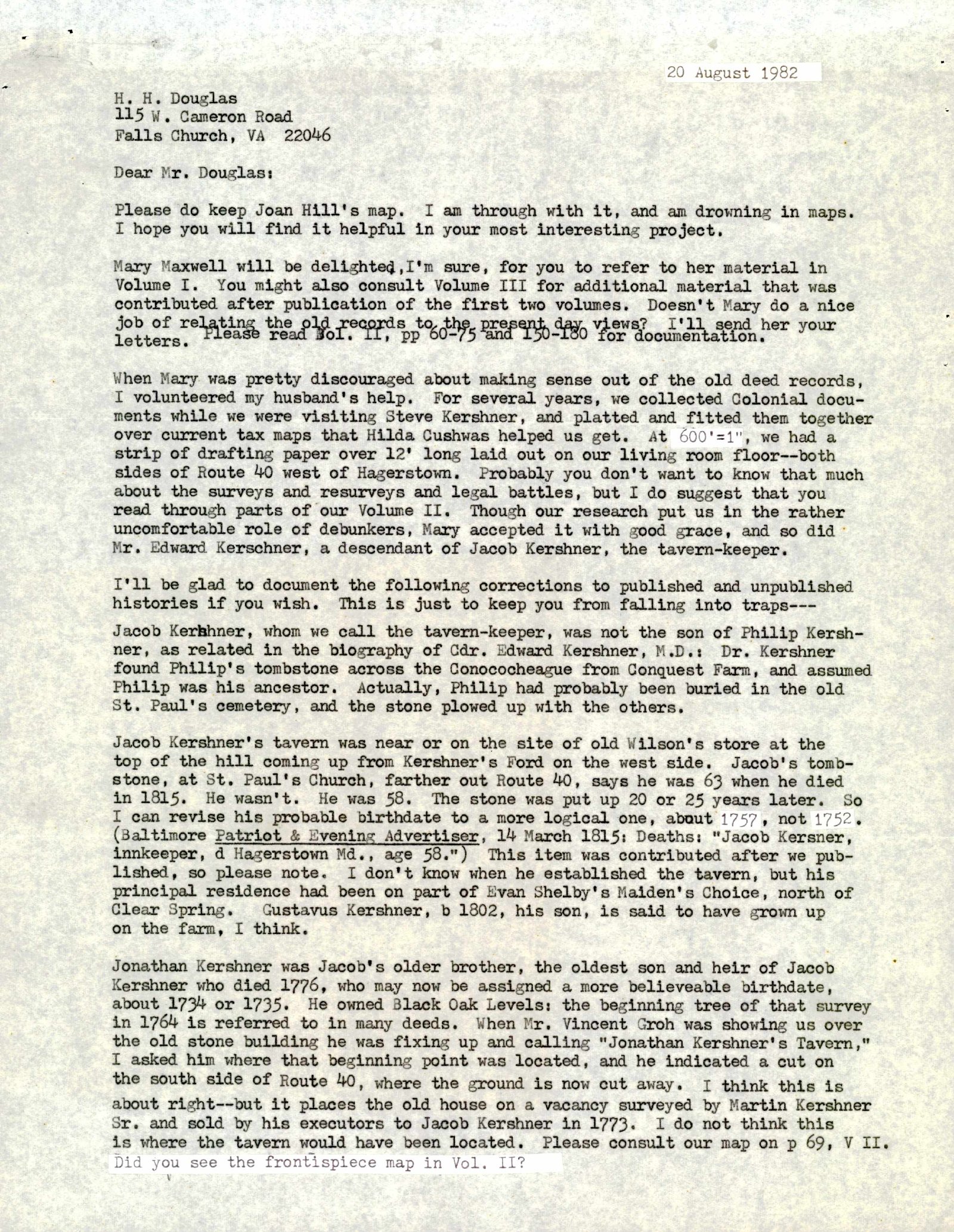
[New letter begins:] 20 August 1982
H. H. Douglas, 115 W. Cameron Road, Falls Church, VA 22046
Dear Mr. Douglas:
Please do keep Joan Hill's map. I am through with it, and am drowning in maps. I hope you will find it helpful in your most interesting project.
Mary Maxwell will be delighted, I'm sure, for you to refer to her material in Volume I. You might also consult Volume III for additional material that was contributed after publication of the first two volumes. Doesn't Mary do a nice job of relating the old records to the present day views? I'll send her your letters. Please read Vol. II, pp 60-75 and 150-180 for documentation.
When Mary was pretty discouraged about making sense out of the old deed records, I volunteered my husband's help. For several years, we collected Colonial documents while we were visiting Steve Kershner, and platted and fitted them together over current tax maps that Hilda Cushwas helped us get. At 600'=1", we had a strip of drafting paper over 12' long laid out on our living room floor--both sides of Route 40 west of Hagerstown. Probably you don't want to know that much about the surveys and resurveys and legal battles, but I do suggest that you read through parts of our Volume II. Though our research put us in the rather uncomfortable role of debunkers, Mary accepted it with good grace, and so did Mr. Edward Kerschner, a descendant of Jacob Kershner, the tavern-keeper.
I'll be glad to document the following corrections to published and unpublished histories if you wish. This is just to keep you from falling into traps---
Jacob Kershner, whom we call the tavern-keeper, was not the son of Philip Kershner, as related in the biography of Cdr. Edward Kershner, M.D.: Dr. Kershner found Philip's tombstone across the Conococheague from Conquest Farm, and assumed Philip was his ancestor. Actually, Philip had probably been buried in the old St. Paul's cemetery, and the stone plowed up with the others.
Jacob Kershner's tavern was near or on the site of old Wilson's store at the top of the hill coming up from Kershner's Ford on the west side. Jacob's tombstone, at St. Paul's Church, farther out Route 40, says he was 63 when he died in 1815. He wasn't. He was 58. The stone was put up 20 or 25 years later. So I can revise his probable birthdate to a more logical one, about 1757, not 1752. (Baltimore Patriot & Evening Advertiser, 14 March 1815; Deaths: "Jacob Kersner, innkeeper, d Hagerstown Md., age 58.") This item was contributed after we published, so please note. I don't know when he established the tavern, but his principal residence had been on part of Evan Shelby's Maiden's Choice, north of Clear Spring. Gustavus Kershner, b 1802, his son, is said to have grown up on the farm, I think.
Jonathan Kershner was Jacob's older brother, the oldest son and heir of Jacob Kershner who died 1776, who may now be assigned a more believeable birthdate, about 1734 or 1735. He owned Black Oak Levels: the beginning tree of that survey in 1764 is referred to in many deeds. When Mr. Vincent Groh was showing us over the old stone building he was fixing up and calling "Jonathan Kershner's Tavern," I asked him where that beginning point was located, and he indicated a cut on the south side of Route 40, where the ground is now cut away. I think this is about right--but it places the old house on a vacancy surveyed by Martin Kershner Sr. and sold by his executors to Jacob Kershner in 1773. I do not think this is where the tavern would have been located. Please consult our map on p 69, V II. Did you see the frontispiece map in Vol. II?
Page 6 — 20 August 1982 continued (typed, Ruth to H.H. Douglas)
Mary has the negatives. I'll send your letter on to her.
I will enclose the following items, to be returned in about a month:
Wash. Co. Md. Inventories A#2:419 — Estate of Jacob Kershner 1776 — List of Debts " " A#2:369-370 — Inventory of Jacob Kershner 1776 " Accounts # 1:291 1791 — Hannah Kershner & Jonathan Kershner, Adms. of Jacob Kershner late of Wash. Co. dec'd " 1819 Admin. Accounts 5:138-141 — The first account of Jacob Kershner Exr of Jacob Kershner dec'd " 1825 " " 7:50 — Second account (of above) " 1815 List of Sales E:271-278 — Goods chattles personal Estate of Jacob Kershner late of Wash. Co. dec'd
(These will give you an idea of the life style and activities of these two men.)
A plat of Conquest on tracing paper. (Quite a number of these plats match the lines of present-day holdings on the tax maps. Hilda Cushwa suggested we do the plats on the same scale, and she was right. Current deeds often describe the boundaries as "according to lines standing more than 50 years." When you look on the ground, there were stone fences, through which generations of trees have grown up. Moving one of these boundaries would require dynamite.) Please return.
A blue line print of the vacancies surrounding old Jacob Kershner's 1764 Black Oak Levels and 1770 Hookes Neglect. Jacob bought these vacancies from Martin Kershner's estate in 1773. Keep this one.
Two pages copied from the USGS map, with the contiguous Kershner tracts located on it as well as we could. We used these for the frontispiece of Vol II. Keep.
I think Mary Maxwell has located an old Ridenour house along Route 40 near Cedar Lawn. Tho the above USGS map shows that tract north of 40, as did the fellow who resurveyed it and took the notch out of Anna Kershner's Widow's Last Shift, he was wrong. The pond in Nicholas Ridenour's Pond was not on top of a ridge, but near the creek, and the surveyor compensated by giving both Kershner and Ridenour extra land. Ridenour's, called an addition, actually was the original survey, and the extra was to the north. Some of those surveys were incredibly bad.
Hilda took us to see one of the original Mason-Dixon line markers in a field near a road not far from her house. Maryland is pretty narrow along here.
Page 7 — 20 August 1982 continued (typed, Ruth to H.H. Douglas)
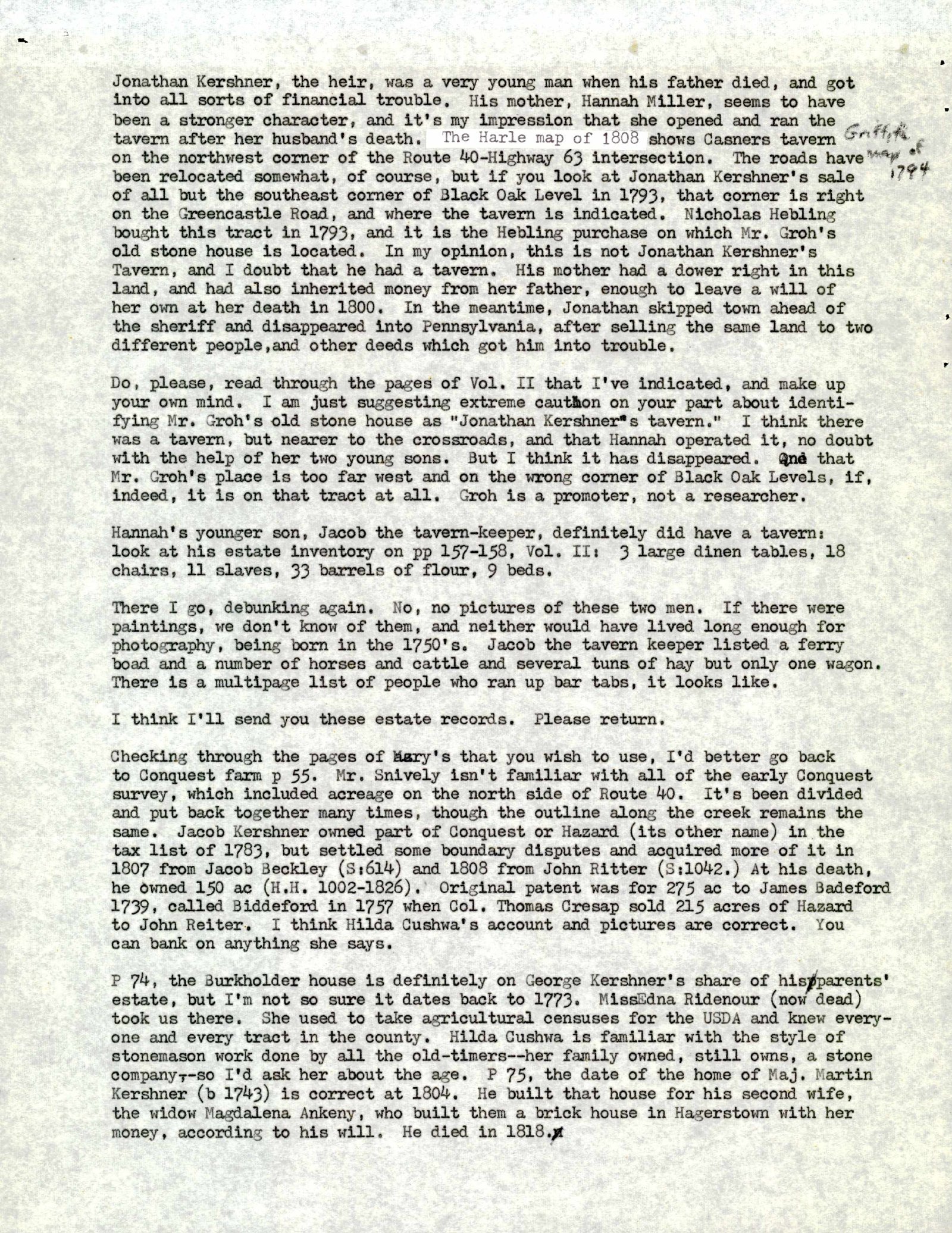
Jonathan Kershner, the heir, was a very young man when his father died, and got into all sorts of financial trouble. His mother, Hannah Miller, seems to have been a stronger character, and it's my impression that she opened and ran the tavern after her husband's death. The Harle map of 1808 [annotated in margin: "Griffith map of 1794"] shows Casners tavern on the northwest corner of the Route 40-Highway 63 intersection. The roads have been relocated somewhat, of course, but if you look at Jonathan Kershner's sale of all but the southeast corner of Black Oak Level in 1793, that corner is right on the Greencastle Road, and where the tavern is indicated. Nicholas Hebling bought this tract in 1793, and it is the Hebling purchase on which Mr. Groh's old stone house is located. In my opinion, this is not Jonathan Kershner's Tavern, and I doubt that he had a tavern. His mother had a dower right in this land, and had also inherited money from her father, enough to leave a will of her own at her death in 1800. In the meantime, Jonathan skipped town ahead of the sheriff and disappeared into Pennsylvania, after selling the same land to two different people, and other deeds which got him into trouble.
Do, please, read through the pages of Vol. II that I've indicated, and make up your own mind. I am just suggesting extreme caution on your part about identifying Mr. Groh's old stone house as "Jonathan Kershner's tavern." I think there was a tavern, but nearer to the crossroads, and that Hannah operated it, no doubt with the help of her two young sons. But I think it has disappeared. And that Mr. Groh's place is too far west and on the wrong corner of Black Oak Levels, if, indeed, it is on that tract at all. Groh is a promoter, not a researcher.
Hannah's younger son, Jacob the tavern-keeper, definitely did have a tavern: look at his estate inventory on pp 157-158, Vol. II: 3 large dinner tables, 18 chairs, 11 slaves, 33 barrels of flour, 9 beds.
There I go, debunking again. No, no pictures of these two men. If there were paintings, we don't know of them, and neither would have lived long enough for photography, being born in the 1750's. Jacob the tavern keeper listed a ferry boad and a number of horses and cattle and several tuns of hay but only one wagon. There is a multipage list of people who ran up bar tabs, it looks like.
I think I'll send you these estate records. Please return.
Checking through the pages of Mary's that you wish to use, I'd better go back to Conquest farm p 55. Mr. Snively isn't familiar with all of the early Conquest survey, which included acreage on the north side of Route 40. It's been divided and put back together many times, though the outline along the creek remains the same. Jacob Kershner owned part of Conquest or Hazard (its other name) in the tax list of 1783, but settled some boundary disputes and acquired more of it in 1807 from Jacob Beckley (S:614) and 1808 from John Ritter (S:1042). At his death, he owned 150 ac (H.H. 1002-1826). Original patent was for 275 ac to James Badeford 1739, called Biddeford in 1757 when Col. Thomas Cresap sold 215 acres of Hazard to John Reiter. I think Hilda Cushwa's account and pictures are correct. You can bank on anything she says.
P 74, the Burkholder house is definitely on George Kershner's share of his parents' estate, but I'm not so sure it dates back to 1773. Miss Edna Ridenour (now dead) took us there. She used to take agricultural censuses for the USDA and knew everyone and every tract in the county. Hilda Cushwa is familiar with the style of stonemason work done by all the old-timers--her family owned, still owns, a stone company--so I'd ask her about that age. P 75, the date of the home of Maj. Martin Kershner (b 1743) is correct at 1804. He built that house for his second wife, the widow Magdalena Ankeny, who built them a brick house in Hagerstown with her money, according to his will. He died in 1818.
Page 8 — 27 August 1982 (typed carbon, Ruth to Mary Maxwell — fuller/duplicate version of the letter partially seen on Page 4)
[This page is a fuller scan of the same 27 Aug 1982 letter excerpted on Page 4 — see that entry for full text: Steve Kershner/Mr. Douglas contact, Joan Hill's map, Paula Dickey on Vincent Groh and the tavern claim, the Hannah/Jonathan/Jacob theory of who really ran a tavern.]
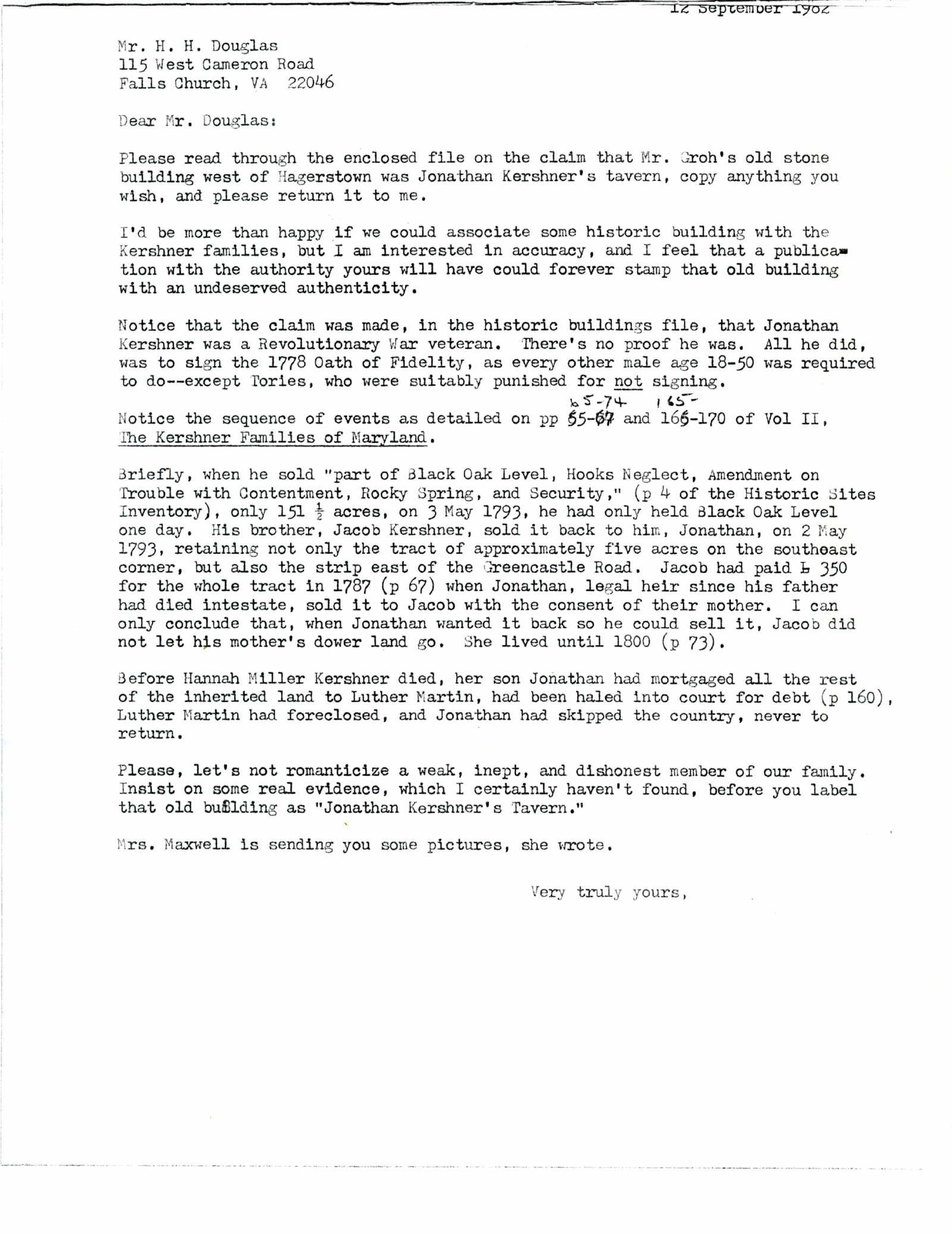
Page 9 — 12 September 1982 (typed, Ruth Bownds Kershner to H.H. Douglas)
Mr. H. H. Douglas, 115 West Cameron Road, Falls Church, VA 22046
Dear Mr. Douglas:
Please read through the enclosed file on the claim that Mr. Groh's old stone building west of Hagerstown was Jonathan Kershner's tavern, copy anything you wish, and please return it to me.
I'd be more than happy if we could associate some historic building with the Kershner families, but I am interested in accuracy, and I feel that a publication with the authority yours will have could forever stamp that old building with an undeserved authenticity.
Notice that the claim was made, in the historic buildings file, that Jonathan Kershner was a Revolutionary War veteran. There's no proof he was. All he did, was to sign the 1778 Oath of Fidelity, as every other male age 18-50 was required to do--except Tories, who were suitably punished for not signing. [marginal note: "65-74, 165-"]
Notice the sequence of events as detailed on pp 65-67 and 166-170 of Vol II, The Kershner Families of Maryland.
Briefly, when he sold "part of Black Oak Level, Hooks Neglect, Amendment on Trouble with Contentment, Rocky Spring, and Security," (p 4 of the Historic Sites Inventory) only 151 1/2 acres, on 3 May 1793, he had only held Black Oak Level one day. His brother, Jacob Kershner, sold it back to him, Jonathan, on 2 May 1793, retaining not only the tract of approximately five acres on the southeast corner, but also the strip east of the Greencastle Road. Jacob had paid £350 for the whole tract in 1787 (p 67) when Jonathan, legal heir since his father had died intestate, sold it to Jacob with the consent of their mother. I can only conclude that, when Jonathan wanted it back so he could sell it, Jacob did not let his mother's dower land go. She lived until 1800 (p 73).
Before Hannah Miller Kershner died, her son Jonathan had mortgaged all the rest of the inherited land to Luther Martin, had been haled into court for debt (p 160), Luther Martin had foreclosed, and Jonathan had skipped the country, never to return.
Please, let's not romanticize a weak, inept, and dishonest member of our family. Insist on some real evidence, which I certainly haven't found, before you label that old building as "Jonathan Kershner's Tavern."
Mrs. Maxwell is sending you some pictures, she wrote.
Very truly yours,
Page 10 — 12 September 1982 (typed, Ruth Bownds Kershner to H.H. Douglas) — duplicate scan of Page 9
[This page is an apparent duplicate scan of the same 12 September 1982 letter transcribed in full at Page 9.]
[End of transcript — 10 pages, all reviewed and transcribed. Note: the physical bundle is not in chronological order and includes at least one duplicated page (9/10) and one letter (27 Aug 1982) partially re-scanned across two locations (Page 4 and Page 8).]