K-007: Research Letters: Kershner German Research, 1970 to 1986
Kershner Research LettersSummary
Closing Summary — ResearchLetters_KershnerGermanResearch_1970-1986.pdf
Actual date range vs. file name
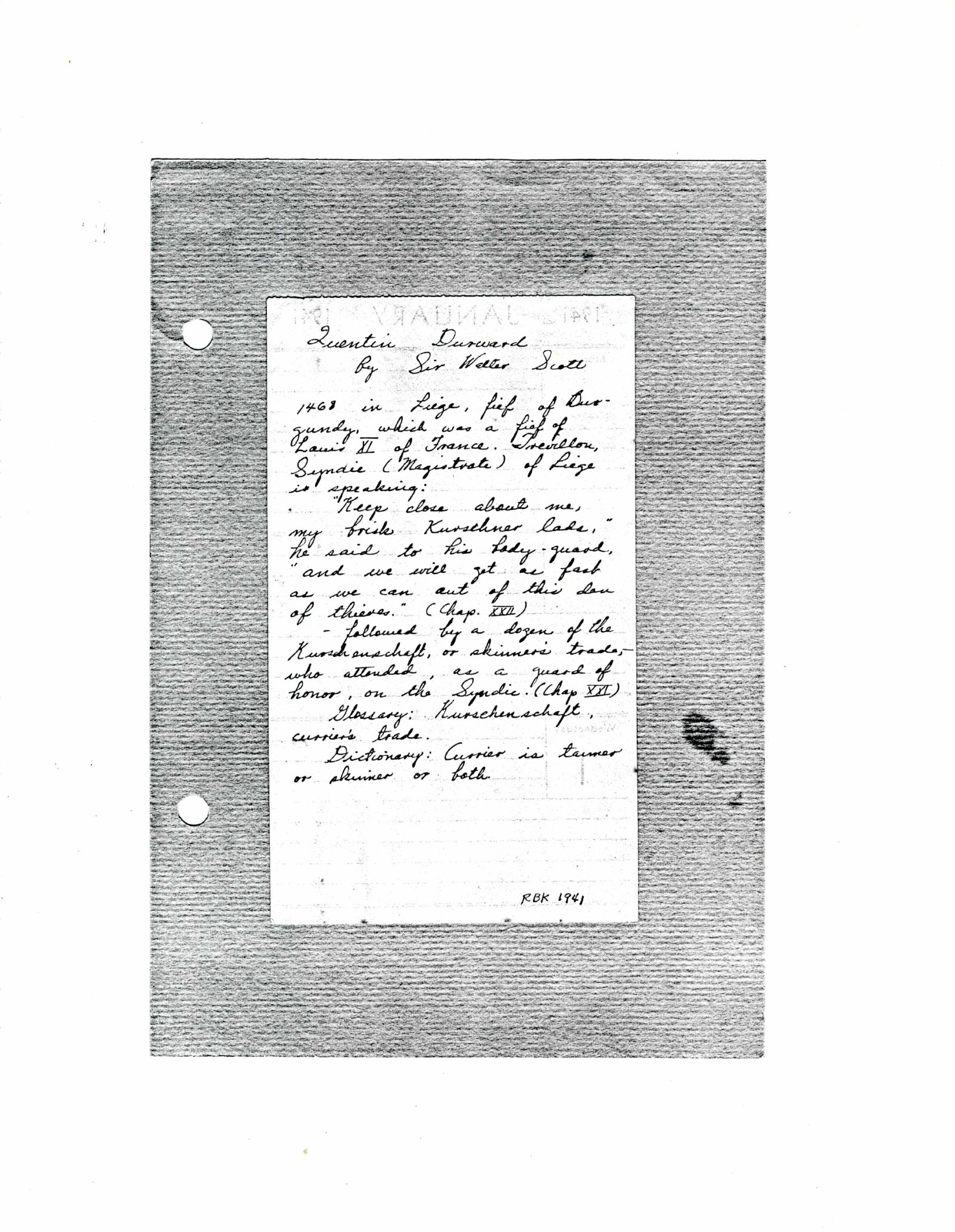
The file name reads "1970-1986," and that range is technically accurate at both ends but badly misleading about what's inside it. The earliest dated item is not from 1970 at all: a handwritten note on Page 3, quoting a "Kurschner" reference in Sir Walter Scott's novel Quentin Durward, is initialed and dated "RBK 1941" — almost certainly Ruth Bownds Kershner's own research jotting, predating everything else in the collection by nearly three decades. The next-earliest substantive item is a typed 1970 research note (duplicated at Pages 1 and 77) quoting German genealogist Dr. Fritz Braun's letter about his 1955 discovery of Johannes Kirschner's 1693 baptismal record — so the research underlying this file actually reaches back to 1955. The bulk of the active correspondence — the hired-genealogist campaign with Max Steinbaur — runs from July 1978 through April 1981, with two follow-on items from 1982 (the letter to the Langenselbold Bürgermeister and Mary Maxwell's personal letter). After a gap of roughly three years, the file closes with two Langenselbolder Zeitung newspaper clippings from May–June 1985 documenting a family reunion in Germany, and finally a 23 April 1986 Wall Street Journal clipping that has nothing to do with the family at all (see Verification Notes). So the true span is 1941–1986 (45 years), or, if one excludes the outlying 1941 note and treats 1970 as the practical starting point, the file name's stated range is reasonably fair to the back end (1986) but omits that the working correspondence itself is concentrated almost entirely in 1978–1982, a full decade earlier than the "1970-1986" label might suggest to a reader expecting evenly-distributed material.
What the document reveals about the broader family-history project
This file documents a distinct, earlier-generation phase of the same broad Kershner Family Association research effort referenced elsewhere in this archive (the multi-volume "Kershner Families of Maryland" project, edited by Ruth Bownds Kershner and Mary Kershner Maxwell): specifically, the push to document the family's German origins in Langenselbold, Hesse, by hiring a professional Frankfurt genealogist, Max Steinbaur, to search original parish church registers. Where other documents in this archive work forward from documented American immigrants toward their present-day descendants, this one works backward — establishing, generation by generation, the Langenselbold Kirschner family from Enders Kirschner (b. c1570, Herbstein) down through Joh. Konrad Kirschner (b.1669) and his four sons, who left for Pennsylvania and Maryland between 1731 and 1742. The correspondence shows genealogical research as a genuinely collaborative, multi-source undertaking: Steinbaur's paid German-archive work is cross-checked against an independently translated set of the same church records (obtained separately by Dorothy Mighell through translator Ernest J. Thode), against Dr. Fritz Braun's earlier 1955 research, and against the family's own prior published volumes — with RBK repeatedly catching and correcting her own previously published dates when better evidence turned up. The 1985 newspaper clippings and the earlier Bürgermeister letter (1982) show the research paying off in an unusually concrete way: it led directly to real, ongoing relationships with present-day Langenselbold residents, culminating in reciprocal family reunions in Germany (1983 and 1985) organized by a German cousin, Rolf Kirschner, and even a private tour of the old family town's Schloss by a local princess.
Correspondent dynamic
The tone here is practical and businesslike where money and Steinbaur's billing are concerned, and warmly personal everywhere else. RBK is again the clear organizing intelligence — she drafts the detailed research-question letters to Steinbaur, tracks the entire correspondence chronology for outside advisors, and is meticulous about correcting her own earlier published errors rather than letting them stand. The Steinbaur relationship itself is the most transactional in the whole archive: his letters are terse, itemized invoices punctuated by brief research findings, and at least two points of friction surface — an unresolved billing dispute with William E. Kershner Jr. (the "Dear Stephan!" letter, 4 Jan 1981, reporting an unpaid $138 invoice) and a general sense, expressed by Stephen Kershner in 1978, that Steinbaur's quoted $50 fee was too low given German inflation since 1955. Alongside this, the American family correspondence (Mary Maxwell's chatty domestic updates about hailstorms and her husband's surgery; Steve Kershner's sailing-weekend postscripts; Bill Kershner's careful, collegial proofreading notes) has the same warm, digression-friendly, pre-internet-pen-pal quality found throughout this archive. The German side of the story, introduced properly only in the 1985 clippings, adds a genuinely moving coda: Rolf Kirschner, described as a "hobby local historian," picks up the family's genealogical thread independently and uses it to host real, personal reunions between the German and American branches — a rare case in this archive of the paper research visibly translating into face-to-face family reconnection.
Top genealogical facts and leads
- The documented Langenselbold Kirschner pedigree traces from Enders Kirschner (b. c1570, Herbstein) through Ludwig (b. c1590) and Peter Kirschner (d. 1665, a Langenselbold juryman/court clerk) to Johann Kirschner (b. 1638/1637, d. 1713) and his son Joh. Konrad Kirschner (b. 1669, d. 1746) — the direct common ancestor of the four immigrant brothers.
- Joh. Konrad Kirschner's four sons all emigrated to America between 1731 and 1742: Johann (b.1693, to Pennsylvania via the ship Elizabeth, 1733), Joh. Görg/Joh. George (b.1695, to Maryland via the ship Samuel, 1731 — Ruth Bownds Kershner's own direct line), Joh. Kaspar (b.1700, apparent non-emigrant), and Joh. Martin (b.1703, to Pennsylvania, 1742).
- Dr. Fritz Braun's 1955 discovery of Johannes Kirschner's exact baptismal date (26 November 1693, Reformed Church, Langenselbold) — found after a three-year search for a $50 fee — is the documented origin point of the whole family-German-research effort, later re-engaged by Max Steinbaur starting in 1978.
- Two independently sourced translations of the same Langenselbold church records exist in this file: Max Steinbaur's paid research for RBK, and a second, separately obtained set translated by professional translator Ernest J. Thode for Dorothy Mighell — the latter explicitly noted as records "Steinbaur didn't send" the family, providing a useful cross-check.
- Several previously published dates in "The Kershner Families of Maryland" are corrected in this correspondence based on new evidence: Jacob Kirschner's birth from "ca. 1732" to "ca. 1733"; his son Jacob Jr.'s birth from an implied ca. 1752 to ca. 1758 (using a contemporary newspaper death notice rather than a tombstone erected decades after death); son Jonathan's birth from ca. 1750 to ca. 1756; and Anna Barbara Kirschner's death place from an assumed Maryland to a documented 1743 marriage in Bern Township, PA.
- Two open, unresolved identity questions run through the correspondence: whether Gertrud(e), wife of the immigrant Johann Kirschner, was born a Dietrich or was a widowed Faust (both are supported by different sources and never reconciled), and how Rosina Kirschner (who married Nicholas Reitnauer/Ridenour and emigrated in 1739) was actually related to the main Kirschner line — Steinbaur's own conclusion, that she was likely a cousin rather than a sister, rests on an absence of contrary evidence rather than a positive record.
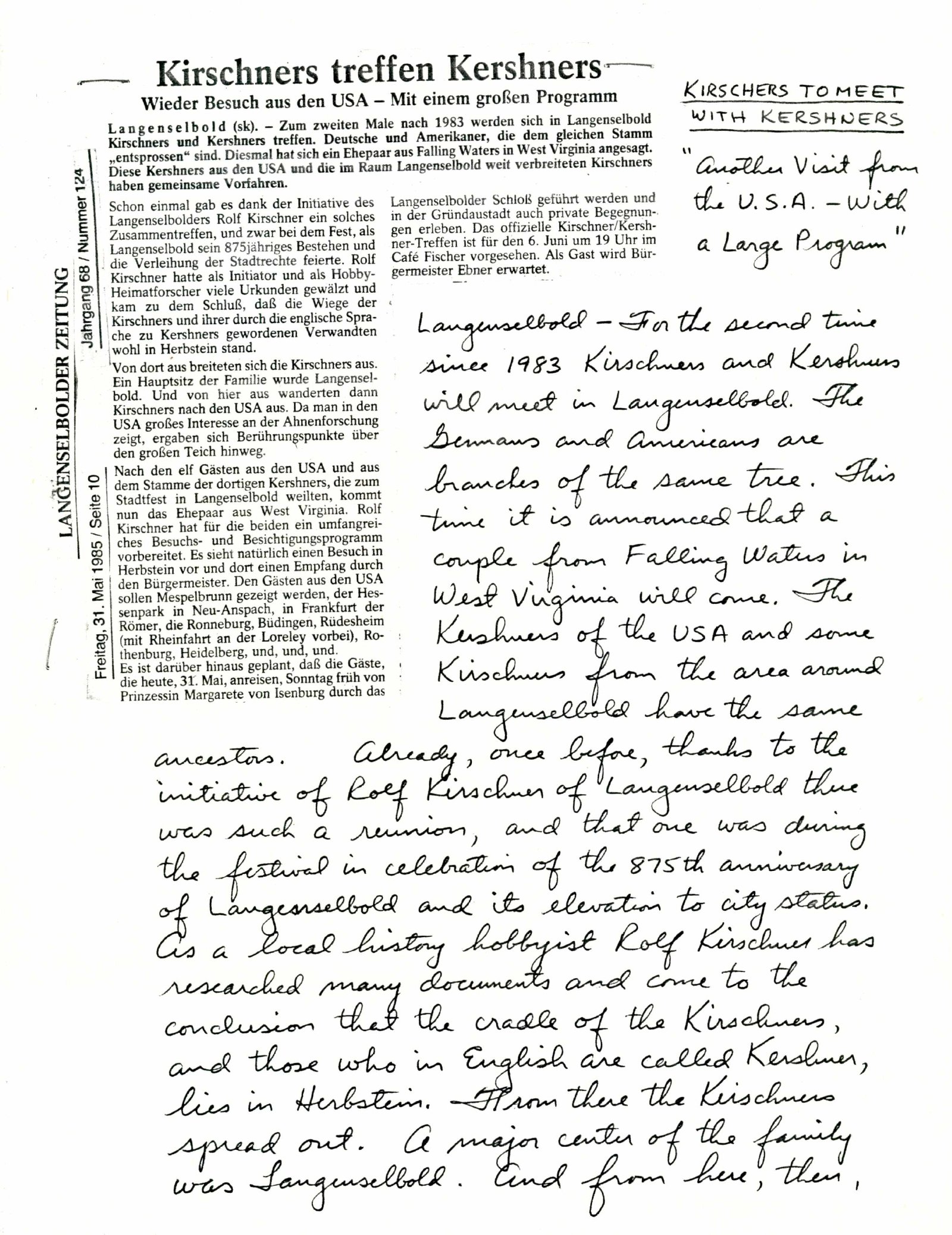
- Rolf Kirschner's independent 1980s local-history research (reported in the 1985 Langenselbolder Zeitung clippings) concluded that the Kirschner/Kershner family's true point of origin was Herbstein, not Langenselbold — Langenselbold was only a later "major center" the family spread to — a finding that extends the documented pedigree's starting point (Enders Kirschner, Herbstein, c1570) but was apparently reached through separate, later German local-history research rather than through Steinbaur's original paid work.
- The research directly produced two real-world reunions between the American and German branches of the family, organized by Rolf Kirschner in Langenselbold: one during the town's 875th-anniversary celebration (1983, eleven American guests) and one in June 1985 for a couple from Falling Waters, West Virginia (Alma and Dan Kershner), who also received a private tour of the Langenselbold Schloss from Princess Margarete von Isenburg.
- Dr. Ammon Kershner of Norristown, PA (a 1969–1970 subject in this file) descends from Conrad Kershner, listed as "age 14" on the 1733 Ship Elizabeth passenger manifest — almost certainly the same Joh. Konrad Kirschner born 17 Sept 1717 to the immigrant Johann and Gertrud(e) — placing him in a documented but different branch of the family from Ruth Bownds Kershner's own Maryland line (which descends instead from Joh. Görg, Johann's brother).
- The Kershner Family Association formally presented Volume III of "The Kershner Families of Maryland" to the Langenselbold town archive on 1 August 1982, via a German-language letter from Mary Kershner Maxwell and RBK to Bürgermeister Peter Neugebauer, hand-delivered by Rolf Kirschner — a symbolic closing of the loop between the published American research and the ancestral German town's own historical record.
Verification notes
This file is roughly two-thirds reference material, not correspondence — a future researcher should not mistake the bulk of these pages for letters. Of the 160 transcribed pages:
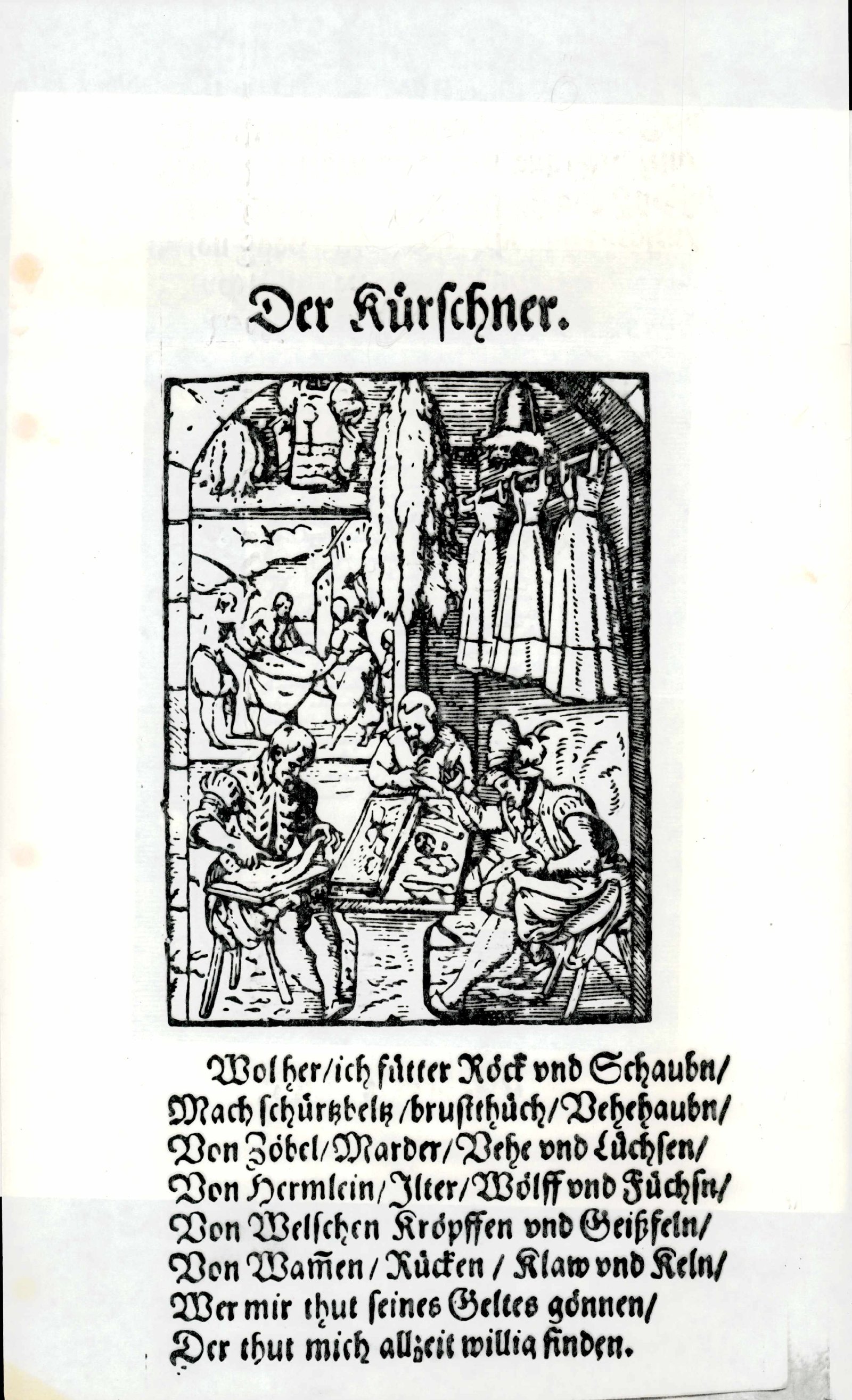
- Pages 1–23: genuine family correspondence and research notes/charts, interspersed with a few early clippings (a 1970 research note on Dr. Ammon Kershner and Dr. Fritz Braun's 1955 research; a woodcut illustration on the meaning of the surname "Kürschner"; a 1941-dated literary note; a hand-drawn pedigree chart dated 6.12.78; two 1985 Langenselbolder Zeitung newspaper clippings about a family reunion; and a letter, in German, to the Langenselbold Bürgermeister).
- Pages 24–39: not correspondence — a complete photocopied excerpt of the German-language local-interest booklet "Langenselbold stellt sich vor" (Langenselbold Introduces Itself), a town-promotional publication padded with local business advertisements (banks, a department store, an auto shop, a beer brand, Coca-Cola) alongside genuine short passages of town history, a municipal directory, and a 1971 town map. Collected purely as ancestral-town background reading, not as family records.
- Pages 40–67: correspondence resumes — the core of the active Steinbaur research campaign (1978–1981), billing statements, pedigree charts, and personal family letters.
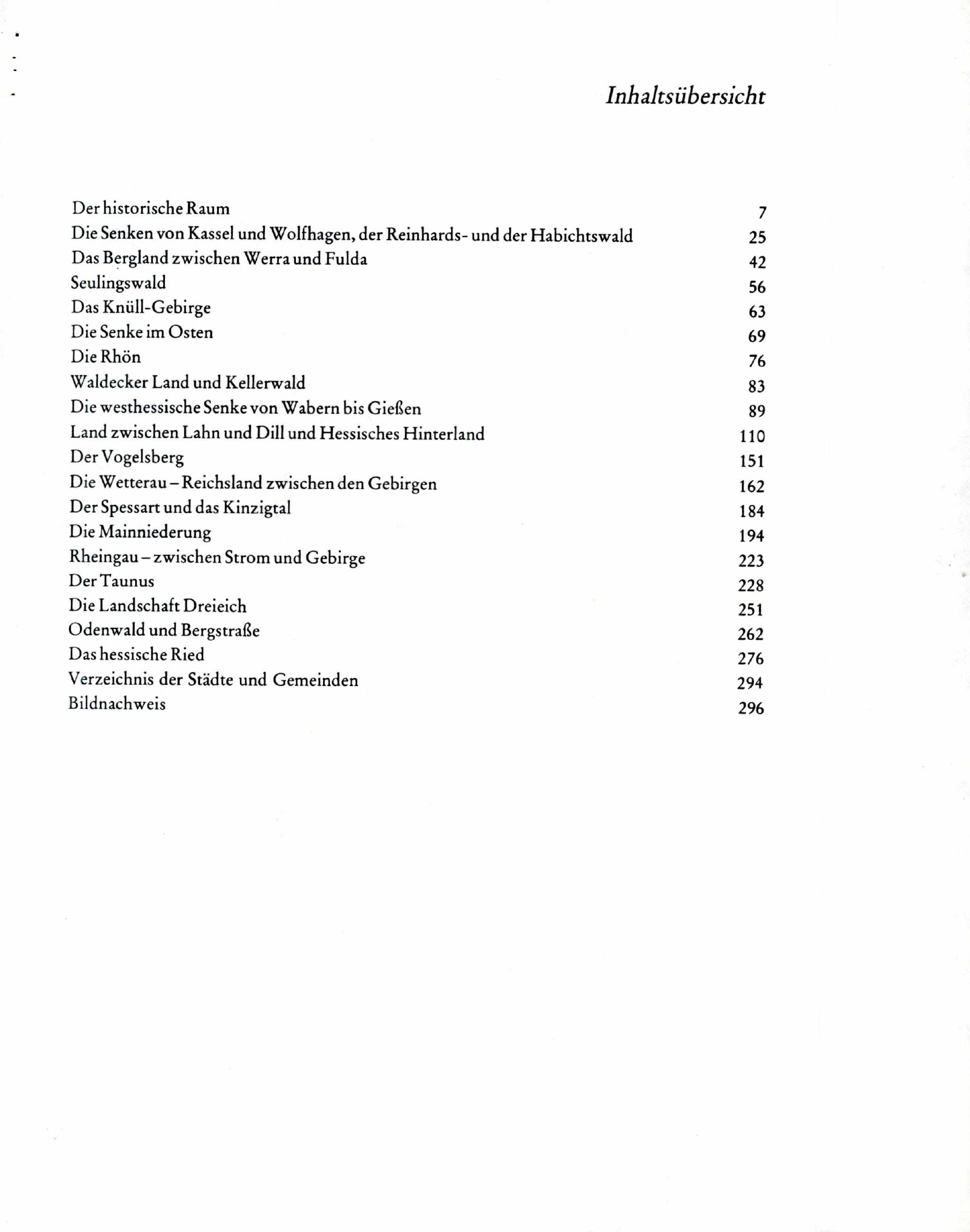
- Pages 68–72: not correspondence — a short excerpt (title page, copyright page, table of contents, and the Langenselbold chapter) from a separate 1976 regional picture-book, "Hessen, Land der Mitte".
- Pages 73–77: correspondence resumes — Dorothy Mighell's independently translated church records (with Ernest J. Thode's translations) and a duplicate of the 1970 Ammon Kershner/Fritz Braun research note.
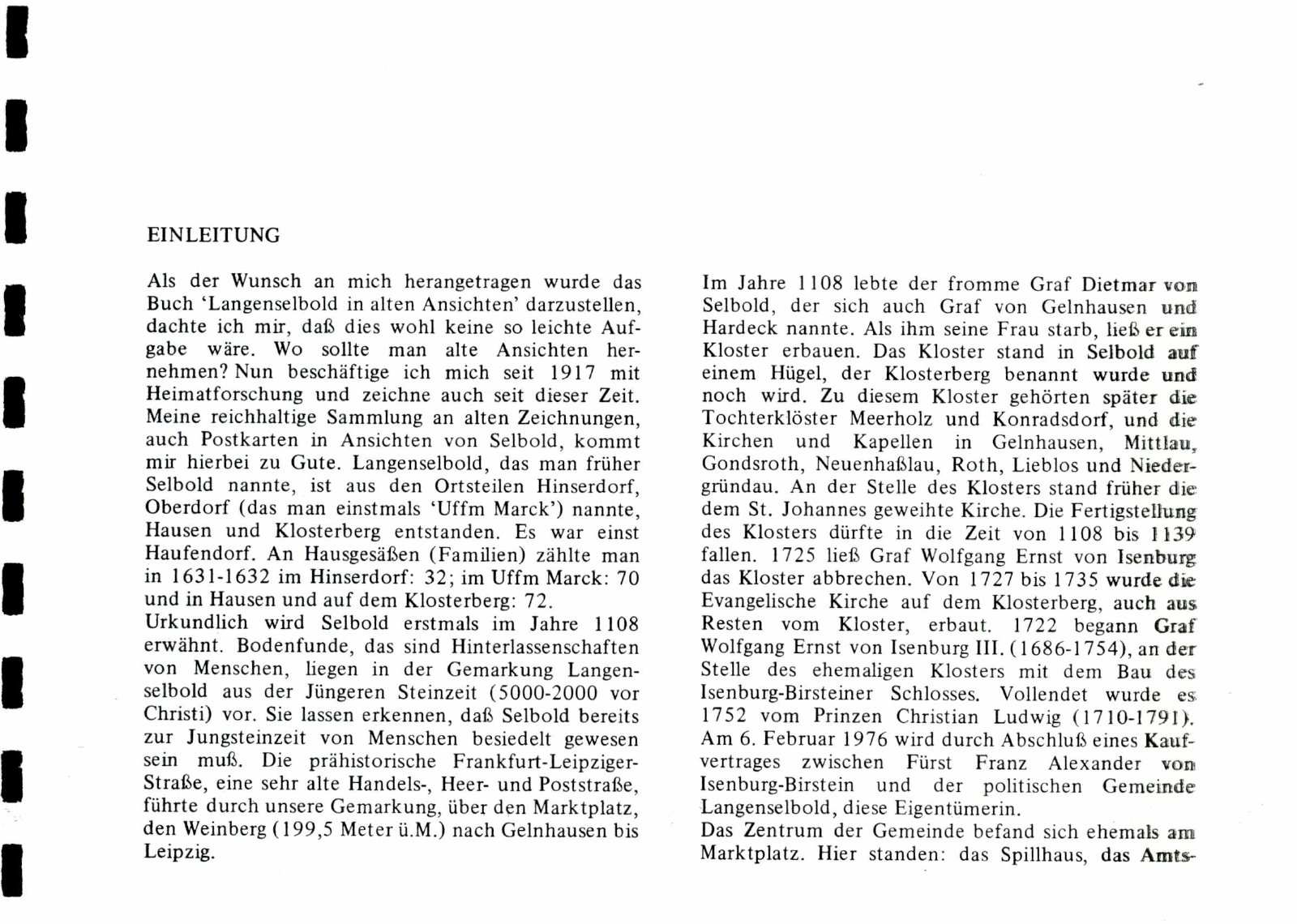
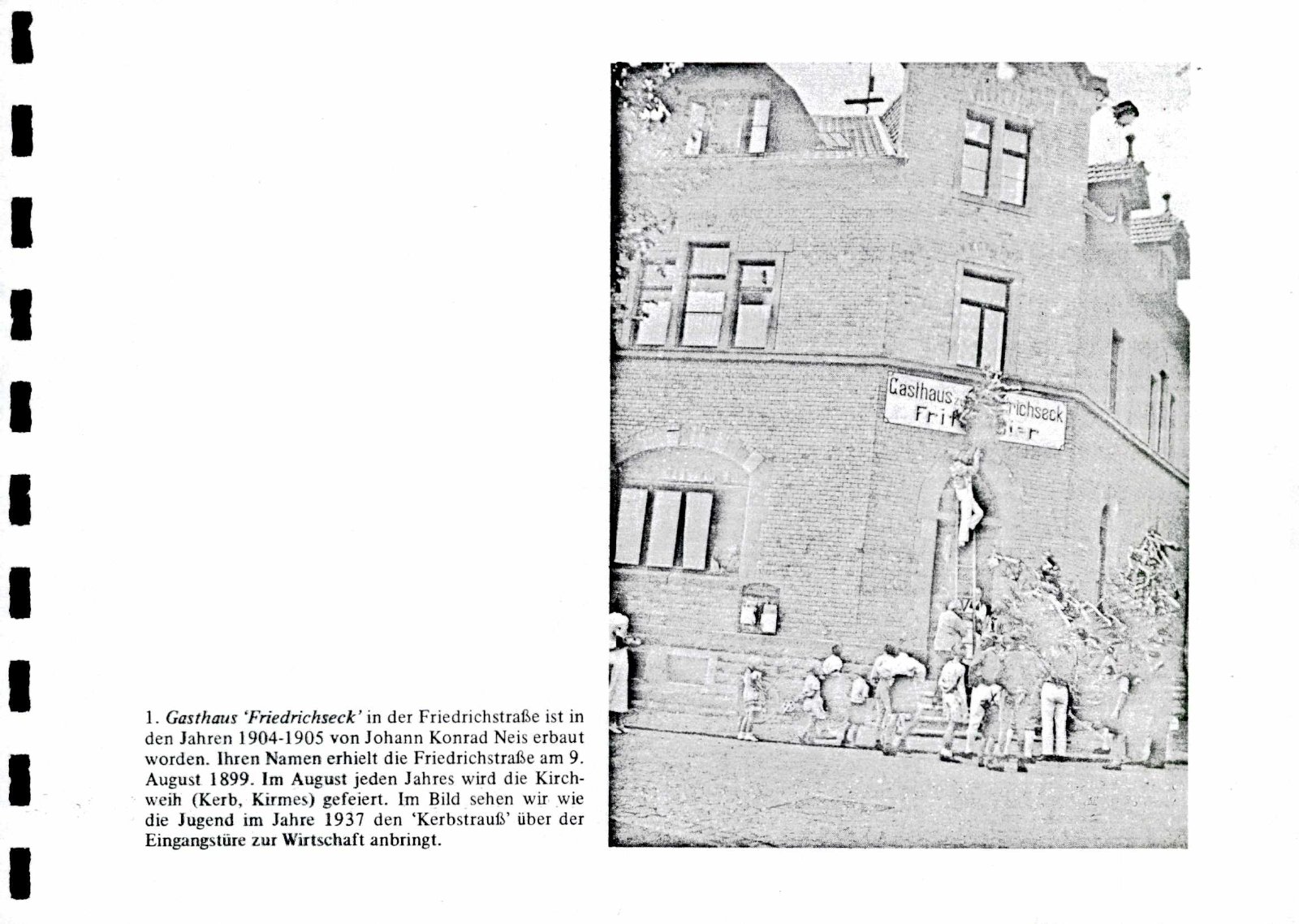
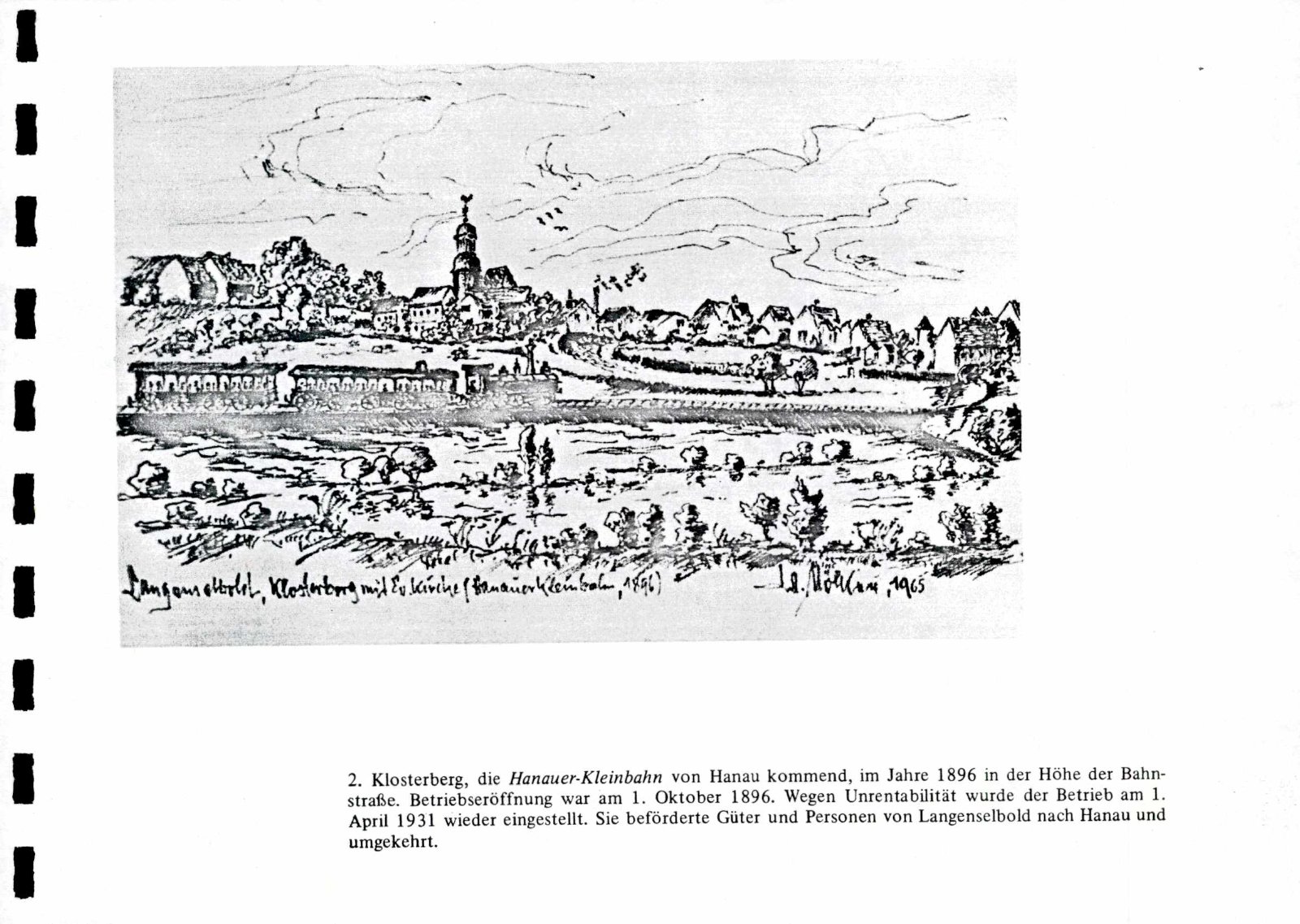
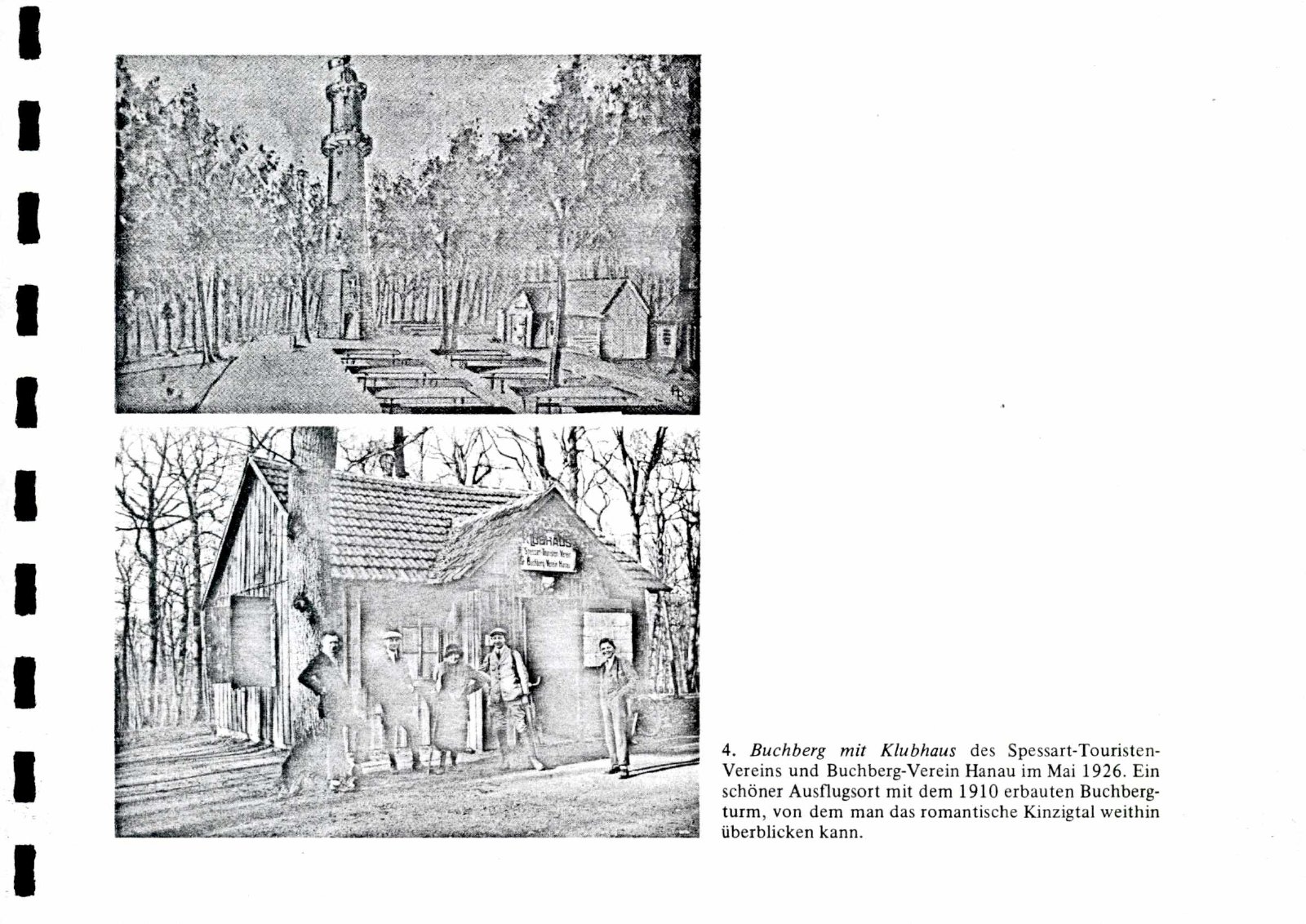
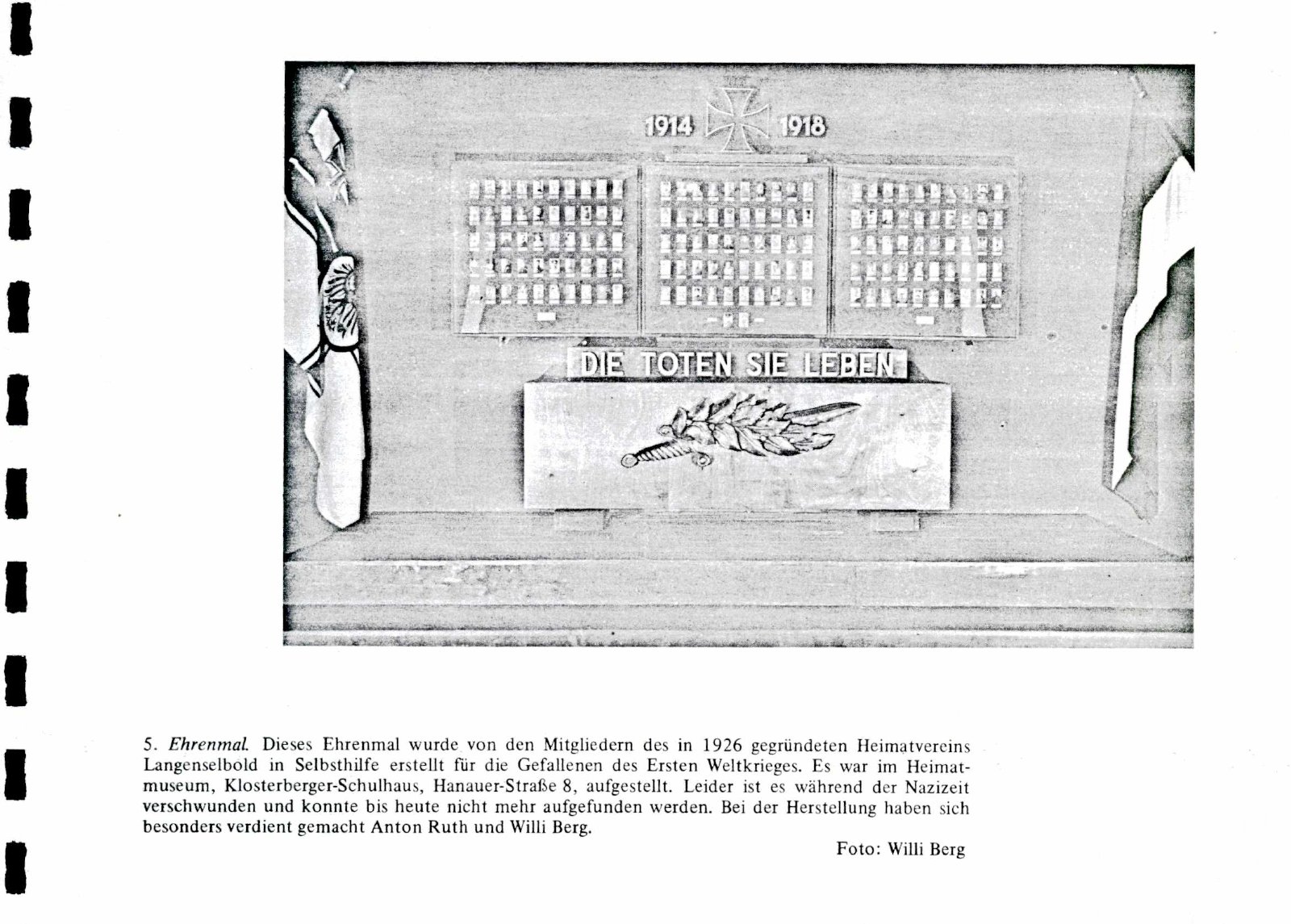
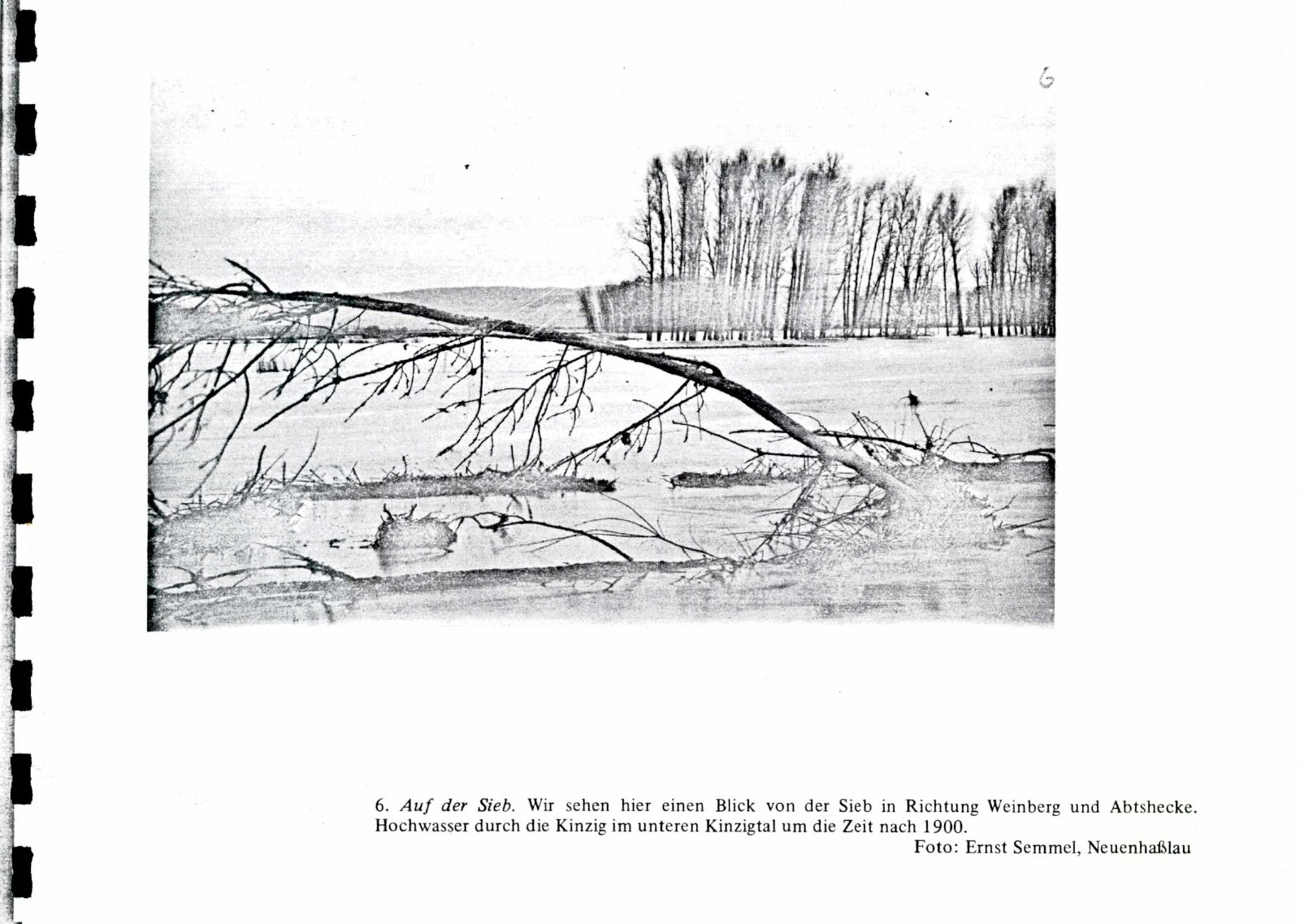
- Pages 78–157: not correspondence — this is the single largest block of non-primary-source material in the file, 80 of 160 pages (50% of the entire document). It is a complete photocopied reproduction of a second local-history picture-book, "Langenselbold in alten Ansichten" (Langenselbold in Old Views) by Wilhelm Völker (1978), consisting of a title page, printer's colophon, a two-page German-language introduction, and 74 numbered historical photo/illustration plates with captions covering town buildings, festivals, floods, gymnastics clubs, war memorials, and local infrastructure — almost entirely unrelated to the Kershner/Kirschner family specifically, apart from two passing photo-credit mentions of local townspeople named "Kirschner" (a "Frau Kirschner" and a "Frau Marg. Kirschner, geb. Grebe," noted in the People section above but not confirmed as relatives).
- Pages 158–160: not correspondence and not genealogically relevant at all — a photocopied 23 April 1986 Wall Street Journal article about heavy-industry success stories in West Germany, which happens to profile a small unrelated manufacturing company, Hans Kuerschner GmbH of Kaldenkirchen. The founder's surname is hand-underlined in red ink twice in the clipping, strongly suggesting a family member saved this purely because of the coincidental name match — there is no other indication anywhere in the document that this company or its founder has any connection to the Kershner/Kirschner genealogical line.
Net effect: only about 56 of 160 pages (roughly 35%) — Pages 1–23, 40–67, and 73–77 — are actual family correspondence, notes, or genealogical charts. The remaining 101 pages (roughly 63%) are German local-history picture-book excerpts collected as ancestral-town background reading, and the final 3 pages (roughly 2%) are an unrelated newspaper clipping kept only for its surname coincidence. A researcher looking specifically for "letters" in this file should focus on Pages 1–23, 40–67, and 73–77 and can safely treat everything else as supplementary/background material.
Legibility was generally good throughout; the German-language material (both the picture-books and Steinbaur's correspondence) was fully transcribable, though several handwritten date annotations on individual photographs in the second picture-book, and a few genealogical-chart marginal notes in the correspondence section (e.g., the "Trevillon" name on Page 3, several nickname/spelling uncertainties in the pedigree charts), remain uncertain and are flagged inline in the transcript and in the Discrepancies section of the companion genealogical index.
The originals
160 scanned pages. Click any one to view it large; use the arrow keys to move through them. Page numbers match the transcript.











































People, places and dates
Show the genealogical index
K-007 Genealogical Index — ResearchLetters_KershnerGermanResearch_1970-1986
Compiled per the standing Cursive Correspondence Analysis Prompt. Cross-referenced against K-007_full_transcript.md. This document's central subject is the Kershner family's decade-plus effort (chiefly 1978–1982, with earlier and later reference material bracketing it) to document their German origins: the Kirschner family of Langenselbold, Hesse, tracing back to Enders Kirschner (b. c1570, Herbstein) and forward through four immigrant brothers who left Langenselbold for Pennsylvania and Maryland in 1731–1742. The primary hired researcher is German professional genealogist Max Steinbaur of Frankfurt am Main; the primary American organizers are Ruth Bownds Kershner (RBK), Mary Kershner Maxwell, William E. (Bill) Kershner Jr., and Stephen W. (Steve) Kershner. Roughly two-thirds of the physical pages in this file are not correspondence at all but two German-language local-history picture-books about Langenselbold and a 1976 regional history volume, evidently collected by the family as background reading on their ancestral town (see Verification Notes in the closing summary for exact page ranges).
People
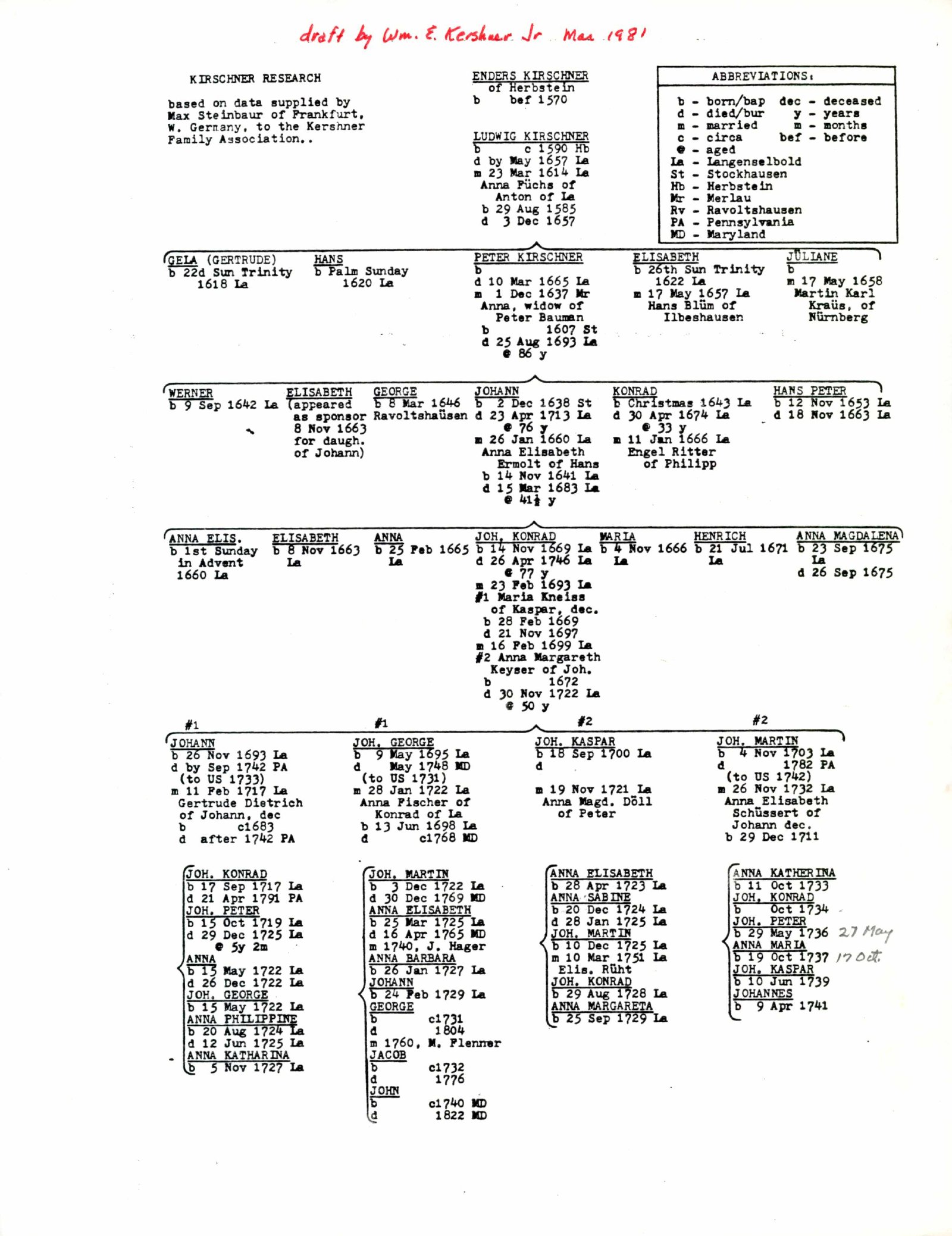
The Langenselbold Kirschner pedigree (per Max Steinbaur's and Dr. Fritz Braun's church-register research; charted on pp. 4–10, 20, and 41)
- Enders Kirschner — b. c1570, Herbstein (Hesse). Earliest-named progenitor in the pedigree; per Rolf Kirschner's later local-history research (1980s), Herbstein — not Langenselbold — was the original "cradle" of the family, with Langenselbold becoming "a major center" only afterward.
- Ludwig Kirschner — b. c1590, Herbstein; d. before May 1657, Langenselbold ("La."); occupation "juryman" (Gerichtsschöffe) at Langenselbold; m. 23 Mar 1614 to Anna Fuchs, daughter of Anton of Langenselbold, b. 29 Aug 1585, d. 3 Dec 1657, Langenselbold.
- Children of Ludwig & Anna Fuchs: Gela (Gertrude), b. 22nd Sunday in Trinity 1618, La.; Hans, b. Palm Sunday 1620, La.; Peter Kirschner (see below); Elisabeth, b. 26th Sunday in Trinity 1622, La., m. 17 May 1657 to Hans/Peter Blum(m) of Ilbesheusen; Juliane, m. 17 May 1658 to Martin Karl Kraus, a teacher from Nürnberg, in La.
- Peter Kirschner — b. c1620s (birthdate not given; death only), d. 10 March 1665, Langenselbold, "without age" given in the record; occupation Gerichtsschöffe and Landscheider (juror and boundary-surveyor) there; per the Death Book entry translated by Ernest J. Thode: "a juryman (Councilman) and clerk of a rural district, was accompanied to the earth in a Christian and honorable manner." Records show he resided at Flensungen near Herbstein as late as 1637 and was already at Langenselbold by 1642. m. before 1638, at Flensungen, to widow Anna (maiden name given inconsistently — "Kneiss," "Kreis," or "Kasper" in different transcriptions), previously married to Hans Bernhard Schad (m. 9 Jan 1690, La.; one child, Joh. Peter Schad, b. 18 Feb 1691, d. 1697/21 Nov 1697, La.); Anna b. c1607, d. 25 Aug 1693, Langenselbold, age 86, "widow."
- Children of Peter Kirschner & Anna: Werner, b. 9 Jan/9 Sep 1642, La. (date given both ways across charts); Elisabeth, recorded as sponsor of a niece 8 Nov 1663 (no birth date given); George, b. 8 Mar 1646, Ravoltshausen; Johann Kirschner (see below); Konrad, b. Christmas 1643, La., d. 30 Apr 1674, La., age 33, m. 11 Jan 1666, La., to Engel Ritter, daughter of Philip; Hans Peter, b. 12 Nov 1653, La., d. 18 Nov 1663, La. (died young).
- Johann Kirschner — b. 2 Dec 1638 (given as "Stockhausen" on the typed chart, p. 490 of transcript / p.20, but "1637, Flensungen" per Steinbaur's own 10.10.78 letter, p. 53); d. 23 Apr 1713, Langenselbold, age 76; occupation Gerichtsschöffe (juror) there like his father. m. 26 Jan 1660, Langenselbold, to Anna Elisabeth Ermolt, daughter of Hans (also a Gerichtsschöffe), b. 14 Nov 1641, La., d. 15 Mar 1683, La., age 41½.
- Children of Johann & Anna Elisabeth Ermolt: Anna Elis., b. 1st Sunday in Advent 1660, La.; Elisabeth, b. 8 Nov 1663, La.; Anna, b. 25 Feb 1665, La.; Joh. Konrad (see below); Maria, b. 4 Nov 1666, La.; Henrich (Heinrich), b. 21 Jul 1671, La. — RBK's 1981 letter singles this Henrich out for a dedicated genealogical page, noting his descendants "had children with some of the same names who could be confused with ours" and "may still live there"; Anna Magdalena, b. 23 Sep/3 Sep 1675, La., d. 26 Sep 1675, La. (infant death).
- Joh. Konrad Kirschner — b. 14 Nov 1669, Langenselbold, son of Johann and Anna Elisabeth Ermolt; d. 26 Apr 1746, Langenselbold, age 77. Married twice: (1st, 23 Feb 1693, La.) to widow Maria (maiden name variously "Kneiss" or unrecorded), previously widow of Hans Bernhard Schad, b. c1669, d. 21 Nov 1697, La., age 28y 9m; (2nd, 16 Feb 1699, La.) to Anna Margarete Keyser, daughter of Johann Keyser (a Wagnermeister — master coach-builder/wheelwright), b. 1672, d. 30 Nov 1722, La., age 50. A marginal note on the pedigree records "a son ('Conrad?') bp. 25 Dec. 1693, Lutheran Ch. Langenselbold, sponsor: Conrad Moll" — of uncertain fit into the family (see Discrepancies).
The four immigrant brothers, children of Joh. Konrad Kirschner (the generation that left for America, 1731–1742)
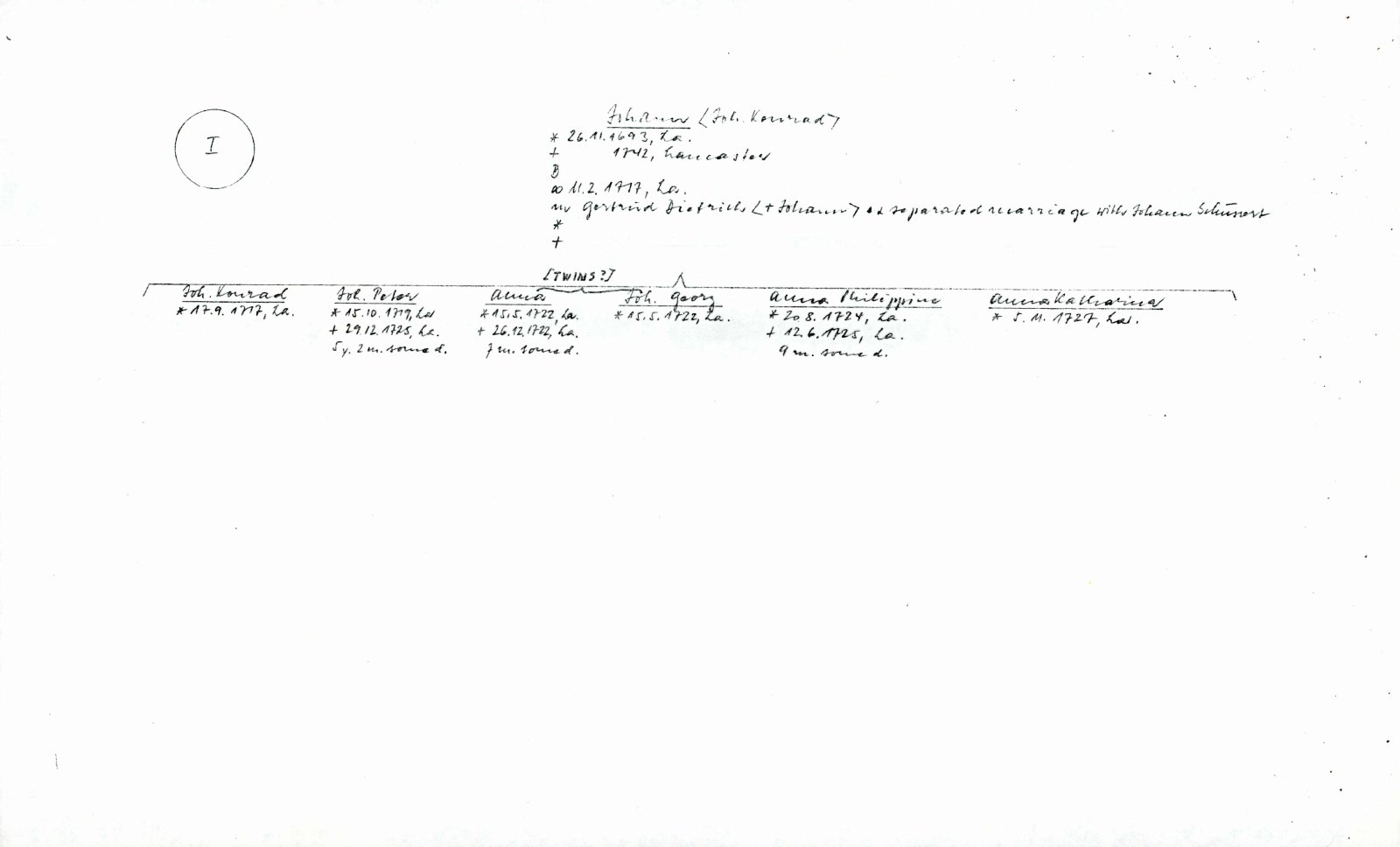
- Johann Kirschner — b. 26 Nov 1693, Langenselbold (baptized at the Reformed Parish Church there; sponsor Hans Bernhard Schad, "a widow[er]"); d. before Sept 1742, Lancaster [Co.], PA. Per Dr. Fritz Braun's 1955 research (quoted at length on pp.1 and 77): "the exactly birthday of your Johannes Kürschner, is Nov. 26, 1693, at Sebold... his parents were Johann Conrad Kürschner and his wife Maria. He was a member of the Reformed Church." Emigrated to America in 1733 aboard the ship Elizabeth, listed on the Palatinate/German-Pioneers passenger roll as "Johannes Kirshner, age 40," traveling with "Kertroudt Kernoser, age 50" (almost certainly his wife, garbled in transcription — likely Gertraut/Gertrude), "Conrad, age 14," and "Johan Yerch, age 12" (likely a garbled rendering of a son's name). m. 11 Feb 1717, Langenselbold, to Gertrud(e) Dietrich, daughter of Johann (deceased), b. c1683/1693, d. after 1742, Maryland. RBK's correspondence notes an unresolved alternate identification of this wife as a widow Faust ("Gertrude Faust") per Dr. Howard M. Faust's research — the correspondents never fully reconcile "Dietrich" vs. "Faust" as her maiden/prior-married name. Their children: Joh. Konrad, b. 17 Sep 1717, La., d. 21 Dec 1791, PA — almost certainly the "Conrad, age 14" on the 1733 ship's list, and the direct ancestor of the Pennsylvania Kershner branch that produced Dr. Ammon Kershner (see below); Joh. Peter, b. 15 Oct 1719, La., d. 29 Dec 1725, La., age 5y 2m; Anna, b. 15 May 1722, La., d. 26 Dec 1722, La. (twin, 7 months); Joh. George, b. 15 May 1722, La. (twin to Anna); Anna Philippine, b. 20 Aug 1724, La., d. 12 Jun 1725, La.; Anna Katharina, b. 5 Nov 1727, La.
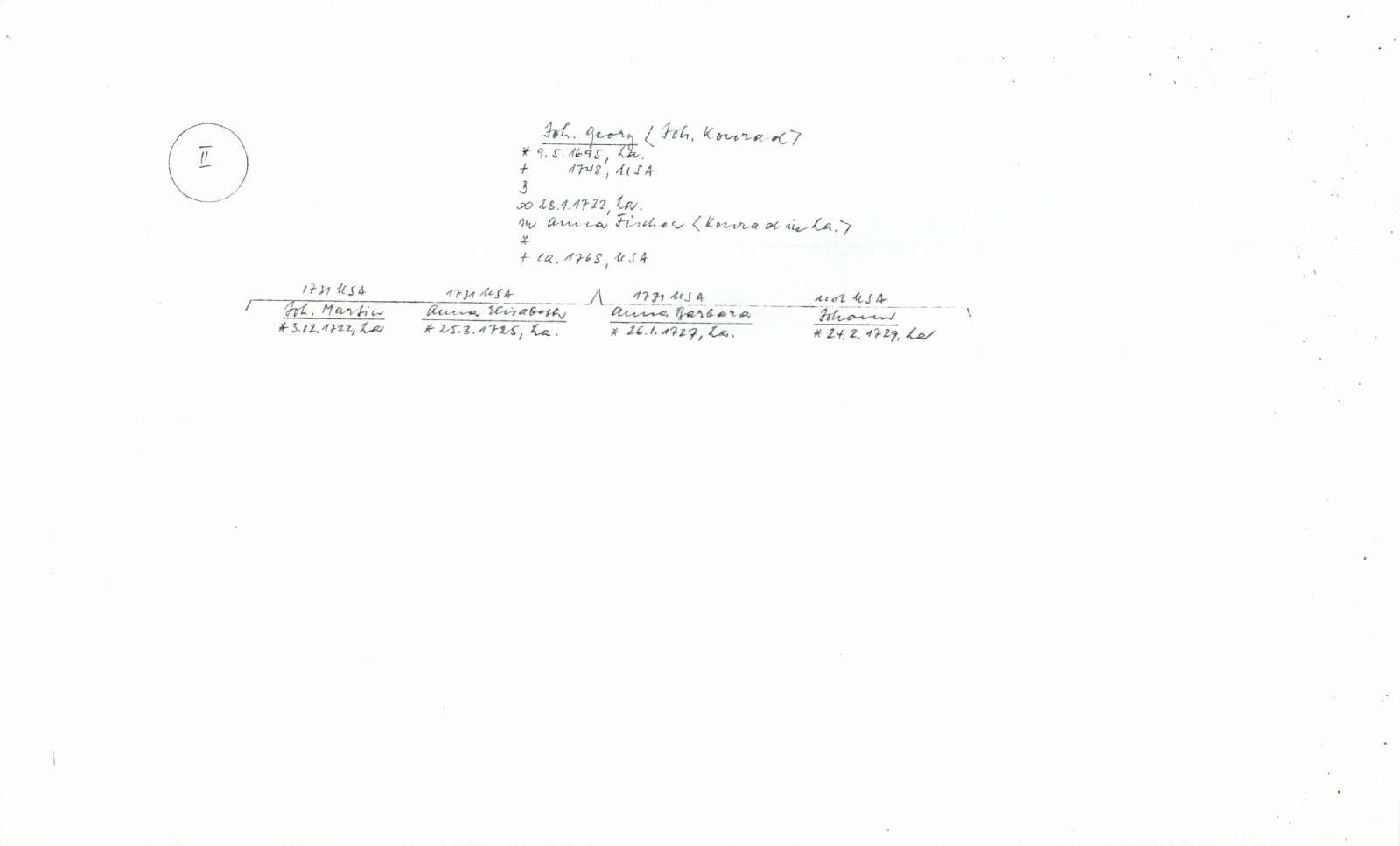
- Joh. George (Joh. Görg) Kirschner — b. 9 May 1695, Langenselbold; d. May 1748, Maryland. Emigrated 1731 aboard the ship Samuel, under Capt. Hugh Percy, arriving Philadelphia August 1731, with wife Anna and children Martin, Elisabetha, and Barbara (all under 16) and probably an infant son George. m. 28 Jan 1722, Langenselbold, to Anna Fischer, daughter of Konrad, b. 13 Jun 1698, La., d. c1768, Frederick Co., Maryland. This is RBK's own direct ancestral line — the Maryland Kershners around whom "The Kershner Families of Maryland" (the multi-volume book project referenced throughout) is built. Children: Joh. Martin, b. 3 Dec 1722, La., d. 30 Dec 1769, MD — noted as also having worked as a miller; Anna Elisabeth, b. 25 Mar 1725, La., d. 16 Apr 1765, MD, m. 1740 to J. Hager; Anna Barbara, b. 26 Jan 1727, La. — RBK's 1981 letter reports finding "what might be Barbara's marriage" in Bern Township, PA, in 1743, to Peter Laucks, correcting Bill Kershner's chart, which had mistakenly listed her as dying in Maryland; Johann, b. 24 Feb 1729, La. (did not emigrate in 1731; RBK's letters leave open whether he died in PA or VA — "a reasonable doubt"); George, b. c1731 (probably born en route or shortly after arrival, since he was later found to be a naturalized citizen, implying non-native birth), d. 1804, m. 1760 to M. Plenner; Jacob, b. c1732/1733 (RBK corrects her own earlier estimate of "ca. 1732" to "ca. 1733" in her 20 April 1981 letter), d. 1776 — his own son Jacob Jr. was b. ca. 1758 (not 1752, as RBK's revised research shows, correcting a tombstone at St. Paul's, Clear Spring, that overstated his age at death), and eldest son Jonathan was b. ca. 1756 (not 1750); John, b. c1740, MD, d. 1822, MD.
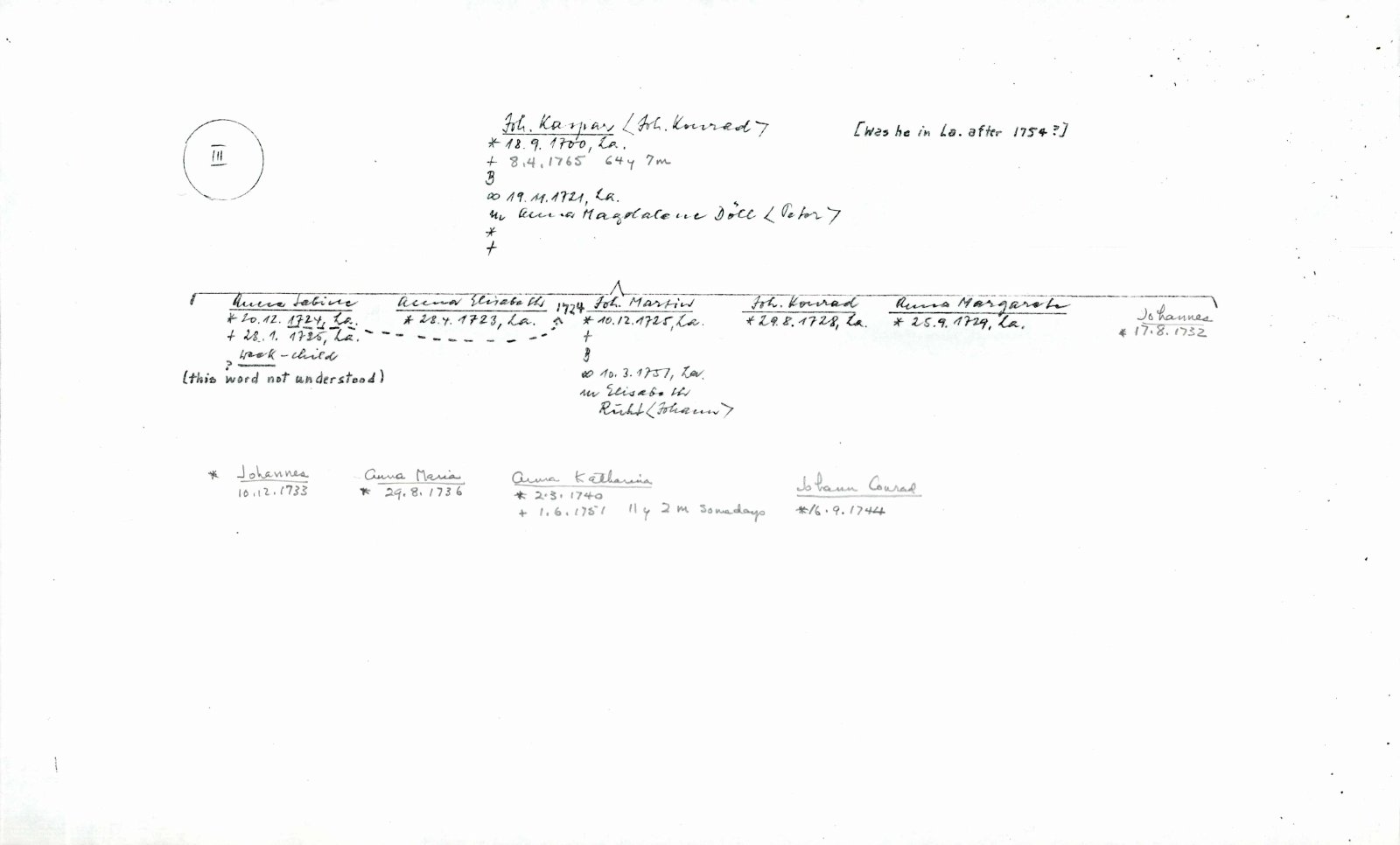
- Joh. Kaspar Kirschner — b. 18 Sep 1700, Langenselbold; d. 8 Apr 1765, age 64y 7m (per the typed chart) — though a marginal query on the handwritten chart p.7 asks "Was he in La. after 1754?", and a 23 Oct 1978 letter from the Kershner Family Association to Steinbaur separately raises the possibility that this man, or a same-named relative, "was pastor of an Evangelical Lutheran Church in Frederick County, Virginia, in 1764" — an identification never confirmed. m. 19 Nov 1721, Langenselbold, to Anna Magdalene Döll, daughter of Peter Döll and wife Elizabeth. Children: Anna Elisabeth, b. 28 Apr 1723, La.; Anna Sabine, b. 20 Dec 1724, La., d. 28 Jan 1725, La.; Joh. Martin, b. 10 Dec 1725, La., m. 10 Mar 1751, La., to Elis. Rüht/Richt/Ruth (spelling varies); Joh. Konrad, b. 29 Aug 1728, La.; Anna Margareta, b. 25 Sep 1729, La.; Johannes, b. 17 Aug 1732, La. — this branch does not appear to have emigrated and its American fate, if any, is left unresolved by the correspondents.
- Joh. Martin Kirschner — b. 4 Nov 1703, Langenselbold; d. 1782, Pennsylvania. Emigrated 1742. m. 26 Nov 1732, Langenselbold, to Anna Elisabeth Schuffert/Schussert (both spellings used; Bill Kershner's 16 Apr 1981 letter reports Steinbaur confirmed "Schussert, not Schuffert" after re-checking the original records), daughter of Johannes Schuffert (deceased) and wife Gertraut, b. 29 Dec 1711, Langenselbold (baptismal sponsor: "Johannes Hübener/Huebener's wife of Hinter-Steinau"). This couple and their children's baptismal records are the specific set that Ernest J. Thode translated for Dorothy A. Mighell in 1978–79 (see Correspondents, below), and are transcribed in unusual detail on pp.73–76, including each child's baptismal sponsor: Anna Katharina, b. 11 Oct 1733, La., d. 11 Dec 1733, La. (sponsor: Johann Peter Scherer's surviving daughter); Joh. Konrad, b. middle of October 1734, La. (sponsor: Peter Schade's son); Joh. Peter, b. 29 May 1736, La., d. 2 Feb 1737, La., age 8mo (sponsor: Conrad Schuffert's oldest son); Anna Maria, b. 19 Oct 1737, La. (sponsor: Johann Heinrich Neidart's wife); Joh. Kasspar, b. 10 Jun 1739, La. (sponsor: his own father's brother, Johann Casspar Kirschner — i.e., his uncle, the Joh. Kaspar listed above); Johannes, b. 9 Apr 1741, La. (sponsor: Johannes Alt's son).
Peripheral/disputed Kirschner lines named in the correspondence
- Rosina Kirschner — reportedly married Nicholas/Nicolas Reitnauer (Americanized "Ridenour/Reitenauer"), b. c1695; the couple came to America in 1739 with five sons and settled in Maryland on land adjoining Joh. Görg Kirschner's. Family tradition places their origin in "Rosenthal, Alsace," though RBK's correspondence notes a Rosenthal in Hesse (about 50 km north of Langenselbold) as a possible alternate origin never resolved; the American Ridenour descendants, corresponding separately with a Pastor Reitnaur in Alsace, had not been able to connect their line to the large Alsatian Reitnauer group as of RBK's 1981 letter. Steinbaur's research found no record in Langenselbold of Rosina's marriage or birth, and concluded that if she was related to the Kirschners at all, it was likely as a cousin rather than a sister.
- Martin Kirschner (a different, likely more distantly related Martin, b. by 1713?) — emigrated 1742 with wife Elizabeth and son Conrad (b. c1733), settling within a mile of Johannes Kirschner (b.1693) in Berks Co., PA; his son Philip (b. 1750) later moved to Maryland to live within a mile of Johann Görg Kirschner's family there.
- Peter Kirschner (d. 1665, the Langenselbold juryman/clerk ancestor listed above) — his 1665 death entry and 1657 marriage record were specifically located by Steinbaur per Bill Kershner's 20 April 1981 letter, which notes Dorothy Mighell "liked" this record.
The American emigrant/descendant generation and 20th-century family (correspondence-era)
- Dr. Ammon Kershner — physician, 510 Swede St., Norristown, PA; age 82 in the 1970 research note; oldest practicing physician in Norristown as of a 1969 Times Herald feature honoring him for 50 years of medical service alongside fellow physician Dr. Joseph E. Beideman (an ophthalmologist whose office nearly abutted his); by 1970 limited his practice to three days a week to play piano and drive visiting relatives around Berks County. Descendant of Conrad Kershner (the "Conrad, age 14" on the 1733 Ship Elizabeth passenger list, son of Johann b.1693). Visited Germany in 1960 with his brother Lloyd Kershner. Recipient of the 1955 Fritz Braun research and its accompanying letter/map, later re-typed as a family research note in 1970 (duplicated at pp.1 and 77).
- Dr. Joseph E. Beideman — Norristown ophthalmologist, 17 E. Airy St.; honored alongside Dr. Ammon Kershner for 50 years of medical service (1969 clipping); per a handwritten annotation on the clipping, had "just retired from practice following a coronary attack" as of 9-15-71.
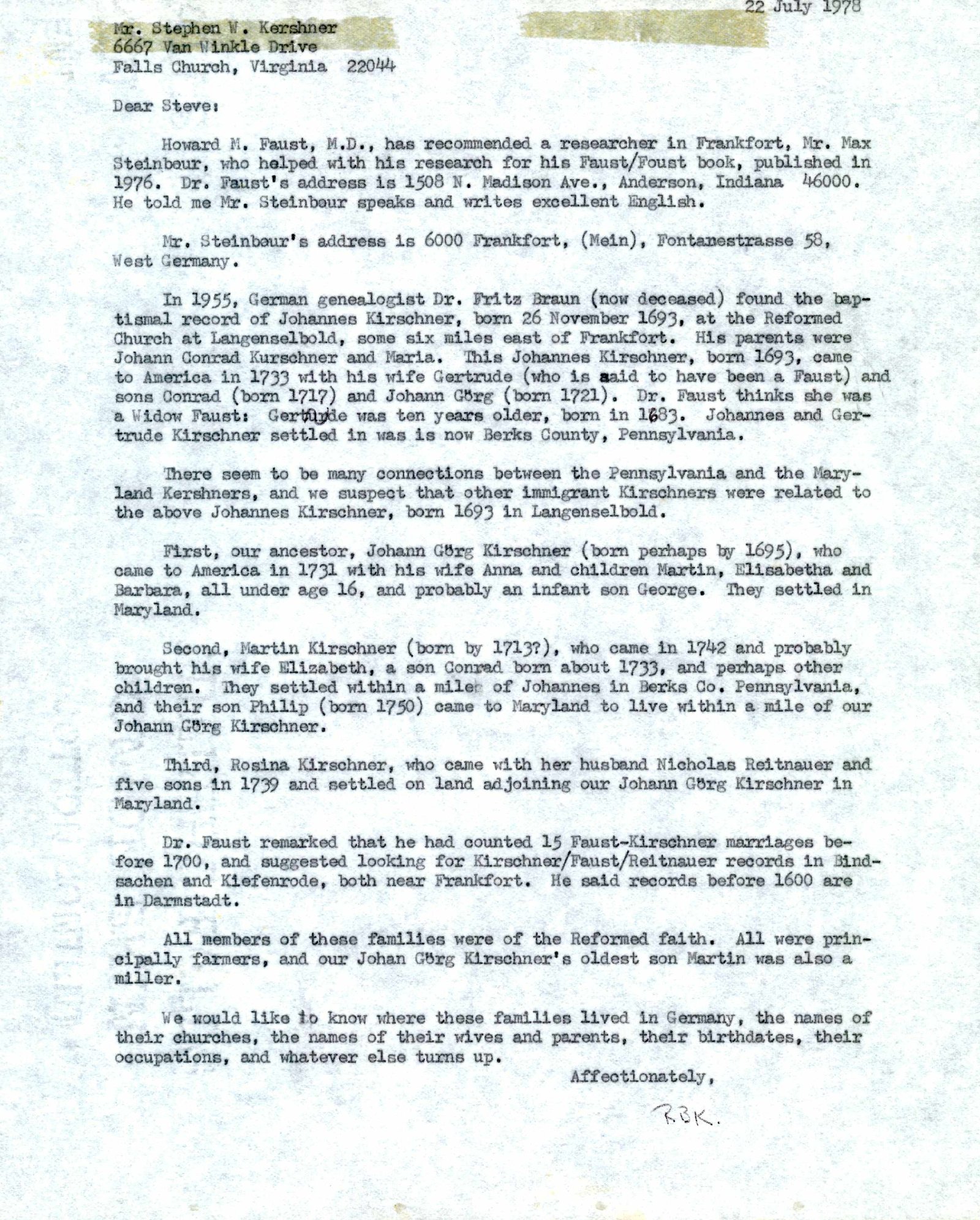
- Dr. Fritz Braun — German genealogist (deceased by the time of the 1978 correspondence); located the 1693 baptismal record of Johannes Kirschner at the Reformed Church, Langenselbold, in 1955, after a three-year search, for a fee of $50; his letter describing Langenselbold's history and Johannes's birthdate is quoted at length in the 1970 research note (pp.1, 77) and referenced repeatedly as the origin point of the whole research effort.
- Ruth Bownds Kershner (RBK) — 1414 Red Bud Trail, Austin, TX 78746, phone 512/327-2020; the central organizer and letter-writer of the correspondence portion of this document. Co-author (with Mary Kershner Maxwell) of "The Kershner Families of Maryland," published in multiple volumes by the Kershner Family Association. Directs and funds the Steinbaur research, drafts detailed research-question letters, tracks correspondence chronologies for other researchers (e.g., her enclosure list to Dr. Dahl, 21 Mar 1979), corrects dates in her own earlier published work (Jacob Kirschner's birth year, his sons' birth years), and personally signs the 1 Aug 1982 German-language letter to the Langenselbold Bürgermeister. Possible author of the 1941 handwritten note on p.3 (initialed "RBK"), which would make her the earliest-dated individual voice in the collection.
- Mary Kershner Maxwell — 1622 W. St. Vrain, Colorado Springs, CO 80904; RBK's co-author on "The Kershner Families of Maryland." Her 19 Aug 1982 handwritten letter is a warm, digression-filled personal update: a new roof after tennis-ball-size hail (12 June), wind damage to antennas (2 April, 102 mph), a new hot-water heater, and her husband Glen's prostate surgery (no cancer found) the same week; she also describes owning slides of a Kershner family chart kept at reunions "in the early 30's" by George C. Kershner, and a 1933 reunion postcard sent to her cousin Daniel Kershner of Denver. Plans to send Rolf Kirschner a copy of Volume III with RBK's signature "cut out ... and paste[d] in the book." Mentions relatives M.E. and Bob (returning from a Caribbean trip, helping paint her house), Helen, Aunt Hanna, and Harry Palmer (a planned autumn-1982 visit itinerary through Wallace, the Blue Ridge, Charlotte, Williamston, and Hagerstown).
- William E. (Bill) Kershner, Jr. — 1449 Fox Run Drive, Charlotte, NC 28212. Prepares the publication-ready typed pedigree charts from Steinbaur's and others' data (pp. 20, 41); corresponds with Mary Maxwell (16 Apr 1981) about proofreading and a correction to Anna Barbara's death place; reports Steinbaur's confirmation of the "Schussert" spelling. Also the recipient of the Steinbaur billing dispute referenced in the "Dear Stephan!" letter of 4.1.81 (owed $138, paid only $50).
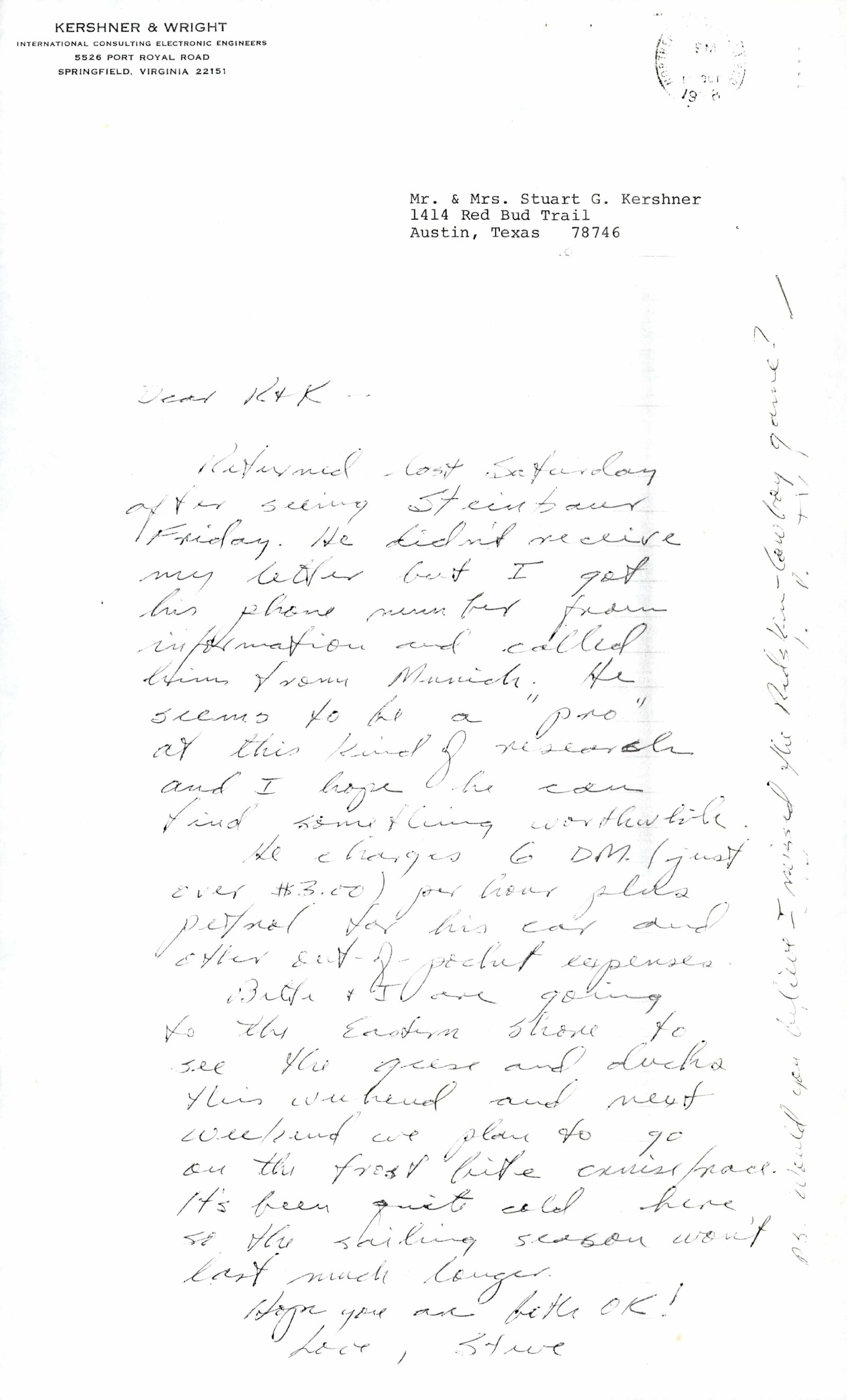
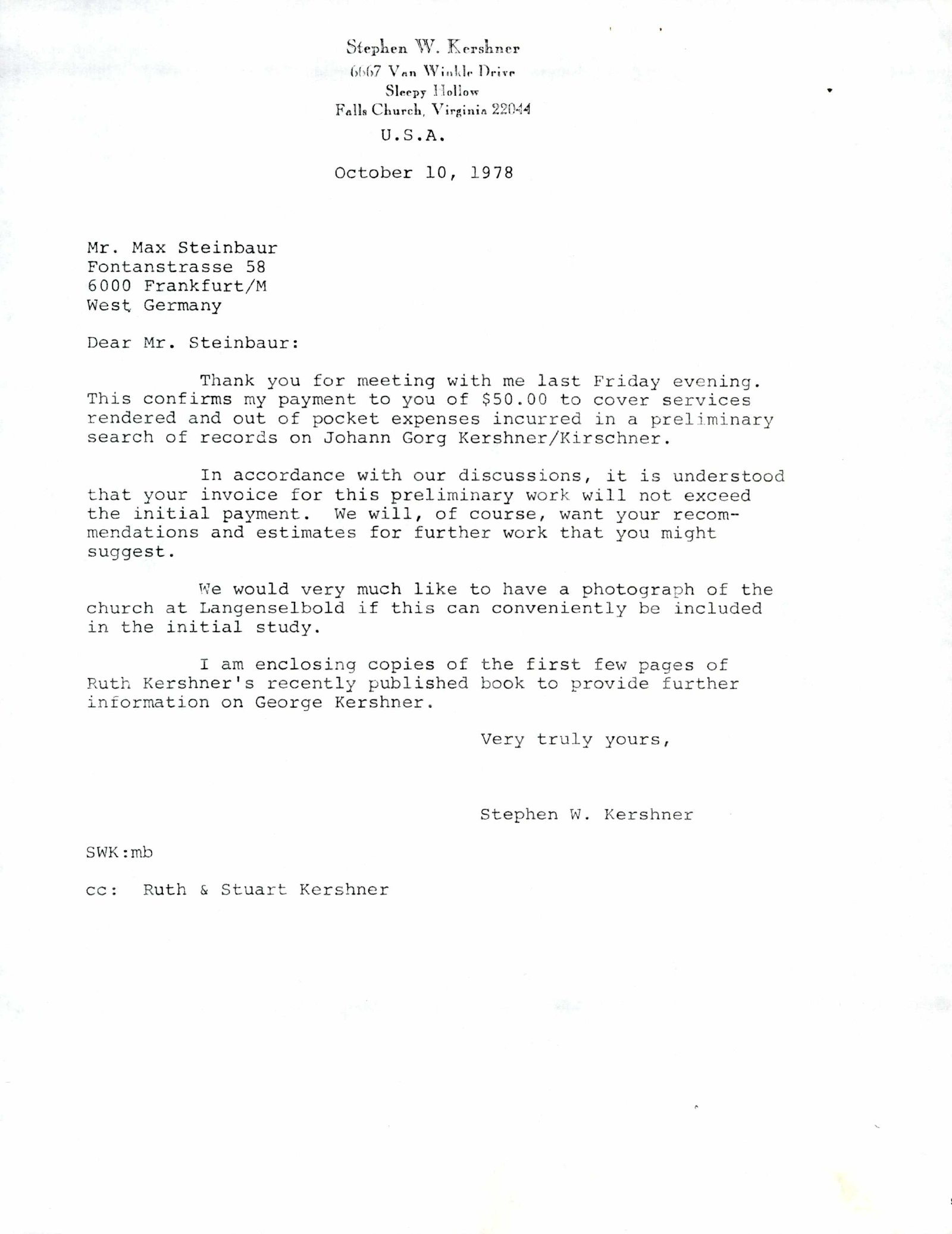
- Stephen W. (Steve) Kershner — 6667 Van Winkle Drive, Sleepy Hollow, Falls Church, VA 22044; principal at "Kershner & Wright, International Consulting Electronic Engineers," 5526 Port Royal Road, Springfield, VA. Personally met with Max Steinbaur in Frankfurt in early October 1978, paid an initial $50 retainer, and formally engaged him by letter (18 Sept/10 Oct 1978) at Dr. Howard M. Faust's recommendation. An avid sailor (references racing off Annapolis, a "frost bite cruise/race," a 26th wedding anniversary sailing weekend in 1978). Wife: Bette. By January 1981 reports "Kirsch" (apparently a family nickname, possibly for RBK or another relative) recovering a blood count, and mentions daughters/relatives Mary Beth (broke her leg skiing in Vermont) and Robin (skiing at Snowshoe, WV; also possibly the same Robin who could "Xerox" letters, per RBK's 22 July 1978 letter).
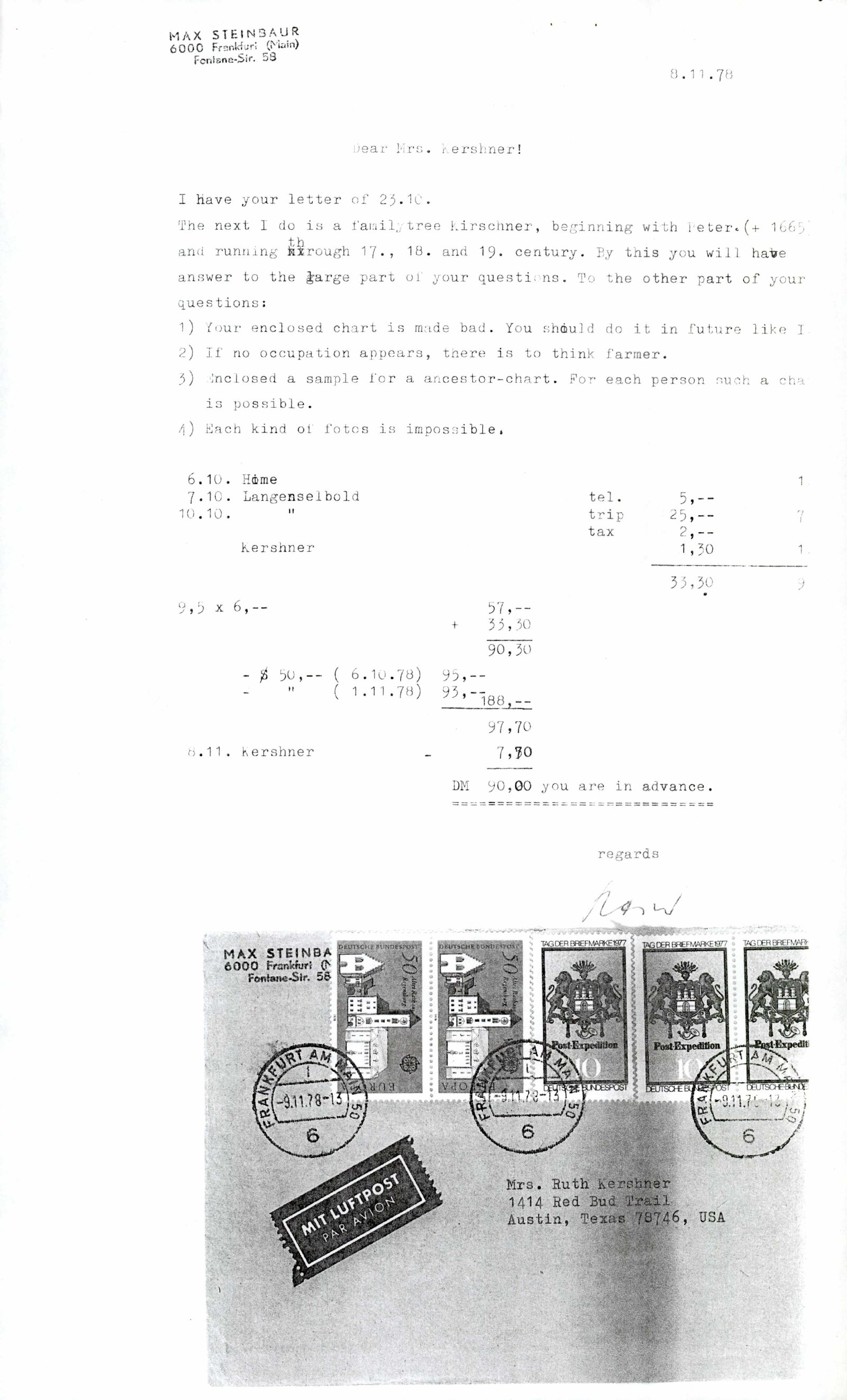
- Max Steinbaur — professional genealogist, Fontanstrasse/Fontane-Str. 58, 6000 Frankfurt (Main), West Germany. Hired by the Kershner family beginning autumn 1978 to research the Langenselbold Kirschner church records; charged roughly 6 DM (about $3) per hour plus travel and telephone expenses, itemized in detailed handwritten/typed billing statements (pp. 46, 48, 53) — his invoices show repeated small balances owed back and forth (e.g., "15.5 hours @ 6 marks = 93 marks... owe 45.90" and "$50 = 90 marks... $25.50"). Produced the formal chart "THE KIRSCHNERS OF HESSE" (p.20) and the related draft (p.41). Corresponded in imperfect but functional English; explained German genealogical terms and abbreviations to the family (Landscheider = boundary surveyor, Wagnermeister = master coach-builder, Gerichtsschöffe = juror/juryman of the local court). By 1981 the family (per RBK's 20 Apr 1981 letter) considered the core research essentially complete and did not plan further paid work except possibly checking Herbstein's Protestant and Catholic records for more on Enders Kirschner. A page of unrelated oval studio-portrait photographs (p.49), captioned with names spanning 1824–1892 (Peter Steinbaur, Therese Hassler, Michael Mappes, Magdalena Sauter, Jos. Anton Breitenmoser, Josef Betz, Agathe Werner, an earlier "Max Steinbaur" 1859–1902, Sophie Mappes, Jakob Breitenmoser, Pauline Betz, Erwin Steinbaur, Martha Betz), appears to be a sample chart Steinbaur sent to illustrate his working method, showing his own family (not the Kirschner/Kershner line).
- Dorothy A. Mighell — 122 Welcome Way W. Dr., Apt. 305-B, Indianapolis, IN 46224. Obtained and forwarded a second, independently sourced set of Langenselbold church records (eight baptisms, one marriage, and Peter Kürschner's death entry) translated by Ernest J. Thode in 1978–79, explicitly noting "Steinbaur didn't send these!" A friend, a female professor of German at Indiana Central (later identified as Dr. Meier), assisted with additional translations and terminology (e.g., "Lanscheider"/"Landscheider" as "a surveyor of land," "Evangelical" as "Protestant"). Reported by Bill Kershner (16 Apr 1981) to be seriously ill.
- Dr. Meier — female professor of German at Indiana Central College, a friend of Dorothy Mighell's who made frequent trips to Germany and helped translate genealogical terminology found in the German church records.
- Ernest J. Thode — Rt. 2, Paul Kern Rd., Marietta, OH 45750. Professional German-English genealogical translator; translated the Langenselbold baptismal/marriage/death records supplied to Dorothy Mighell (pp. 73–76). Advertised his services (per the Nov 1978 newsletter of the Maryland Genealogical Society, quoted on p.73) at $6/hour plus postage for translation, $6 per inquiry letter to German churches/archives (including postage and a 5 DM reply-coupon fee), and $2 minimum for consultations.
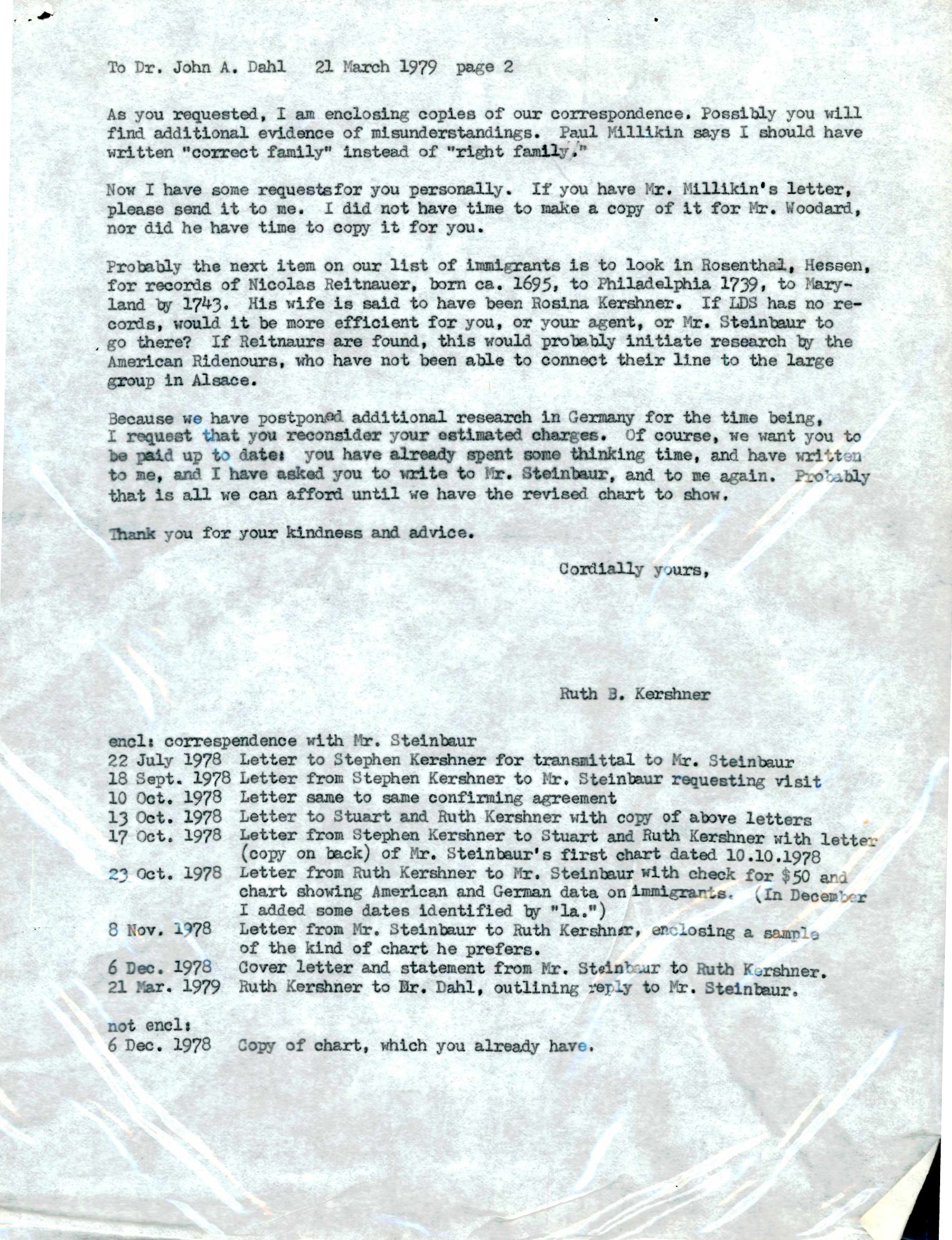
- Dr. John A. Dahl — recipient of RBK's detailed 21 March 1979 letter (duplicated on tan/green paper, p.63) that reviews the entire Steinbaur correspondence chronology and requests his advice on reconsidering Steinbaur's charges since further German research had been postponed; his own role/expertise is not otherwise described in the document, but the letter's tone (and RBK addressing him formally as "Dr.") suggests he was an outside genealogical advisor.
- Paul Millikin — a correspondent (address given elsewhere as Columbus, OH, per the 1977–78 contact list echoed from the K-005 document) who commented that RBK should have written "correct family" rather than "right family" in a letter to Steinbaur — cited in RBK's 21 March 1979 letter to Dr. Dahl as an example of a wording misunderstanding worth flagging.
- Doug Woodard — offered to research Joh. Georg (b.1722, son of Johann/Gertrude) after school let out; located the original 1768 Orphan's Court guardianship record for Anna Maria (finding the printed abstract had both omitted Martin, b.1703, as her guardian and misspelled the family name "Kerchner" instead of "Kerschner"); found no estate or land-sale record for a "George" in Berks Co., PA before 1773.
- Jack K. Halley — Secretary, Kershner Family Association, 4603 El Salvador, Houston, TX 77066; issued a 24 March 1978 typed memo to book subscribers explaining a delay in mailing Volume I due to pending indexing (Volume II had already shipped).
- Rolf Kirschner — German researcher and cousin based in Langenselbold; employed at the Frankfurt airport. As a "hobby local historian" (Hobby-Heimatforscher), researched many original documents and concluded the Kirschner/Kershner family's true "cradle" was Herbstein, with Langenselbold becoming a later major family center. Personally delivered Volume III of "The Kershner Families of Maryland" to the Langenselbold town archive on the family's behalf (per the 1 Aug 1982 letter). Organized at least two Kershner/Kirschner family reunions in Langenselbold — one during the town's 875th-anniversary/city-status celebration (1983, per the Langenselbolder Zeitung's own back-reference) and a second in June 1985 for a visiting couple from Falling Waters, West Virginia — and was interviewed/quoted in both 1985 newspaper clippings (pp.12, 14–15) describing this genealogical bridge-building.
- Peter Neugebauer — Bürgermeister (mayor) of the Gemeinde Langenselbold as of 1982; formal recipient (per the 1 Aug 1982 letter, sent in duplicate) of Volume III of "The Kershner Families of Maryland" for the town archive. Separately identified in the "Langenselbold stellt sich vor" booklet (pp.24–38) as the editor of that publication's text ("Redaktioneller Teil: Peter Neugebauer").
- Bürgermeister Ebner — named as the mayor expected to attend the official Kirschner/Kershner reunion on 6 June 1985 at Café Fischer (per the Langenselbolder Zeitung clipping of 31 May 1985), suggesting a change in the mayoralty between 1982 and 1985.
- Alma and Dan Kershner — the American guests from Falling Waters, West Virginia, whose May–June 1985 visit to Langenselbold is the subject of both 1985 newspaper clippings; toured the town, met Rolf Kirschner, and were photographed with him for the local paper; also received a private tour of the Langenselbold Schloss from Princess Margarete von Isenburg on the morning of 31 May 1985 (a Sunday), along with an extensive sightseeing itinerary (Herbstein, Mespelbrunn, Hessenpark, Frankfurt's Römer, Ronneburg Castle, Büdingen, a Rhine cruise past the Loreley, Rothenburg, Heidelberg).
- Princess Margarete von Isenburg — gave Alma and Dan Kershner a private guided tour of the Langenselbold Schloss (the former seat of the Isenburg-Birstein princely family, built on the site of the former monastery) on 31 May 1985.
- Howard M. Faust, M.D. — 1508 N. Madison Ave., Anderson, IN 46000; recommended Max Steinbaur to RBK, having used Steinbaur's services for his own Faust/Foust family history (published 1976). Reported having found fifteen documented Faust-Kirschner marriages before 1700, and suggested the researchers look for further Kirschner/Faust/Reitnauer records in Bindsachen and Kiefenrode, near Frankfurt (noting records predating 1600 are held in Darmstadt).
- Al Karschner — of Atlanta; had offered to try to obtain the Johannes/Gertraut Schuffert marriage records but, per RBK's 1981 letter, was never heard from again.
- George C. Kershner — kept a genealogical chart displayed at Kershner family reunions "in the early 30's," per Mary Maxwell's 1982 letter, who photographed it on slides and suggested an 8x10 enlargement be made so descendants could find their names with a magnifying glass.
- Daniel Kershner — Mary Maxwell's cousin in Denver, CO; received a 1933 postcard notice of the Kershner reunion, which Mary describes as her first contact of any kind with the "eastern Kershners."
- Margie — mentioned by RBK (22 July 1978) as owning a reliable Xerox machine ("make that machine sit up and beg"), used for copying family correspondence.
- Ernestine Ray — assisted RBK with final typing of a book index (1978); had injured her knee and faced possible surgery.
- "Stephan" — recipient of an undated-signature (dated 4.1.81) letter written in accented English, apparently by a German researcher based near Langenselbold (possibly Rolf Kirschner or another local contact), reporting a billing dispute with William E. Kershner Jr.: $50 requested on 14 Nov [1980], work completed, an invoice for $138 sent 11 Dec, and no payment received by 4 Jan 1981; also references a research topic or place called "Flensungen" that "I better could clear, than I thought." The signature is illegible and the writer's identity is not confirmed elsewhere in the document.
- Kershner Family Association contacts (per RBK's 1977–78 correspondent list, echoed here as background context, not detailed further in this document's own pages): the Association published "The Kershner Families of Maryland" in multiple volumes and later the quarterly newsletter "Kershner Kinfolk."
Named "Kirschner" individuals in the Langenselbold local-history reference material (non-correspondence; noted for possible future relevance, not confirmed as relatives)
- Frau Kirschner — thanked by name in the "Einleitung" (Introduction, p.83) of "Langenselbold in alten Ansichten" (1978) among townspeople who lent the book's author historical photographs/postcards.
- Frau Marg. (Margarete) Kirschner, geborene Grebe — separately credited (p.104) as the source of the photograph/illustration "Marktplatz um 1870" in the same book. May or may not be the same person as "Frau Kirschner" above; spelled "Kirschner" (German form), not "Kershner," in both instances, consistent with the surname never having anglicized among the German branch that stayed in Langenselbold.
- Wilhelm Völker — author and illustrator of "Langenselbold in alten Ansichten" (1978), a longtime local historian ("beschäftige ich mich seit 1917 mit Heimatforschung") who compiled the book from his own drawing collection and postcards, and whose own birth-house appears in one of the book's photo captions (item 11, Hanauer-Straße).
- K. H. Peters — author of the historical text in "Hessen, Land der Mitte" (1976), the regional picture-book that includes a chapter/section on Langenselbold (pp.68–72 of this archive).
The 1986 Wall Street Journal clipping (unrelated business article; surname coincidence only)
- Hans Kuerschner — founder of a small West German machinery manufacturer, Hans Kuerschner GmbH, based in Kaldenkirchen on the German-Dutch border; per the article, the company made candle-making machinery, had roughly 100 employees and about $5 million in sales, and exported globally. The company has no established or claimed connection to the Kershner/Kirschner genealogical line; the clipping was evidently saved and hand-marked in red ink (the surname underlined twice) purely because of the name match. General manager Werner L. Gross is referenced in the article's continuation (not fully captured in this scan). Reporter: Thomas F. O'Boyle, staff reporter, The Wall Street Journal (Southwest Edition, 23 April 1986). Other companies/individuals discussed in the same article (Bayer AG's Hermann J. Strenger and Hans Juergen Rosenkranz, Volkswagen, and Harvard Business School's Michael E. Porter) are unrelated to the family and are noted here only for completeness.
Places
- Herbstein, Hesse — per Rolf Kirschner's later research, the true point of origin ("cradle") of the Kirschner family, predating their move to Langenselbold; home of Enders Kirschner (b. c1570) and Ludwig Kirschner (b. c1590).
- Flensungen (near Herbstein, east of Giessen) — Peter Kirschner's residence as late as 1637, per Steinbaur's research; local church records (held at "Herlau"/Herbstein) begin only in 1634, limiting how far back marriage records could be traced. Referenced repeatedly in correspondence as a planned future research target ("research after winter," "to research Flensungen").
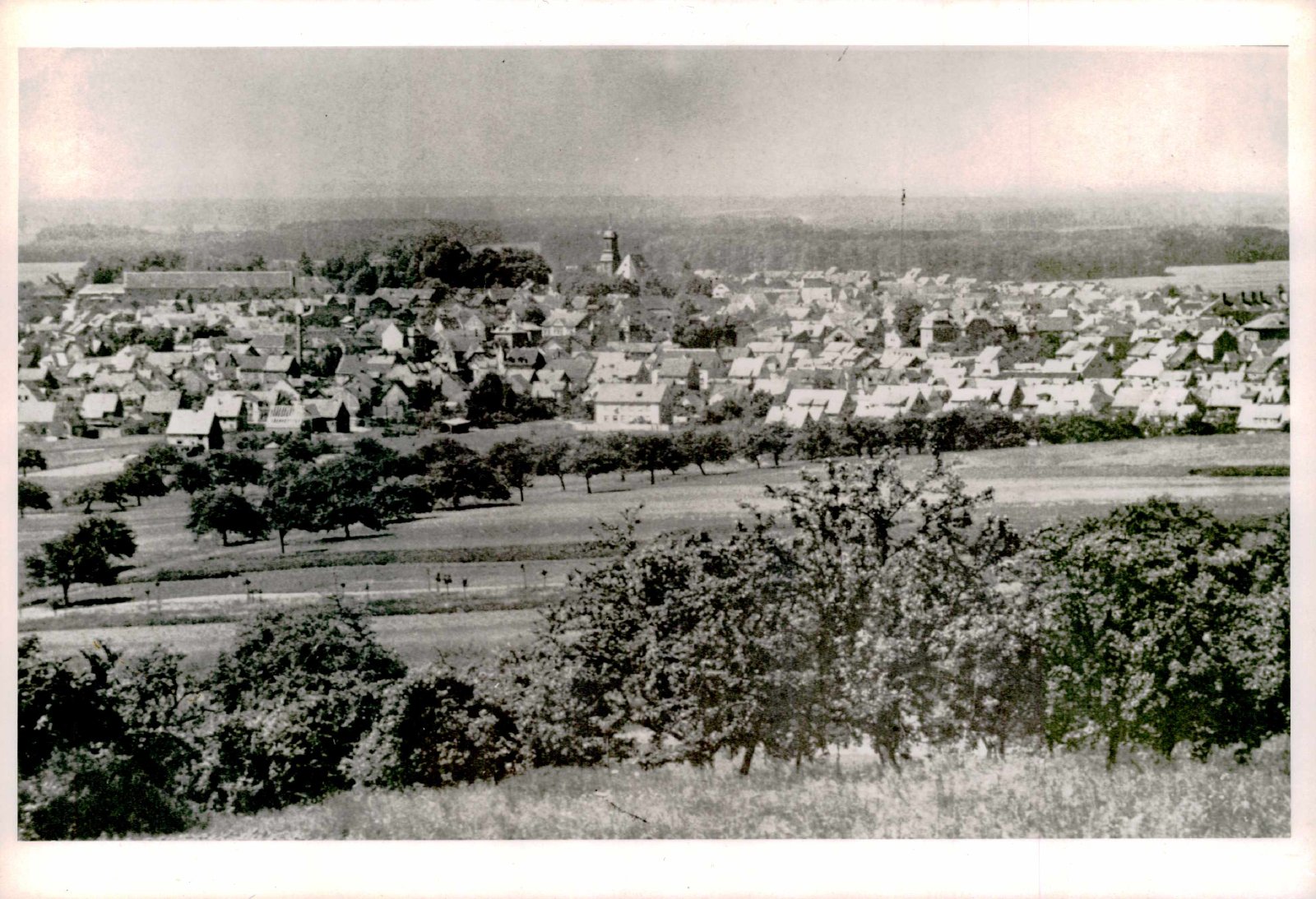
- Langenselbold, Hesse (also "Selbold," "La." in the charts) — the principal ancestral town, about 15 miles east of Frankfurt am Main and 6 miles east of Hanau, on the Gründau river; site of the Reformed and Lutheran parish churches holding the Kirschner baptismal/marriage/death records; first documented in 1108 in a papal charter; home of Kloster Selbold (an Augustinian monastery, founded by Count Dietmar von Selbold, dissolved 1725) and later the Isenburg-Birstein family's Schloss, built partly from the monastery's remains (1722–1752). Subject of extensive local-history background material collected in this file (two picture-books, pp.24–39 and 78–157, plus a chapter in a third regional history book, pp.68–72) — see Verification Notes in the closing summary.
- Frankfurt am Main — Max Steinbaur's home and base of research operations, Fontanstrasse/Fontane-Str. 58.
- Philadelphia, PA — port of arrival for the emigrating Kirschner brothers: Johann (b.1693) on the ship Elizabeth, 1733; Joh. Görg (b.1695) on the ship Samuel, 1731, under Capt. Hugh Percy.
- Lancaster County, PA — death place of Johann Kirschner (b.1693), before Sept 1742.
- Berks County, PA — settlement area of the Martin Kirschner (b. by 1713?) branch, near Johannes (b.1693); also where Dr. Ammon Kershner drove visiting relatives in 1970; site of a 1768 Orphan's Court guardianship record researched by Doug Woodard.
- Frederick County, MD — death place (c1768) of Anna Fischer, wife of Joh. Görg Kirschner; also the county referenced regarding a possibly-related Joh. Kaspar Kirschner said to have pastored an Evangelical Lutheran church there in 1764 (unconfirmed link).
- Bern Township, PA — site of Anna Barbara Kirschner's 1743 marriage to Peter Laucks, per RBK's research correcting Bill Kershner's chart.
- Clear Spring, MD (St. Paul's church) — burial site of Jacob Kirschner Jr., whose tombstone RBK determined overstated his age at death.
- Norristown, PA — home of Dr. Ammon Kershner (510 Swede St.) and Dr. Joseph E. Beideman (17 E. Airy St.); site of the 1969 Times Herald feature on both physicians.
- Austin, TX — Ruth Bownds Kershner's home, 1414 Red Bud Trail.
- Colorado Springs, CO — Mary Kershner Maxwell's home, 1622 W. St. Vrain.
- Charlotte, NC — William E. (Bill) Kershner Jr.'s home, 1449 Fox Run Drive.
- Falls Church, VA (Sleepy Hollow) — Stephen W. Kershner's home, 6667 Van Winkle Drive.
- Springfield, VA — address of "Kershner & Wright, International Consulting Electronic Engineers," Stephen Kershner's firm, 5526 Port Royal Road.
- Indianapolis, IN — Dorothy A. Mighell's home.
- Marietta, OH — Ernest J. Thode's home/translation-service base.
- Houston, TX — Jack K. Halley's home, as Secretary of the Kershner Family Association.
- Anderson, IN — home of Dr. Howard M. Faust.
- Rosenthal — two candidate locations debated in the correspondence for the Reitnauer/Ridenour family's origin: one in Alsace (family tradition) and one in Hesse, about 50 km north of Langenselbold (RBK's alternate hypothesis, unresolved).
- Herbstein and its church records — planned but seemingly unexecuted further research target for Enders Kirschner's origins ("both Protestant and Catholic," per Bill Kershner's 16 Apr 1981 letter).
- Gelnhausen — nearby town with historical ties to Kloster Selbold (a daughter church); site of a 1543 Reformation plaque discussed in the second picture-book.
- Kaldenkirchen, West Germany — headquarters of Hans Kuerschner GmbH, subject of the unrelated 1986 Wall Street Journal clipping.
Dates / Events
- c1570 — birth of Enders Kirschner, Herbstein (earliest-named progenitor in the pedigree).
- 1614 (23 Mar) — marriage of Ludwig Kirschner and Anna Fuchs, Langenselbold.
- 1638/1637 — birth of Johann Kirschner (per conflicting transcriptions of Steinbaur's own records: "1637, Flensungen" in his 10.10.78 letter vs. "2 Dec 1638, Stockhausen" on the typed chart).
- 1657 (1 Dec) — Peter Kirschner marries widow Anna (of Hans Bernhard Schad), Langenselbold [one chart gives this as 1637, likely a transcription error — see Discrepancies].
- 1660 (26 Jan) — Johann Kirschner marries Anna Elisabeth Ermolt, Langenselbold.
- 1665 (10 Mar) — death of Peter Kirschner, Langenselbold; buried "in a Christian and honorable manner" per the Death Book.
- 1669 (14 Nov) — birth of Joh. Konrad Kirschner, the immediate common ancestor of the four immigrant brothers.
- 1693 (23 Feb) — Joh. Konrad Kirschner's first marriage, to widow Maria (of Hans Bernhard Schad), Langenselbold.
- 1693 (26 Nov) — birth/baptism of Johann Kirschner (the elder immigrant brother), Reformed Parish Church, Langenselbold; per Dr. Fritz Braun's later research, "the exactly birthday" was Nov. 26, 1693.
- 1695 (9 May) — birth of Joh. Görg (Joh. George) Kirschner, RBK's direct Maryland-line ancestor.
- 1699 (16 Feb) — Joh. Konrad Kirschner's second marriage, to Anna Margarete Keyser, Langenselbold.
- 1700 (18 Sep) — birth of Joh. Kaspar Kirschner.
- 1703 (4 Nov) — birth of Joh. Martin Kirschner.
- 1717 (11 Feb) — Johann Kirschner (b.1693) marries Gertrud Dietrich, Langenselbold.
- 1717 (17 Sep) — birth of Joh. Konrad Kirschner (son of Johann & Gertrud) — probably the "Conrad, age 14" on the 1733 ship's list.
- 1721 (19 Nov) — Joh. Kaspar Kirschner marries Anna Magdalene Döll, Langenselbold.
- 1722 (28 Jan) — Joh. Görg Kirschner marries Anna Fischer, Langenselbold.
- 1731 (Aug) — Joh. Görg Kirschner emigrates with his family aboard the ship Samuel (Capt. Hugh Percy), arriving Philadelphia; settles in Maryland.
- 1732 (26 Nov) — Joh. Martin Kirschner marries Anna Elisabeth Schuffert/Schussert, Langenselbold.
- 1733 — Johann Kirschner (b.1693) emigrates with his family aboard the ship Elizabeth, arriving Philadelphia; settles in what becomes Berks County, PA.
- 1739 — Nicholas Reitnauer and Rosina Kirschner emigrate to America with five sons.
- 1742 — Joh. Martin Kirschner (b.1703) emigrates to Pennsylvania.
- 1748 (May) — death of Joh. Görg Kirschner, Maryland.
- 1750 — birth of Philip Kirschner (Martin-line, Berks Co. PA), who later moves to Maryland near Joh. Görg's descendants.
- 1765 (8 Apr) — death of Joh. Kaspar Kirschner, age 64y 7m.
- 1769 (30 Dec) — death of Joh. Martin Kirschner (son of Joh. Görg), Maryland.
- 1776 — death of Jacob Kirschner (son of Joh. Görg).
- 1782 — death of Joh. Martin Kirschner (the immigrant brother, b.1703), Pennsylvania.
- 1791 (21 Dec) — death of Joh. Konrad Kirschner (b.1717, the probable 1733 emigrant child), Pennsylvania.
- 1804 — death of George Kirschner (b. c1731, son of Joh. Görg).
- 1816 — [not directly referenced in this document; included for cross-reference to related Kershner-line research elsewhere in the archive.]
- 1822 — death of John Kirschner (b. c1740, son of Joh. Görg), Maryland.
- 1933 — Kershner family reunion; postcard notice sent to Daniel Kershner in Denver, per Mary Maxwell's 1982 letter.
- early 1930s — George C. Kershner displays a genealogical chart at Kershner reunions.
- 1941 — date on RBK's handwritten note (p.3) quoting a "Kurschner" reference in Sir Walter Scott's "Quentin Durward" — the earliest dated item in this document if the "RBK 1941" notation is read as a date of composition rather than a later archival note.
- 1955 — Dr. Fritz Braun, after a three-year search, locates the 1693 baptismal record of Johannes Kirschner at the Reformed Church, Langenselbold, for Dr. Ammon Kershner, for a fee of $50.
- 1960 — Dr. Ammon Kershner and his brother Lloyd visit Germany.
- 1969 (3 Jun) — The Times Herald (Norristown, PA) publishes a feature honoring Dr. Ammon Kershner and Dr. Joseph E. Beideman for 50 years of medical service.
- 1970 — the "KERSHNER — Pennsylvania, 1970" typed research note (quoting Dr. Braun's 1955 letter) is composed/filed (duplicated at pp.1 and 77); marginal annotation notes Dr. Beideman's Sept. 1971 retirement after a coronary.
- 1976 — publication of "Hessen, Land der Mitte" (regional picture-book, 1st edition), including its Langenselbold chapter.
- 1978 (24 Mar) — Jack K. Halley's memo to Kershner book subscribers re: Volume I mailing delay.
- 1978 (18 Jun–Jun) — Dr. Howard M. Faust recommends Max Steinbaur to RBK.
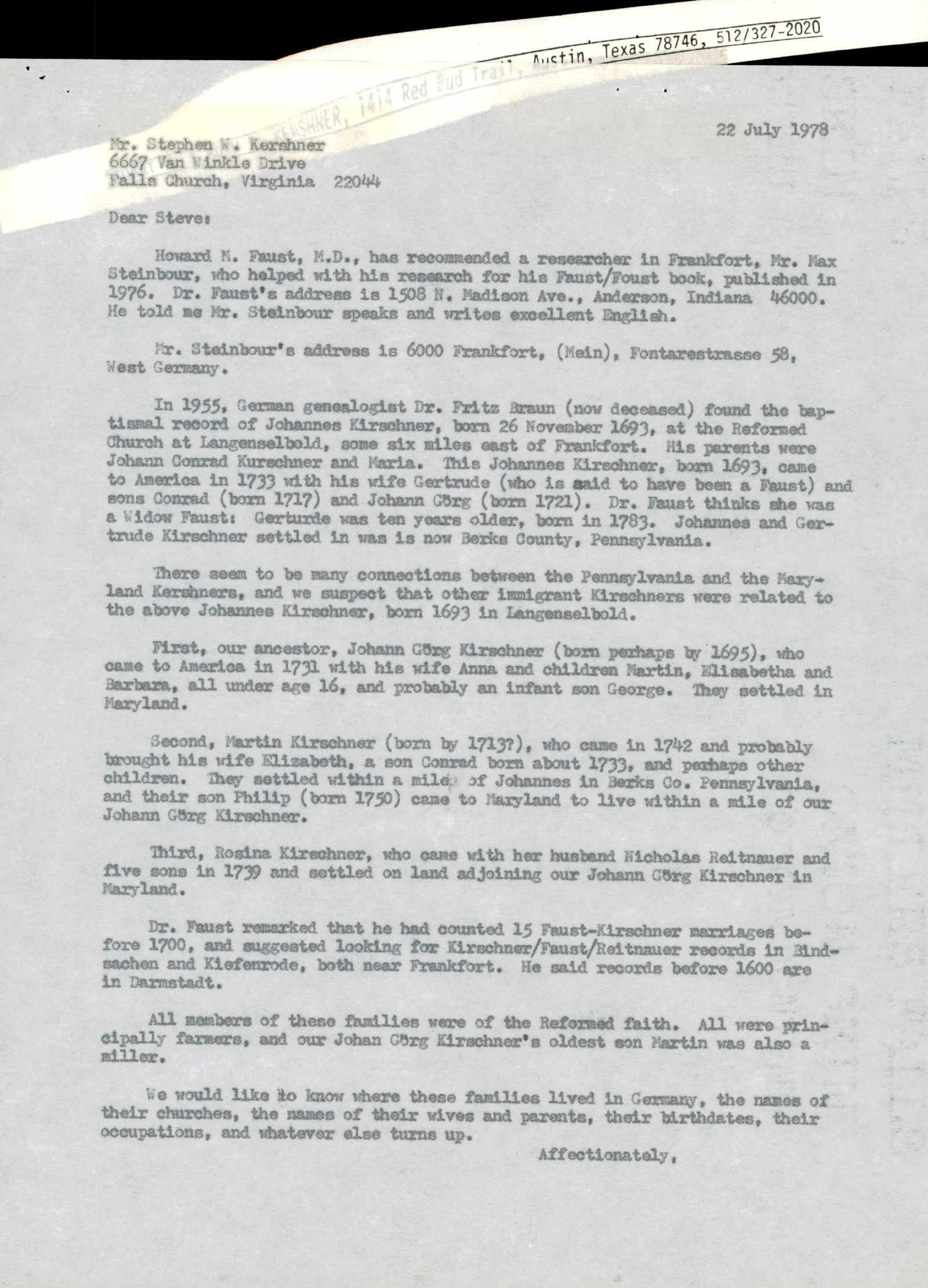
- 1978 (22 Jul) — RBK's two letters: to Steve and Bette Kershner (funding/strategy for engaging Steinbaur) and to Stephen W. Kershner (detailed background on Braun's 1955 findings and the three immigrant Kirschner lines).
- 1978 (18 Sep) — Stephen W. Kershner's formal letter to Max Steinbaur proposing an in-person meeting in Frankfurt.
- 1978 (21 Sep) — Steve's handwritten letter reporting the meeting letter had just been mailed.
- 1978 (4–6 Oct) — Stephen Kershner meets Max Steinbaur in Frankfurt/Munich; pays an initial $50 retainer.
- 1978 (10 Oct) — Stephen Kershner's follow-up letter to Steinbaur confirming the $50 payment and requesting a photograph of the Langenselbold church.
- 1978 (10 Oct) — Max Steinbaur's first reply/chart, "the first Kirschner," tracing the family from Peter (d.1665) forward; billing table dated 6, 7, 10 Oct.
- 1978 (23 Oct) — RBK's detailed letter to Steinbaur with a further $50 payment, a research chart, and a long list of specific genealogical questions (Maria Schad's maiden name, Rosina Kirschner's relationship, Joh. Martinus's birth date, Gertrude Faust's status, Joh. Casper's possible emigration, etc.).
- 1978 (2 Jun; per p.73 dating) — Dorothy Mighell forwards a second, Thode-translated set of Langenselbold church records to RBK ("Steinbaur didn't send these!").
- 1978 (8 Nov) — Steinbaur's letter with a sample ancestor-chart and billing statement; envelope postmarked Frankfurt, 9 Nov 1978.
- 1978 (6 Dec) — Steinbaur's cover letter and detailed billing worksheet/statement to RBK ("Dear Mrs. Kershner").
- 1978 (12/13 Dec) — the large handwritten multi-generation pedigree chart (pp.4–10) is drafted, dated "6.12.78" in the corner, cross-referencing Steinbaur's and RBK's own research.
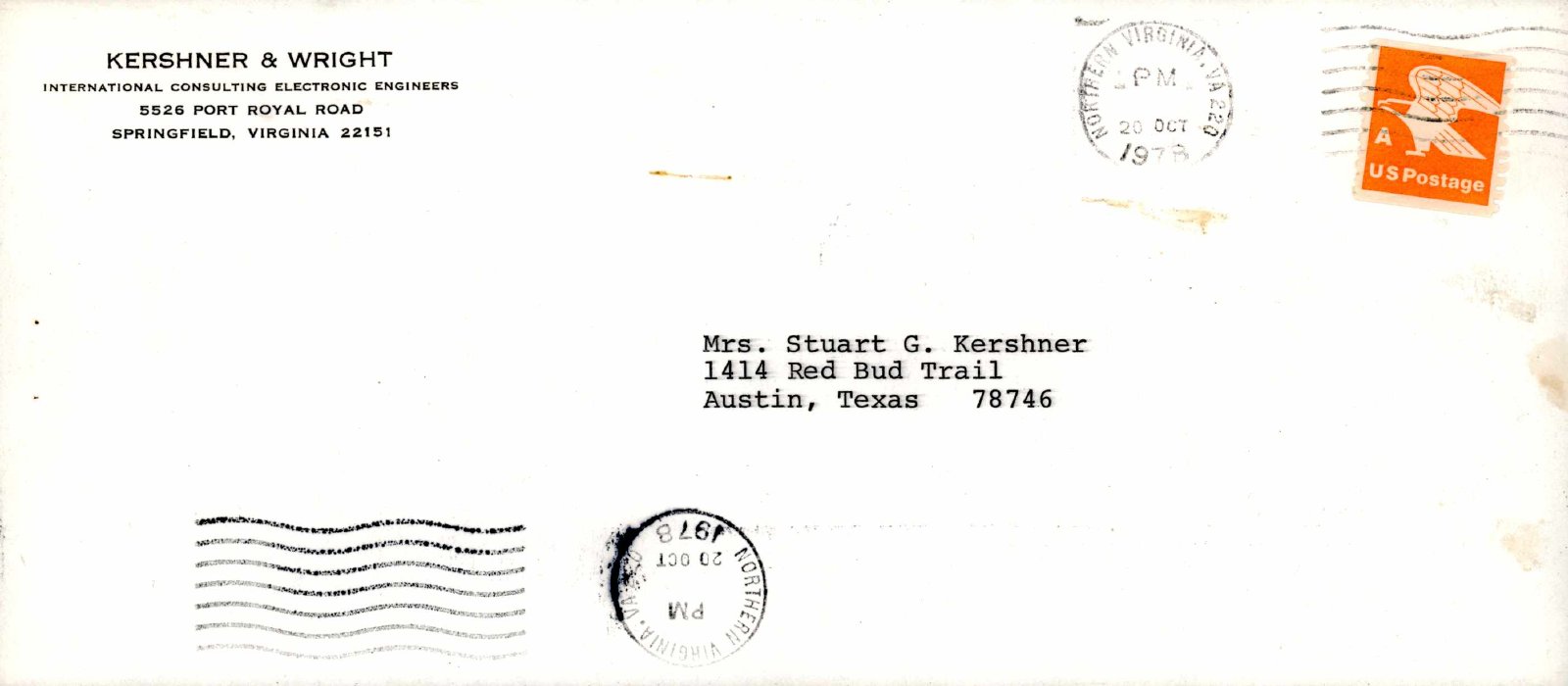
- 1978 (20 Oct) — envelope from Kershner & Wright postmarked to Mrs. Stuart G. Kershner.
- 1979 (21 Mar) — RBK's letter to Dr. John A. Dahl, summarizing the full Steinbaur correspondence chronology to date and requesting advice on reconsidering his charges.
- 1979 (2 Jun) — Dorothy Mighell's cover note formally transmitting the Thode-translated Langenselbold records to RBK.
- 1981 (4 Jan) — the "Dear Stephan!" letter reporting a billing dispute between an unnamed German researcher and William E. Kershner Jr. over a $138 invoice.
- 1981 (29 Jan) — Stephen Kershner's handwritten letter enclosing a card from Steinbaur and directing that further correspondence go through Bill Kershner.
- 1981 (16/20 Apr) — Bill Kershner's letter to Mary Maxwell enclosing Steinbaur's reply and the finalized "KIRSCHNERS OF HESSE" chart, declaring the core research essentially complete; RBK's parallel 20 April 1981 letter ("Dear Bill") covers chart formatting for DAR-compliant book margins, source citations, and a long list of specific corrections and open questions.
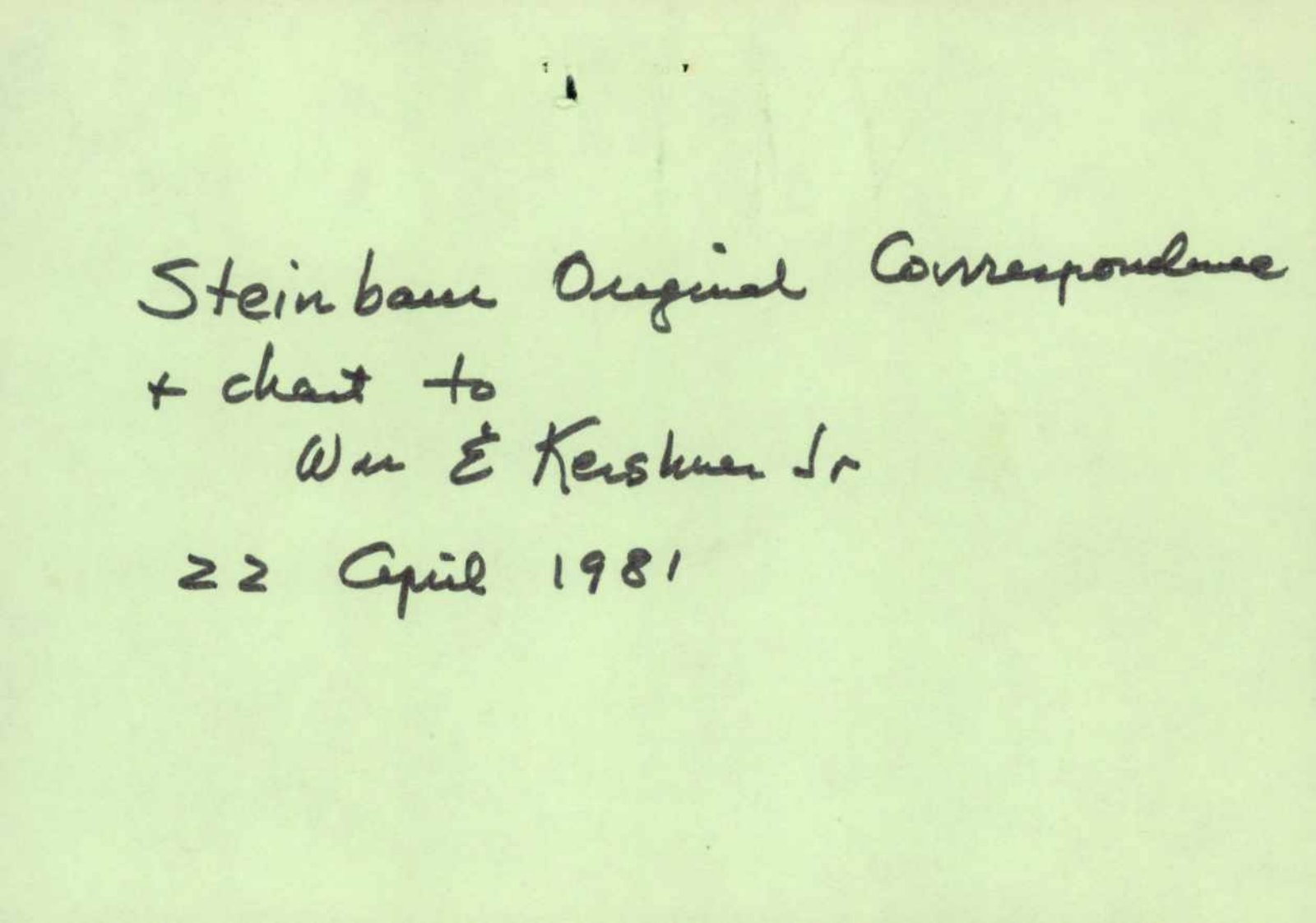
- 1981 (22 Apr) — green routing card recording that Steinbaur's original correspondence and chart were forwarded to Bill Kershner.
- 1981 (Mar) — "KIRSCHNER RESEARCH" chart drafted by Wm. E. Kershner Jr. (p.41), a refined version of the p.20 chart.
- 1982 (1 Aug) — Mary Kershner Maxwell and RBK jointly write (in German) to Bürgermeister Peter Neugebauer of Langenselbold, sending Volume III of "The Kershner Families of Maryland" for the town archive, to be personally delivered by Rolf Kirschner.
- 1982 (19 Aug) — Mary Maxwell's long personal letter to Ruth & Stuart describing recent domestic events (hail damage, Glen's surgery) and family-history-sharing plans.
- 1983 — first Kershner/Kirschner family reunion in Langenselbold, organized by Rolf Kirschner, held during the town's 875th-anniversary/city-status celebration; eleven American guests attend (per the 1985 Langenselbolder Zeitung's retrospective account).
- 1985 (31 May) — Langenselbolder Zeitung publishes "Kirschners treffen Kershners," previewing the visit of Alma and Dan Kershner from Falling Waters, WV, and detailing Rolf Kirschner's research placing the family's "cradle" in Herbstein.
- 1985 (31 May, Sun. morning) — Princess Margarete von Isenburg gives Alma and Dan Kershner a private tour of the Langenselbold Schloss.
- 1985 (4 Jun) — Langenselbolder Zeitung publishes a photo and caption confirming final arrangements for the reunion, showing Alma and Dan Kershner with Rolf Kirschner.
- 1985 (6 Jun, 7:00 PM) — the official 1985 Kirschner/Kershner reunion takes place at Café Fischer, Langenselbold, with Bürgermeister Ebner expected as a guest.
- 1986 (23 Apr) — The Wall Street Journal (Southwest Edition) publishes "Success Stories: Three German Firms Show Heavy Industry Can Still Turn a Dollar," including the unrelated Hans Kuerschner GmbH profile, clipped and hand-marked by a family member for the surname coincidence — the latest-dated item in the entire document.
Research Leads and Open Questions (as left unresolved by the correspondents)
- Was Gertrud(e), wife of Johann Kirschner (b.1693), a Dietrich or a Faust? RBK's own pedigree charts consistently give her maiden name as Dietrich (daughter of Johann Dietrich), but Dr. Howard M. Faust's research suggested she may have been a widow surnamed Faust before marrying Johann. The 23 Oct 1978 letter to Steinbaur explicitly asks him to resolve this ("Was Gertrude Faust... a widow when she married Johannes Kirschner? If so, what was her maiden name and did she have Faust children?"), but no answer is recorded in this document.
- How was Rosina Kirschner (wife of Nicholas Reitnauer/Ridenour) related to the main Kirschner line? Steinbaur's search found no Langenselbold record of her birth or marriage; his working conclusion — that she was a cousin rather than a sister to the immigrant brothers — is not backed by a specific documented relationship, and the Alsace-vs.-Hesse origin of the surname "Rosenthal" associated with the family is never resolved.
- Did Joh. Kaspar Kirschner (b.1700) ever emigrate? A single unconfirmed hint — that a man of the same name "was pastor of an Evangelical Lutheran Church in Frederick County, Virginia, in 1764" — is raised in the 23 Oct 1978 letter to Steinbaur but never followed up or confirmed elsewhere in the document.
- What became of Johann Kirschner (b. 24 Feb 1729), son of Joh. Görg, who did not emigrate with the rest of the family in 1731? RBK's 20 April 1981 letter leaves open "a reasonable doubt" about whether he died in Pennsylvania or Virginia, asking Bill Kershner simply to note "d. in America" pending further research; no resolution appears in this document.
- Did any of Joh. Martin Kirschner's (b.1703) other Berks Co., PA descendants (Conrad b. c1733, Johannes, Georg b. c1721) leave further traceable records? Referenced in passing on the tentative chart (p.64) but not developed further.
- The identity of the "Stephan" letter's author (4.1.81) and the underlying nature of the "$138" billing dispute with Bill Kershner is never clarified — the signature is illegible and no reply or resolution is preserved in this document.
- Whether the Association ever pursued further research at Herbstein (both Protestant and Catholic church records), as Bill Kershner proposed "later, when I have more time" (16 Apr 1981) — not confirmed as having happened within the correspondence captured here; Rolf Kirschner's independent 1980s research (per the 1985 newspaper clippings) does appear to have picked up exactly this thread, concluding Herbstein was indeed the family's point of origin, though the document does not show whether this was coordinated with the American researchers or conducted entirely independently.
- Whether "Kertroudt Kernoser" and "Johan Yerch" on the 1733 Ship Elizabeth passenger list are transcription errors for "Gertraut Kirschner" and a son's name (possibly "Joh. Görg") — the document reproduces the passenger-list spellings exactly as printed in the cited source (Strassburger's "Pennsylvania German Pioneers") without correcting or explaining the apparent garbling.
Discrepancies Flagged in (or Evident From) the Records Themselves
- Peter Kirschner's marriage date to widow Anna: given as "1 Dec 1657" on the typed chart (p.20/488) but as "1 Dec 1637" on the alternate typed draft (p.41/711) — a twenty-year discrepancy that is almost certainly a typographical error in one of the two charts, since Anna's own birth year (c1607) and the fact that her first husband died in 1663 make the 1657 date far more plausible.
- Johann Kirschner's (b.1693's father) birthplace/birth year: given as "2 Dec 1638, Stockhausen" on the formal typed pedigree (p.20) but as "1637, Flensungen" in Steinbaur's own original 10.10.78 letter (p.53) — the correspondence does not reconcile which is correct.
- Schuffert vs. Schussert: the maiden name of Joh. Martin Kirschner's wife Anna Elisabeth is spelled both ways across different documents in this file; Bill Kershner's 16 Apr 1981 letter reports that Steinbaur, on request, re-checked the original record and confirmed "Schussert, not Schuffert" — but earlier pages in this same file (pp. 73–74, the Thode-translated records) consistently use "Schuffert," so the correction may postdate, or simply not have propagated to, all copies in this archive.
- Jacob Kirschner's and his sons' birth years: RBK's 20 April 1981 letter documents her own correction of previously published estimates — Jacob Sr. from "ca. 1732" to "ca. 1733"; his son Jacob Jr. from an inferred "in his 64th year" (implying b. ca.1752) to a corrected b. ca.1758, based on a contemporary newspaper death notice rather than a tombstone erected 20–25 years after death; and eldest son Jonathan from "ca 1750" to "ca 1756."
- Anna Barbara Kirschner's death place: Bill Kershner's chart originally (mistakenly, per his own 16 Apr 1981 letter) listed her as dying in Maryland; RBK's research instead found a probable 1743 marriage record for her in Bern Township, PA.
- A possibly misplaced baptismal note: the marginal note on the pedigree reading "a son ('Conrad?') bp. 25 Dec. 1693, Lutheran Ch. Langenselbold, sponsor: Conrad Moll" does not clearly correspond to any of Joh. Konrad Kirschner's documented children on the main chart, and its placement/relationship is not explained in the document.
- RBK's 1941 note vs. the file's overall chronology: the "RBK 1941" note on p.3 is difficult to place — it may record an actual 1941 research jotting (making it the earliest-dated item in the whole file, decades before the rest of the correspondence begins) or may be a later archival annotation using "1941" as a shorthand reference of uncertain meaning; the document offers no further context to resolve which.
Full transcript
Typed from the scans, handwriting included. Unclear words are marked [?]. The original scans are kept in the family archive.
Transcript: ResearchLetters_KershnerGermanResearch_1970-1986.pdf — Pages 1-40
Page 1 — 1970, typed, "KERSHNER / Pennsylvania, 1970" research note
KERSHNER
Pennsylvania, 1970
Dr. Ammon Kershner, 82, of 510 Swede St., Norristown, Penna., and his brother Lloyd Kershner visited Germany in 1960. They are descendants of Conrad Kershner, who is shown thus on the ship's list:
from Pennsylvania German Pioneers, Strasburger
Ship Elizabeth, 1733 Johannes Kirshner age 40 Kertroudt Kernoser age 50 Conrad age 14 Johan Yerch age 12
A letter from Dr. Fritz Braun, a German genealogist, is quoted below:
"Your forefathers came from the village Langenselbold, in the district Wetterau, Hessen, about 15 miles eastward from Frankfurt, Main, or about 6 miles Eastward from Hana [Hanau]. The enclosed copy of a map shows the dwelling place of your Johannes Kirschner, before he left Germany. Langeselbold is mentioned at first in 1108 in an old document given by the Pope Paschallis Second. Then the Earl of Selbold made a donation for an Augustiner Cloister, which was the richest of the Wetterau, during all the years till it was destroyed by the Bauerkrieg (Farmer's War) in 1525. You will find more dates of this place in the Hidderich genealogy which will be published in a short time by Miss Louisa Hetrick of South W. 29 St. Camp Hill, Pa.
"The exactly birthday of your Johannes Kurschner, is Nov. 26, 1693, at Sebold, today Langensebold, Hessen.
"His parents were Johann Conrad Kurschner and his wife Maria. He was a member of the Reformed Church."
Dr. Kershner is the oldest practicing physician in Norristown. He now limits his practice to three days a week, so he has time to play the piano and drive his visiting relatives around Berks County.
Page 2 — Woodcut illustration with German verse, "Der Kürschner" (The Furrier), undated (historical reproduction)
A page bearing an old woodcut illustration titled "Der Kürschner" (The Furrier), depicting a fur-trade workshop scene: men seated at a table cutting and sewing furs, with pelts and finished fur garments hanging on display racks around them (apparently a reproduction from a 16th-century "Book of Trades" / Ständebuch, in the style of Jost Amman).
Below the woodcut, printed in an old Fraktur/calligraphic typeface, is a German rhyming verse (period spelling with old long-s):
"Wol her/ich fütter Rock und Schauben/ Mach schürtzbeltz/brusttüch/Vehehaubn/ Von Zobel/Marder/Vehe und Lüchsen/ Von Hermlein/Ilter/Wölff und Füchsen/ Von Welschen Kröpffen und Geißfeln/ Von Wammen/Rücken/Klaw und Keln/ Wer mir thut seines Geltes gönnen/ Der thut mich allzeit willig finden."
(A furrier's trade-verse: "Come here, I line coats and robes, make fur girdles, breast-cloths, fur caps, of sable, marten, ermine [Vehe] and lynx, of ermine, polecat, wolf and fox, of foreign pelts and kid-skins, of belly, back, claw and throat-fur; whoever is willing to spend his money will always find me obliging.") No translation is provided on the page itself; the above rendering is descriptive only, not a translation supplied by the document.
This page appears to be included in the archive as background research illustrating the origin/meaning of the surname "Kürschner" (= furrier), which the family believes evolved into "Kershner."
Page 3 — Handwritten note (undated, marked "RBK 1941"), pasted clipping re: "Quentin Durward" novel reference to "Kurschner"
A small handwritten note card, pasted onto a gray photo-album-style backing page (mounting corners/dots visible).
Text of the note:
"Quentin Durward by Sir Walter Scott
1468 in Liege, fief of Burgundy, which was a fief of Louis XI of France. [Trevillon?], Syndic (Magistrate) of Liege is speaking: 'Keep close about me, my brisk Kurschner lads,' he said to his body-guard, 'and we will get as fast as we can out of this den of thieves.' (Chap. XXI) — followed by a dozen of the Kurschenschaft, or skinner's trade, who attended, as a guard of honor, on the Syndic. (Chap. VII) Glossary: Kurschenschaft, currier's trade. Dictionary: Currier is tanner or skinner or both.
RBK 1941"
(The name of the speaker is written in cursive and is difficult to read with confidence; it may read "Trevillon" or similar — [illegible/uncertain]. The initials "RBK" and year "1941" at bottom right appear to be the note-taker's initials and date, likely Ruth Bownds Kershner.)
Page 4 — Handwritten genealogy chart (dated 6.12.78), "Kirschner" family tree, overview page listing branches I–VI
A large handwritten genealogical chart, landscape orientation, continuing from a prior page ("...Joins bottom of pg 1" noted top-left). It documents multiple marriages and children of the Kirschner/Kershner family in "La." (Langenselbold), with German-style genealogical notation (∞ = married, * = born, † = died, date formats day.month.year).
Left portion shows four columns of children under a common ancestor, labeled "Kirschner E.K.", "Kirschner, Kirschner, Kuerschner, Kirchner E.K.", each headed:
- Johann, *26.11.1693, La.; † 1742 Lancaster [Pa.]; ∞ 11.2.1717, La., m. Gertrud Dietrich (†Johann), ex-separated marriage w. Johann Schunert; divorced from...
- Joh. Georg, *9.5.1695, La.; † 1748, USA; ∞ 28.1.1722, La., m. Anna Fischer (Konrad and Anna Veronica, in La.), *13 June 1698, † ca. 1768 USA
- Joh. Kaspar, *18.9.1700, La.; † 8.4.1765 Pa.; ∞ 19.11.1721, La., m. Anna Magdalene Doll (Peter)
- Joh. Martin, *4.11.1703, La.; † 1782, Pa.; ∞ 26.11.1732, La., m. Anna Elisabeth Schu[ss/ff]ert (Schuffert/Schussert — noted "T."), and Gertraut, [†Johann]
Right portion (second marriage / different family group), headed "Kirschner":
- Marriage record: ∞I 23.2.1693, La., m. widow Maria (born Kreis? / Kasper), of Hans Bernhard Schad in their marriage of 9.1.1690, La., with only 1 child: Joh. Peter Schad, *18.2.1691, La.; † 1669; † 21.11.1697, La., 28y 9m.; ∞II 16.2.1699, La., m. Anna Margarete Keyser (Johann, Wagnermeister/wheelwright master), *167[2], †30.11.1722, La., 50y — some m.
- Children listed: Johann, *24.10.1697, La.; †10.12.1741, La., 14y 8w 2d.
- Joh. Heinrich, *20.6.1700, La.
- Werner, *28.5.02, La.
- Joh. Bernhard, *28.9.'04, La.
- Johann, *9.9.'08
- Joh. Georg, *9.9.'08, La., unmarried, [d.] 25.11.1723
Far right column: ∞I 7.1.1697, La., m. Anna Christina Diefrich (†Heinrich), *1675, †16.4.1724, La., 49y 3m.; ∞II 24.1.1725, La., m. widow Katharina, of Christoph Rack. Additional names at far right margin: "Anna Katharina, Rosina Kath. Steind, *10.1.1723, La." and "*11.1.1723, La."
Below the main chart are six labeled circles (I through VI), each apparently keying to a detailed sub-chart on a following page.
Footer, right side (printed/typed letterhead-style text): "Ruth Bownds Kershner 1414 Red Bud Trail Austin, Texas 78746 Ph. 512/327-2020"
"MAX STEINBAUR 6000 Frankfurt (Main) Fontana-Str. 58"
Handwritten date at bottom right: "6.12.78"
Page 5 — Handwritten genealogy chart, Circle "I": Johann (Joh. Konrad), children listing
Circle "I" at top left. Header:
"Johann (Joh. Konrad) *26.11.1693, La. † 1742, Lancaster ∞ 11.2.1717, La. m. Gertrud Dietrich (†Johann) ex-separated re-marriage with Johann Schunert * †"
Below, a row of six children, labeled "[TWINS?]" over two of them:
- Joh. Konrad, *17.9.1777 [sic, likely 1717], La.
- Joh. Peter, *15.10.1719, La.; †29.12.1725, La., 5y 2m soned. [sonn'd/some notation]
- Anna, *15.5.1722, La.; †26.12.1722, La., 7m sone d.
- Joh. Georg, *15.5.1722, La. (marked as twin with Anna, caret above)
- Anna Philippine, *20.8.1724, La.; †12.6.1725, La., 9m sone d.
- Anna Katharina, *5.11.1727, Ka[?].
Page 6 — Handwritten genealogy chart, Circle "II": Joh. Georg, children listing
Circle "II" at top left. Header:
"Joh. Georg (Joh. Konrad) *9.5.1695, La. † 1748, USA ∞ 28.1.1722, La. m. Anna Fischer (Konrad, in La.) * † ca. 1768, USA"
Below, four children listed (all annotated "1731 USA" above the first three, "not USA" above the fourth — emigration notes):
- Joh. Martin, *3.12.1722, La.
- Anna Elisabeth, *25.3.1725, La.
- Anna Barbara, *26.1.1727, La.
- Johann, *24.2.1729, La.
Page 7 — Handwritten genealogy chart, Circle "III": Joh. Kaspar, children listing
Circle "III" at top left. Header, with marginal query "[Was he in La. after 1754?]":
"Joh. Kaspar (Joh. Konrad) *18.9.1700, La. † 8.4.1765, 64y 7m ∞ 19.11.1721, La. m. Anna Magdalene Doll (Peter) * †"
Below, a row of children:
- Anna Sabine, *20.12.1724, La.; †28.1.1785, La. — annotated "?book-child (this word not understood)"
- Anna Elisabeth, *28.4.1723, La. — connected by dashed line to "Joh. Martin" entry below (query mark)
- Joh. Martin, *10.12.1725, La. (year 1724 noted above); †; ∞ 10.3.1751, La., m. Elisabeth Richt (Johann)
- Joh. Konrad, *29.8.1728, La.
- Anna Margarete, *25.9.1729, La.
- Johannes, *17.8.1732
Second row of grandchildren (children of Joh. Martin & Elisabeth Richt):
- Johannes, *10.12.1733
- Anna Maria, *29.8.1736
- Anna Katharina, *2.3.1740; †1.6.1751, 11y 2m Sonnetags [Sundays?]
- Johann Konrad, *16.9.1744
Page 8 — Handwritten genealogy chart, Circle "IV": Joh. Martin Kirschner, children listing
Circle "IV" at top left. Header, marked "Kirschner E.K." at top right:
"Joh. Martin (Joh. Konrad) *4.11.1703, La. † ∞ 26.11.1732, La. m. Anna Elisabeth Schunert (†Johann) and Gertraut [T.] *29 Dec. 1711 †"
Below, six children:
- Anna Katherina, b. 11 October 1733; †11 December 1733
- Joh. Konrad, b. middle of October 1734
- Joh. Peter, b. 29 May 1736; †2 February 1737, 8 mo. some d.
- Anna Maria, b. 19 October 1737
- Joh. Kasspar, b. 10 June 1739
- Johannes, b. 9 April 1741
Marginal note at right: "[Did any of these children die by 1743?]"
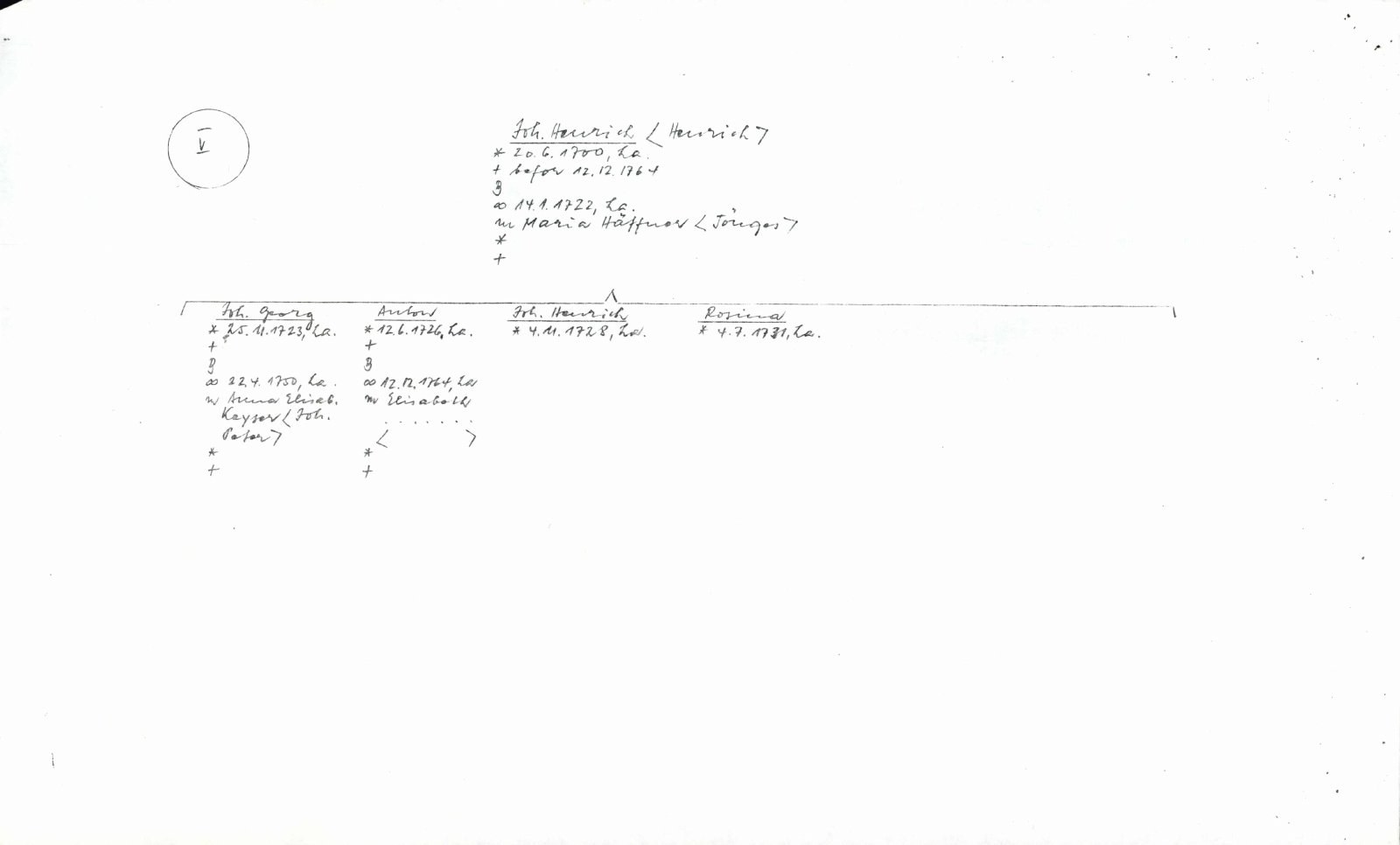
Page 9 — Handwritten genealogy chart, Circle "V": Joh. Heinrich, children listing
Circle "V" at top left. Header:
"Joh. Heinrich (Heinrich) *20.6.1700, La. † before 12.12.1764 ∞ 14.1.1722, La. m. Maria Häffner (Jöngest) * †"
Below, four children with sub-marriages:
- Joh. Georg, *25.11.1723, La.; †; ∞ 22.4.1750, La., m. Anna Elisab. Keyser (Joh. Peter); *; †
- Anton, *12.6.1726, La.; †; ∞ 12.12.1764, La., m. Elisabeth [.......] (illegible name in angle brackets); *; †
- Joh. Heinrich, *4.11.1728, La.
- Rosina, *4.7.1731, La.
Page 10 — Handwritten genealogy chart, Circle "VI": Johann (Heinrich), children listing
Circle "VI" at top left. Header:
"Johann (Heinrich) * † ∞ 28.1.1728, La. m. Anna Katharina Lach (Martin) * †"
Below, one child listed:
- Anna Kath. Elisab., *13.10.1728, La.
(Rest of page blank.)
Page 11 — Newspaper clipping, The Times Herald, Norristown PA, Tuesday June 3, 1969, "5 County Doctors to Get 50-Year Service Honors"
A full newspaper page clipping from The Times Herald, Norristown, Pa., Tuesday, June 3, 1969. Partial headline visible at top: "...Says Evans Turned..." (unrelated front-page story, cut off). A handwritten annotation at the top reads: "Note under date 9-15-71. Dr. Beideman has just retired from practice following a coronary attack."
Large photo caption: "STILL FIT FOR ANOTHER FIFTY — Dr. Ammon G. Kershner, left, of 510 Swede St., and Dr. Joseph E. Beideman, 17 E. Airy St., whose offices almost abut each other and who have practiced in Norristown for 50 years since their graduation from the University of Pennsylvania Medical School, give each other a check-up as they approach their second fifty-year period. Dr. Kershner, a general practioner, applies a stethoscope to Dr. Beideman's chest while Dr. Beideman, ophthalmologist, wields his ophthalmoscope in checking Dr. Kershner's eyes. The two will be among five honored this week for fifty years of service by the County Medical Society. (Times Herald Photo)"
Article headline: "5 County Doctors to Get 50-Year Service Honors"
Article text (partial, as legible): "Presentation of 50-year plaques to five physicians and scholarship awards to two students will highlight the annual dinner meeting of the Montgomery County Medical Society at the Valley Forge Hotel Wednesday night. Principal speaker will be Dr. Edward R. Annis, of Miami, Fla., past president of the American Medical Association and the World Medical Association. Nationally known as a speaker, Dr. Annis presently is serving as a member of the AMA Board of Trustees. Presiding over the dinner meeting will be Dr. Frank J. Tornetta, president of the County unit. Pennsylvania Medical Society service will be given Drs. Joseph E. Beideman, 17 E. Airy St.; George Cordonna, 832 W. Marshall St.; Ammon G. Kershner, 510 Swede St.; Ralph H. Merkel, 860 High St., Pottstown, and Howard E. Twining, Allentown Rd., Lansdale. Montgomery County Medical Society scholarships will be given [to] Kathleen W. McNicholas, 932 Netherwood Dr., Norristown, and Stephen J. Gabin, 4034 Woodruff Rd., Lafayette Hill."
Surrounding columns contain unrelated news items (Lancaster paper sub price hike, Coughlin funds-sharing bill, Philadelphia prison hunger strike, circus festival) — not transcribed as not relevant to the family research.
Page 12 — Newspaper clipping, Langenselbolder Zeitung, Dienstag 4. Juni 1985, with handwritten English caption/note
Left: newspaper clipping headed "LANGENSELBOLDER ZEITUNG, Dienstag, 4. Juni 1985 / Seite 11, Jahrgang 68 / Nummer 127." Photo shows three people standing in front of a building (two men and a woman). Photo caption (German): "ALLES KLAR FÜR das Kershner-/Kirschner-Treffen am nächsten Donnerstag, 19 Uhr, im Café Fischer. Die Gäste aus Amerika sind in Langenselbold eingetroffen. Inzwischen haben Alma und Dan Kershner schon mancherlei von Langenselbold kennengelernt, darunter auch das Schloß. Unser Bild zeigt die beiden Gäste aus den USA zusammen mit dem Langenselbolder Rolf Kirschner, der dieses neuerliche Familientreffen organisiert (wir berichteten bereits darüber). (sk)"
Right: handwritten English note (not a translation of the clipping, but a related note, apparently by a family member):
"Everything is ready for the Kershner/Kirschner Reunion next Thursday at 7:00 PM in the Cafe Fischer. The American guests have arrived in Langenselbold. In the meantime Alma and Dan Kershner have already gotten to learn many things about Langenselbold, among them the Palace. Our picture shows the two guests from America together with Rolf Kirschner, of Langenselbold, organizer of the up-coming Family Reunion. (We will report on it.)"
Page 13 — Typed letter, 1 August 1982, Colorado Springs, Mary Kershner Maxwell & Ruth Bownds Kershner to Bürgermeister Peter Neugebauer (German)
1622 W. St. Vrain Colorado Springs, CO 80904
- August 1982
Herrn Peter Neugebauer Buergermeister Gemeinde Langenselbold 6456 Langenselbold
Sehr geehrter Herr Buergermeister,
Die Vereinigung der Kershner Familien hatte sich gefreut Ende 1980 der Gemeinde unserer Vorfahren je ein Exemplar der ersten beiden Baende "The Kershner Families of Maryland" zu uebergeben.
Damals wurde die Herausgabe eines dritten Bandes in Aussicht gestellt, der sich mit unserer Abstammung aus Langenselbold befassen sollte.
Wir sind nunmehr in der Lage, Ihnen Band III fuer das Archiv der Gemeinde Langenselbold zu uebersenden. Dieser Band wird in der Erwartung und Hoffnung uebergeben, in den Buergern von Langenselbold die Erinnerung an die Mitglieder der Kirschner Familie wachzurufen, die im 17. Jahrhundert nach Amerika auswanderten, ebenso wie wir, deren Nachkommen, unseren Ursprung entlang der Gruendau nicht vergessen haben.
Unser Langenselbold Vetter, Rolf Kirschner, erklaerte sich ueber unser briefliches Ersuchen bereit, die Uebergabe dieses Bandes an die Gemeinde persoenlich zu uebernehmen. Damit soll die erneut her- gestellte Verbindung zwischen den beiden so lange getrennten Zweigen unserer Familie zum Ausdruck gebracht werden.
Mit freundlichen Gruessen,
[signed] Mary Kershner Maxwell Mary Kershner Maxwell
[signed] Ruth Bownds Kershner Ruth Bownds Kershner
Page 14 — Newspaper clipping, Langenselbolder Zeitung, Freitag 31. Mai 1985, "Kirschners treffen Kershners," with handwritten English translation (part 1)
Left: newspaper clipping headed "Kirschners treffen Kershners" — subheading "Wieder Besuch aus den USA — Mit einem großen Programm." Printed sideways along the margin: "LANGENSELBOLDER ZEITUNG, Jahrgang 68 / Nummer 124, Freitag, 31. Mai 1985 / Seite 10."
German article text (as printed): "Langenselbold (sk). — Zum zweiten Male nach 1983 werden sich in Langenselbold Kirschners und Kershners treffen. Deutsche und Amerikaner, die dem gleichen Stamm 'entsprossen' sind. Diesmal hat sich ein Ehepaar aus Falling Waters in West Virginia angesagt. Diese Kershners aus den USA und die im Raum Langenselbold weit verbreiteten Kirschners haben gemeinsame Vorfahren.
Schon einmal gab es dank der Initiative des Langenselbolders Rolf Kirschner ein solches Zusammentreffen, und zwar bei dem Fest, als Langenselbold sein 875jähriges Bestehen und die Verleihung der Stadtrechte feierte. Rolf Kirschner hatte als Initiator und als Hobby-Heimatforscher viele Urkunden gewälzt und kam zu dem Schluß, daß die Wiege der Kirschners und ihrer durch die englische Sprache zu Kershners geworden Verwandten wohl in Herbstein stand.
Von dort aus breiteten sich die Kirschners aus. Ein Hauptsitz der Familie wurde Langenselbold. Und von hier aus wanderten dann Kirschners nach den USA aus. Da man in USA großes Interesse an der Ahnenforschung zeigt, ergaben sich die Berührungspunkte über den großen Teich hinweg.
Nach den elf Gästen aus den USA und dem Stamme der dortigen Kershners, die zum Stadtfest in Langenselbold weilten, kommt nun das Ehepaar aus West Virginia. Kirschner hat für die beiden ein umfangreiches Besuchs- und Besichtigungsprogramm vorbereitet. Es sieht natürlich einen Besuch in Herbstein vor und dort einen Empfang durch den Buergermeister. Den Gästen aus den USA sollen Mespelbrunn gezeigt werden, der Hessenpark in Neu-Anspach, in Frankfurt der Römer, die Ronneburg, Büdingen, Rüdesheim (mit Rheinfahrt an der Loreley vorbei), Rothenburg, Heidelberg, und, und, und.
Es ist darüber hinaus geplant, daß die Gäste, die heute, 31. Mai, anreisen, Sonntag früh von Prinzessin Margarete von Isenburg durch das Langenselbolder Schloß geführt werden und in der Gründaustadt auch private Begegnungen erleben. Das offizielle Kirschner/Kershner-Treffen ist für den 6. Juni um 19 Uhr im Café Fischer vorgesehen. Als Gast wird Bürgermeister Ebner erwartet."
Right: handwritten English translation/summary, headed "KIRSCHERS TO MEET WITH KERSHNERS" and subtitled "'Another Visit from the U.S.A. — With a Large Program'":
"Langenselbold — For the second time since 1983 Kirschners and Kershners will meet in Langenselbold. The Germans and Americans are branches of the same tree. This time it is announced that a couple from Falling Waters in West Virginia will come. The Kershners of the USA and some Kirschners from the area around Langenselbold have the same ancestors. Already, once before, thanks to the initiative of Rolf Kirschner of Langenselbold there was such a reunion, and that one was during the festival in celebration of the 875th anniversary of Langenselbold and its elevation to city status. As a local history hobbyist Rolf Kirschner has researched many documents and come to the conclusion that the cradle of the Kirschners, and those who in English are called Kershner, lies in Herbstein. From there the Kirschners spread out. A major center of the family was Langenselbold. And from here, then,"
(Text continues on next page.)
Page 15 — Continuation of handwritten English translation from Page 14
"some Kirschners emigrated to the USA. There in the USA there is great interest in historic research which results in establishing contacts across the ocean.
Eleven guests from the stateside branch of the Kershners came to the town festival in 1983 but only one couple from West Virginia is coming now. A program of visits and sightseeing has been prepared for these two by Rolf Kirschner. They plan to visit Herbstein, of course, and to have a reception with the mayor there. The American guests will also visit Mespelbrunn, Neu-Anspach (Hesse Park), the town hall in Frankfurt, Ronneberg Castle, Büdingen, Rüdesheim (with a boat ride on the Rhine River past the rocks of the Loreley), Rothenburg, Heidelberg, etc.
In addition it is planned that the guests will be escorted through the Langenselbold Mansion by Princess Margarete von Isenburg today, Sunday morning May 31st, and will have a private meeting with the Princess. The official Kirschner/Kershner Reunion is set for the 6th of June at 7PM in the Cafe Fischer. All the guests will meet Mayor Ebner."
Page 16 — Typed letter, 20 April 1981, "Dear Bill" — genealogy research correspondence re: chart revisions, DAR margin requirements, German record translations (page 1 of 2)
20 April 1981
Dear Bill:
The copy of your revised chart has just reached me. You've done wonders in getting all the information on one page.
I surmise from your remark to Mary about deleting the Md death place of Anna Barbara b 1727—which was heads-up thinking—that you prepared this for her use in the book as camera-ready copy. Somehow, I had thought you were preparing the other one, the prior one, for Steinbaur, and I did not think to mention the space limits on her page formats.
She is using the margins required by the DAR, which wants wide binding-side margins so the books can be opened for copying. Their requirements are one-inch margins on three sides, and one-and-a-half-inch margins on the binding side. We have left the wide margins on the left, and the printer has shifted the even-numbered pages to make the wide margin on the right when necessary. You have handled the space requirements by reducing, but I can see you would have trouble with the panel of abbreviations if you reduced any further.
Let me reassure you that it's not really necessary to put all of them on one page. It's customary to put three generations on a page, with perhaps a repetition of the key name or names at the bottom of one page, again at the top of the next.
Mary and I have written back and forth about the Schuffert/Schussert spelling, which I think you have covered by ascribing the Schuffert to Steinbaur. We agree that you know a lot more about the German research than either of us do, and would like to leave the presentation of those records in your hands, if we can persuade you to do so. One of the great strengths of the Kershner volumes is the contribution of viewpoints as well as records! We would both appreciate it very much if you would select the records to be reproduced, and the remarks to explain them.
For example, I've re-read Dorothy's correspondence and Mr. Thode's translations, and the explanations by Dorothy's friend, the professor of German, and think they sound pretty good. I liked Dr. Meier's translation (in Dorothy Mighell's letter of June 2 1979) of "Lanscheider" [Landscheider] "no longer used in modern German," as "a surveyor of land." I read out loud to my husband Steinbaur's description of a landscheider, and he instantly responded, "a surveyor." Dr. Meier said a Schneider is someone who separates or shorts out something. Mr. Thode, and, I think, Dr. Meier, translated "juryman" into an American equivalent, "councilman." I don't think Dorothy mentioned her friend's name, but Dr. Meier is a woman Professor of German at Indiana Central, who makes frequent trips to Germany. So I have these contributions, but you have some from other sources, and we think you should choose, or make explanations, as you consider desirable.
I am sending you the original chart Steinbaur sent. He told me to send it back, but that is absolutely all I had gotten for our $126, and I wasn't about to return it. So I furnished Xeroxes and held onto the original. You should keep it with the other Steinbaur correspondence.
I'm in favor of publishing every scrap of data we got, especially godparents, German texts, and translations. Some seem quaint and touching. Dorothy liked the one on the burial of Peter Kirschner, 1665. I think there should be a separate page on Henrich Kirschner b 1671, for he had children with some of the same names who could be confused with ours, and his descendants may still live there. I suppose Joh. Kaspar's may, too.
Somewhere, Gertrude Dietrich's "divorce by law" should be discussed, and it seems to me that there is a strong possibility that Anna Elisabeth Schuffert's mother Gertraut is the same person. We never heard from Al Karschner of Atlanta, did we? He was going to try to get the Johannes/Gertraut Schuffert marriage records.
Now that Steinbaur found Peter Kirschner's marriage record, 1657, did he ever explain what he meant by the "Anna (Kaspar)" meant on his original chart? It wasn't
Page 17 — Continuation of "Dear Bill" letter (page 2 of 2 of this letter, no separate signature page shown)
in brackets, as he usually put a parent's name, but parentheses.
Just came across two more translations from Dorothy Mighell. The German word we've translated as "Evangelical" is given as "Protestant" and was used instead of either Lutheran or Reformed. And "Pfarrant" is "Pastor," as used in America by Lutheran and Reformed ministers, instead of the dictionary "Parson."
A minor point, but I explained to Steinbaur that the Germans emigrated to America before the Revolution, instead of to the U.S., the name after 1776.
There's a slight revision of a date that I'd like you to make. The explanation will be in Vol. III. Vol. II had an estimated birth for Jacob Kirschner (d 1776) as "ca. 1732," a son of Joh. Georg & Anna. Please change to "ca. 1733." I was vastly relieved to find my suspicions confirmed, that the age of his second son, Jacob Jr., at death in 1815, was not "in his 64th year," but was 57. The tombstone at St Pauls, Clear Spring, was probably not put up till 20 or 25 years after his death, but I've recently gotten a contemporary newspaper death notice. So the son Jacob Jr. was born ca. 1758 (instead of 1752) and Jonathan, the oldest, ca 1756 (instead of 1750). I know Jacob Sr. was born in America, for he was not naturalized, yet Jonathan inherited his land without any trouble. The next older brother of Jacob Sr., George, was naturalized, hence was born, probably, en route in 1731, (unless he is the same child as Johann b 1729 in La.)
It may trouble some people that the handsome vertical line of descent shown on your chart suggests that all of our ancestors were middle children. Although Steinbaur had one or two children out of birthdate order, left to right, I think one was a simple error, and another was because he didn't have the birthdate yet and made a wrong guess. Don't we all?
Thank you for omitting the death date of Joh. Georg b 1722, of Johannes. Since there is still a question, a reasonable doubt, about whether he died in Pa. or Va., could you just say he d. in America? That would also suffice for Anna Barbara b 1727 and Joh Conrad b 1734 (of Martin).
Doug Woodard offered to do more research on Joh Georg b 1722 after school is out. He did locate the original Orphan's court record, 1768, re: guardianship for the two children, and we find that the printed abstract of those records did omit Martin (b 1703) as Anna Maria's guardian, and misspelled their name "Kerchner" when the original plainly said "Kerschner." He has not found ANY other estate record, or sale of land by any George in Berks Co Pa prior to 1773. I will suggest a search in later records, for sometimes no deeds were recorded until the next transfer of the land, perhaps 30 years later. But at the present, my inclination is to say there are two possible death dates for George. Certainly this is not going to be resolved in time for Vol III, and does not need to be mentioned in your German records. They only need to indicate that George b 1722 did immigrate.
Tradition in the Ridenour/Reitnaur family is said to be that they lived in "Rosenthal, Alsace," and that the emigrant of 1739 was married to Rosina Kershner and had five sons when he arrived. Only Nicholas was on the ship's list—no list of women and children. The family historians have been searching Alsace for years, and are even corresponding right now with a Pastor Reitnaur. Lots of Reitnaurs but no Nicholas. I've been told there are 50 towns named Rosenthal in Germany and France, and one of my Ridenour correspondents thinks the Rosenthal in Hesse, about 50 km north of Langenselbold, might be worth investigating. I keep trying to inspire Ridenour researchers to contribute some money or effort, but without success so far. Perhaps you could find out if Steinbaur knows anything about their records, and I can do some more letter-writing to Ridenours. I think no one has found a written record that Nicholas Ridenour's wife was even named, but she did have a granddaughter Rosenna mentioned in a 1792 will by Mathias Ridenour, who also had a son Jacob who married Susanna Fisher of Peter. I have a copy of the 1908 Autobiography of Peter D. Ridenour b 1831, who had not done European research.
Please let me know when you need more funds.
With boundless appreciation,
[unsigned in this copy — see following page for signature]
Page 18 — Typed letter, 16 April 1981, Charlotte NC, Bill Kershner to Mary K. Maxwell (page 1 of 2)
1449 Fox Run Drive Charlotte, NC 28212 April 16, 1981
Mary K. Maxwell 1622 West St. Vrain Colorado Springs, CO 80904
Dear Mary,
Here is the reply from Max Steinbaur and the resulting chart of the "KIRSCHNERS OF HESSE". I didn't copy the marked up chart Max returned to me. It was rather sloppy and didn't change very much.
In my opinion we have answered most of the questions we started with and can proceed to publish without any further contacts with Mr. Steinbaur. Rosina was not resolved, except to find that no reference was found in Langenselbold to her marriage or birth. If she was related, it was probably not as a sister to the boys. More likely a cousin....
All the rest of the questions have been answered in his previous correspondence, also. If there aren't any last minutes questions, I will let him know that we are done for now. Later, when I have more time I may ask him to check the records in Herbstein, both Protestant and Catholic to find out more about Enders, if possible.
Seems to me there was a reference in your book to the Reitenauers coming from Alsace. I know a local woman who has done research in the Mormon records from Alsace. I'll ask her how she found the right parish to start and pursue that also sometime in the future. Perhaps we'll find Rosina there. That sounds like Volume IV work, though. Perhaps I can collaborate with some other Kershner cousins five or ten years from now in bringing together any other facts that have cropped up in the meantime. You have done your part magnificently. If it hadn't been for you, none of this would have even started. All the Kershners who have an interest in their ancestors owe you a great deal. I'll bet you are pleased and proud that you have been able to accomplish so much.
I am sending a copy of this to Ruth, so she will know how we are progressing. Thanks a lot for Dorothy Mighell's records. They confirm everything we found, which is reassuring. I'm sorry to hear Dorothy is so ill. I will send her a thank you note for her contribution to the effort.
By mistake I see I have typed Anna Barbara (b 26 Jan 1727) as dying in Maryland. I guess I just assumed she moved down with her family, but Ruth says she has found what might be Barbara's marriage in Bern Township, PA in 1743 to Peter Laucks. If you wish, just use liquid paper or correction tape to block out the "Md" on the chart before it is copied. I have proofread the rest, but please do so again. If there are any major changes you want, please let me know. I will be happy to re-type it as you wish. You have so many other details to handle, and that's one thing I can do from a distance.
Page 19 — Continuation of 16 April 1981 letter, page 2, signed by Bill Kershner
Oh, one last note. Max says that Joh. Martin's wife was definitely Schussert, not Schuffert. He had my questions in front of him as he checked the records, and saw the discrepancy, so he inspected it very carefully.
Hope Glen is feeling better now and that this finds you both well and pleased at your accomplishments.
Best regards
[signed] Bill Kershner
Bill Kershner
cc: Ruth B. Kershner
Page 20 — Typed genealogy chart, "THE KIRSCHNERS OF HESSE" (based on data from genealogist Max Steinbaur), full multi-generation chart
A typed, formal genealogy chart titled:
"THE KIRSCHNERS OF HESSE
based upon data supplied by professional genealogist Max Steinbaur, Frankfurt, West Germany, to the Kershner Family Association"
Top-left box, "ABBREVIATIONS": b = born/bapt; bf = before; c = circa; d = died/bur.; m = married; mo = months; nee = maiden name; p = profession; y = years / Hb = Herbstein; La = Langenselbold; Md = Maryland; Mr = Merlau; Nb = Nürnberg; Pa = Pennsylvania; Rv = Ravoltshausen; St = Stockhausen.
Generation 1: Enders Kirschner, b c1570 Hb.
Generation 2: Ludwig Kirschner, b c1590 Hb; d bf May 1657 La; p juryman La; m 23 Mar 1614 Anna Fuchs, dau of Anton La, b 29 Aug 1585, d 3 Dec 1657 La.
Generation 3 (children of Ludwig): Gela, b 22nd Sunday in Trinity 1618 La. | Hans, b Palm Sunday 1620 La. | Peter Kirschner, b 10 Mar 1665[sic, likely earlier] La; p juryman/judge of land boundaries; m 1 Dec 1657 Mr Anna, widow of Peter Bauman, b 1607, d 25 Aug 1693 La, 86 y old widow. | Elisabeth, b 26th Sunday in Trinity 1622 La; m 17 May 1657 Peter Blum of Ilbesheusen. | Juliane, m 17 May 1658 La, Martin Karl Kraus of Nb, a teacher in La.
Generation 4 (children of Peter Kirschner and wife Anna): Werner, b 9 Jan 1642 La. | Elisabeth, sponsor of her niece 8 Nov 1663. | George, b 8 Mar 1646 Rv. | Johann Kirschner, b 2 Dec 1638 St; d 23 Apr 1713 La, 76 y old; p juryman; m 26 Jan 1660 La, Anna Elis Ermolt, dau of Hans La, b 14 Nov 1641 La, d 15 Mar 1683 La, 41½ y old. | Konrad, b Christmas 1643 La; d 30 Apr 1674 La, 33 y old; m 11 Jan 1666 La Engel Ritter, dau of Philip. | Hans Peter, b 12 Nov 1653 La; d 18 Nov 1663 La.
Generation 5 (children of Johann Kirschner and Anna Elis Ermolt): Anna Elis., b 1st Sunday in Advent 1660 La. | Elisabeth, b 8 Nov 1663 La. | Anna, b 25 Feb 1665 La. | Joh. Konrad, b 14 Nov 1669 La; d 26 Apr 1746 La, 77 y old; m1 23 Feb 1693 Maria nee Kneiss, widow of Hans Bernhard Schad, b 28 Feb 1669 La, d 21 Nov 1697 La; m2 16 Feb 1699 La, Anna Marg Keyser, dau of Johann, b 1672, d 30 Nov 1722, 50 y old. | Maria, b 4 Nov 1666 La. | Henrich, b 21 Jul 1671 La. | Anna Magdalena, b 23 Sep 1675 La, d 26 Sep 1675 La.
Generation 6, divided into "(1st marr.)" and "(2nd marr.)" sons of Joh. Konrad:
(1st marr.): Johann, b 26 Nov 1693 La; d bf Sep 1742 (to U.S. 1733); m 11 Feb 1717 Gertrude Dietrich, dau of Johann, b c1693, d after 1742 Md. | Joh. George, b 9 May 1695 La; d May 1748 (to U.S. 1731); m 28 Jan 1722 Anna Fischer, dau of Konrad, b 13 Jun 1698 La, d c1768 Md.
(2nd marr.): Joh. Kaspar, b 18 Sep 1700 La; d 8 Apr 1765, 64y 7mo old; m 19 Nov 1721 Anna Magd. Döll, dau of Peter. | Joh. Martin, b 4 Nov 1703 La; d 1782 (to U.S. 1742); m 26 Nov 1732 La, Anna Elis. Schuffert, dau of Johann (dec), b 29 Dec 1711.
Generation 7 — great-grandchildren, listed under each of the four Generation-6 sons:
Under Johann: Joh. Konrad b 17 Sep 1717 La; Joh. Peter b 15 Oct 1719 La d 29 Dec 1725 La; Anna b 15 May 1722 La d 26 Dec 1722 La; Joh. George b 15 May 1722; Anna Phillipine b 20 Aug 1724 La d 12 Jun 1725 La; Anna Katharina b 5 Nov 1727 La.
Under Joh. George: Joh. Martin b 3 Dec 1722 La d 30 Dec 1769 Md; Anna Elisabeth b 25 Mar 1725 La d 16 Apr 1765 Md; Anna Barbara b 26 Jan 1727 La; Johann b 24 Feb 1729 La.
Under Joh. Kaspar: Anna Elisabeth b 28 Apr 1723 La; Anna Sabine b 20 Dec 1724 La d 28 Jan 1725 La; Joh. Martin b 10 Dec 1725 La m 10 Mar 1751 Elis. Ruth; Joh. Konrad b 29 Aug 1728 La; Anna Margareta b 25 Sep 1729 La; Johannes b 17 Aug 1732 La.
Under Joh. Martin: Anna Katharina b 11 Oct 1733 La d 11 Dec 1733 La; Joh. Konrad b Oct 1734 La; Joh. Peter b 27 Oct 1736 La d 2 Feb 1737 La; Anna Maria b 17 Oct 1737 La; Joh. Kaspar b 10 Jun 1739 La; Johannes b 9 Apr 1741 La.
(This is the typed, publication-ready version of the same data hand-drafted on pages 4–10.)
Page 21 — Typed letter, 1 August 1982, Colorado Springs, Mary Kershner Maxwell & Ruth Bownds Kershner to Bürgermeister Peter Neugebauer (German) — duplicate copy of Page 13
This page is a duplicate (apparently a second filed copy, word-for-word identical in content, format, and signatures) of the letter transcribed above at Page 13: the 1 August 1982 German-language letter from Mary Kershner Maxwell and Ruth Bownds Kershner, 1622 W. St. Vrain, Colorado Springs, CO 80904, to Bürgermeister Peter Neugebauer of Gemeinde Langenselbold, announcing the sending of Volume III ("The Kershner Families of Maryland") for the town archive, and noting that cousin Rolf Kirschner agreed to personally deliver the volume. Both handwritten signatures ("Mary Kershner Maxwell" and "Ruth Bownds Kershner") again appear at the bottom. See Page 13 for full transcription; text is identical.
Page 22 — Handwritten letter, "Aug 19, 1982," Dear Ruth & Stuart (page 1 of 2)
Aug 19, 1982
Dear Ruth & Stuart,
I was so happy to see your letter today.
I think it may be 2 weeks before I get the books in the mail — I've collected boxes for I think that may be better on our prized hard covers.
Now — yesterday the new roof was put on from the June 12th tennis ball size hail — riddled our roof. I was so afraid windows would go — it sounded terrible. Luckily insurance covered it. The Apr 2nd 102 mile wind took the antennas. Then yesterday the plumbers replaced the Hot H2O tank. The old one was 15 years old and the thermo control had given trouble and shut off the pilot light. Then by 2 P.M. I had Glen at the Hospital — I didn't know if I'd make the day or not — but I did.
Glen was improving so much from getting so low last May. Then Saturday there was more bloody urine. So Monday A.M. I called the Doctor's office and it was set up to do surgery this A.M. at 9. There was no cancer — that's always everyone's worry. He didn't lose much blood so luckily won't need a transfusion unless he bleeds now. The doctor said he scraped [?] all the prostate gland out and cauterized in hopes of a good healed area. Glen had a spinal and wasn't up to feeding himself on his back. So I fed him and since he ate and drank he got the I.V. out. He was in good spirits when he went in and is now so I think he'll come back faster. He was beginning to move his feet when I left. So now I know he'll be O.K.
Page 23 — Handwritten letter continuation (page 2 of 2), same Aug 19, 1982 letter
If you can hang on until I have time I can send you a good picture of Mr. A.G. [Ammon G. Kershner] taken at this desk. Also I took slides of this chart George C. [Kershner] kept at the reunions in the early 30's — I think an 8x10 enlargement page of that would be interesting; perhaps someone could use a magnifying glass and find their name. Also I know where the post card notice of the reunion is that was sent to my cousin Daniel Kershner in Denver in 1933. That was my first of anything from the eastern Kershners and I always felt like since I had it I'd find more.
I'll get photocopies of the German letter tomorrow. I really feel like I'd like for Rolf Kirschner to have Vol III — it shows the connection of the German & American families. I thought I'd cut out your signature, where you are co-author, and paste it in the book. I think I could type him a short double spaced letter and someone at the Frankfurt Air port where he works write in the translation. I think he'd like to see what we look like and he can show his book to his family. I think he can make print the 3 brothers sections — I mean the title pages of each & otherwords.
The reason I say I may be 2 weeks getting the books in the mail is that the wood parts of the house have to be painted — I intended to sand & prime the bad spots last week but it rained and also the ground was too wet for a ladder on one side — then you know what this week has been. M.E. & Bob were to give the wood an all over coat. School starts Aug 27 or 30, M.E. & Bob get back from 6 days in the Caribbean tomorrow, won't I have a surprise for them. Tomorrow is my Hospital volunteer day, then Saturday I hope to get painting stuff collected so they can get going. Then I can begin to breathe again I hope. As for vacation we'd intended to leave middle of Sept. Now it will be probably 6 weeks — that is if Helen [continues in margin, truncated] can make it by then. We'd thought we'd go to Wallace to see Aunt Hanna [?] — then up to the Blue Ridge to Harry Palmer, then on to Charlotte, then over to Williamston & Charlotte, then on to Hagerstown. Glen wants to go but I don't know if he'll be able to by then — you know me — all my life your cousin Mary.
Page 24 — Booklet cover page: Volksbank Langenselbold ad and "Langenselbold stellt sich vor" title page (Langenselbold town-information booklet)
This scanned page shows two facing pages of a printed German local-history/town booklet ("Heimatbuch"-style publication) bound into the archive alongside the correspondence.
Left page: an advertisement — "Zur Ausführung aller Bankgeschäfte empfiehlt sich ein modernes Kreditinstitut: Volksbank Langenselbold e.G.m.b.H." — with a photo of the bank building, address "Langenselbold, Friedrichstr. 13, Telefon (06184) 368 u. 2747," and slogan "...denn wir bieten mehr als Geld und Zinsen."
Right page: a pen-and-ink drawing of the Langenselbold town church (steeple and nave), with the caption/title below: "Langenselbold stellt sich vor" (Langenselbold Introduces Itself) — this is the title page of the booklet.
Page 25 — Booklet pages: Kaufhof department store ad, auto repair shop ad, Binding Bier ad
Left page: advertisement for "KAUFHOF" department store in Hanau — "Im Einkaufszentrum am Markt mit direktem Zugang zur Tiefgarage. JUNG - MODERN - PREISWERT. KAUFHOF HANAU."
Right page, top: advertisement for "D. von Werne & J. Günther," 6456 Langenselbold, Hanauer Straße 66a, Telefon (06184) 7218 — an auto repair shop ("Auto-Reparatur-Werkstatt, Lack- und Blecharbeit, Motortest - Abgastest, Gebrauchtwagenvermittlung in Kommission, Freitank - Pkw-Transport"). Proprietors: Dieter von Werne u. Jochen Günther, Meisterbetrieb G.d.b.R.
Right page, bottom: illustrated advertisement for "Binding" beer — "Binding pflegt den Pils-Geschmack... und braut das herrliche, schäumende Römer Pils!" with an illustration of a brewer filling glasses from a barrel.
Page 26 — Booklet pages: Coca-Cola ad, Kinzig-Chemie ad, and booklet title/imprint page
Left page, top: Coca-Cola advertisement — "Trink Coca-Cola das erfrischt richtig. COCA-COLA · koffeinhaltig · köstlich · erfrischend." Distributor: "Peter Herdt & Söhne, 605 Offenbach am Main, Im Eschig 1, Telefon 88 80 91."
Left page, bottom: advertisement for "KINZIG-CHEMIE GMBH, 6456 Langenselbold, Kinzigstraße 3-7, Tel. 06184-389, Telex 4184717 — Pekaplast-Flüssigkunststoff, Lacke u. Farben, div. Klebestoffe, PVC-Pasten, Chemische Produkte. Ein Unternehmen der Metzeler Firmengruppe."
Right page: title "Langenselbold stellt sich vor" with the municipal coat of arms (a shield emblem) beneath it, and imprint information: "Herausgeber: Gemeindevorstand Langenselbold. Redaktioneller Teil: Peter Neugebauer. Anzeigen: Werbeverlag Günther Gropler, Hausen. Druck: SBB-Druck, Heusenstamm." Page number "28" printed at bottom left.
Page 27 — Booklet article: "Aus der Geschichte Langenselbolds" (From the History of Langenselbold), pages 2 and 27 of the booklet
Left column (booklet page 2), headed "Aus der Geschichte Langenselbolds": a lengthy German-language article on the town's history — noting Langenselbold was long the largest municipality between Hanau and Fulda; discusses the Gründau river valley, prehistoric finds (Bandkeramik, Schnurkeramik pottery) near Rötelberg and Obermühle, Bronze Age/Cimbri-Teutoni era settlement, Roman-era "Ödgrenze" near the Limes, Alemanni and later Frankish settlement, formation of royal estates ("Königshöfe"), origin of the name "Selbold" possibly from Saxon settlers forcibly resettled by Charlemagne, expansion of Langenselbold after the Thirty Years' War, first mention of a church in the oldest charter about Selbold in 1108 (church dedicated to St. John the Baptist, near the later castle/Schloss), founding of Kloster Selbold monastery by Count Dietmar von Selbold in memory of his wife Adelheid, with Augustinian canons under Prior Rabenaldus.
Right column (booklet page 27): continuation of a different article about children's playgrounds ("Spielplätze") in town — six playgrounds including a 20x40m roller-skating rink, athletic fields at the "Brühl" sports center — followed by discussion of the elderly-care complex "Haus Gründautal," built by the municipality 1964–1969 (outpatient clinic, social station, senior residence with 24 single and 17 double apartments), and a Red Cross station ("Rot-Kreuz-Haus") established there in 1970. Includes an advertisement for "Helmuth Kessler · Fahrschule" (driving school), "WIR SCHULEN AUF VW," 6456 Langenselbold, Leipziger Straße 16 / Bremesgasse 3, Tel. 06184/7719.
Page 28 — Booklet article: "Fürsorge für Jung und Alt" (Care for Young and Old), pages 26 and 3 area
Left column, headed "Fürsorge für Jung und Alt" (Care for Young and Old): discusses the Evangelische Kirchengemeinde establishing a kindergarten in 1903; a 100-place kindergarten built in the "Ellenbügel" development area including midday meals and nap facilities, called "Buchbergblick"; plans for another kindergarten at the Gemeindezentrum on the "Brühl," and another planned on Wiesgasse. Includes an advertisement for "Elektrizitäts-AG Mitteldeutschland," EAM-Betriebsverwaltung Hanau, Geibelstraße 22, Beratung: Hospitalstr. 22, Tel. (06181) 2 39 19.
Right column: continuation of the Kloster Selbold monastery history — expansion of the monastery's holdings, daughter cloisters at Meerholz and Konradsdorf, churches/chapels in Gelnhausen, Mittlau, Gondsroth, Neuenhaßlau, Roth, Lieblos and Niedergründau, vineyards on the Rhine; mentions manor farms ("Musterhöfe") such as Baumwieserhof (1238), Bruderdiebacherhof (1238), the Klosterhof in Hüttengesäß, the Lindenlohhof, and the Riedmühle (first mentioned 1483); notes the Petruskirche and Liebfrauenkapelle on the old cemetery ("Totenhof"), first mentioned 1248, founded by the Selbold canons; the Romanesque church (22x9m) was demolished in 1854; the Marienkapelle was torn down in 1724, with part of its walls remaining in the old cemetery wall. Includes a photograph of an aerial/rural landscape view. Page number "26" visible bottom left.
Page 29 — Booklet: continuation of monastery history/"Bachtanz" legend, and "Freundschaftsbund" treaty text between Langenselbold, Simpelveld, and Mondelange
Left column: continuing history — "Das Kloster ging 1542 an die Grafen von Isenburg über" (The monastery passed to the Counts of Isenburg in 1542); mentions the gravestone of Abbot Antel of Krotzenburg (d. 1511); the Thirty Years' War nearly destroyed Langenselbold; introduces the old legend "Bachtanz" (Dance in the Brook), recounting a story from the local Heimatbuch of a count of Isenburg imposing an unlawful tax on the Selbold peasants, leading to conflict with Mainz soldiers who tried to sack the town while residents had gathered at the fortified churchyard; the soldiers were repelled with stones and flails; women and children celebrated, dancing in the town brook afterward. Includes ads: "Helmuth Kessler · Fahrschule · Wir schulen auf VW" (repeated), and "Heizöl Wärme-Tank-Technik, RAAB KARCHER, HANAU, Canthalstr. 6-8, Tel. 24331."
Right column: text of an official "Freundschaftsbund der Gemeinden Langenselbold, Simpelveld, Mondelange" (Friendship Pact of the towns of Langenselbold [Germany], Simpelveld [Netherlands], and Mondelange [France]) — describes exchange visits since 1965 fostering mutual understanding among peoples, and a pledge toward a united Europe; the treaty text is trilingual and kept in the town halls of all three municipalities. Signed: "gez. Neugebauer, Bürgermeister; gez. Honecker, Bürgermeister; gez. Franssen, stellv. Bürgermeister." Includes an ad for "LEONHARD MOLL KG, Bauunternehmung," Niederlassung 6000 Frankfurt a.M., Mainlußtraße 6, Tel (0611) 234872; Lagerplatz 6456 Langenselbold, Industriestraße 7, Tel (06184) 683/684.
Page 30 — Booklet: list of local clubs/associations, continuing "Bachtanz" legend text, and district court ("Gerichtsbezirk") history
Left column: a list of local associations — Schachclub (chess club), Handel- und Gewerbeverein, Freiwillige Feuerwehr, Deutsche Lebensrettungsgesellschaft, Deutsches Rotes Kreuz, Verband der Kriegsbeschädigten VdK, Verband der Heimkehrer VdH, Arbeiterwohlfahrt, Caritasverband, Evangelische Frauenhilfe — followed by a list of names and street addresses (apparently club officers/contacts): Heinz Barth (Friedrichstr. 4), Hugo Eysel (Ronneburgblick 6), Friedrich Lukas (Seegasse 10), Gerhard Schießer (Gärtnerweg 6), Peter Frank (Kreuze 3), Heinrich Weidenbach (Spessartstr. 15), Friedrich Lukas (Hüttengesäßer Str. 13), Marie Dreßbach (Wilhelmstr. 13), Josef Wistuba, Pfarrer (Wilhelmstr. 29), Elisabeth Weidenbach (Marktplatz 28).
Continuing legend text about the "Bachtanz" tradition being reenacted annually to commemorate the Mainz defeat, and villagers later grumbling at having to deliver 20 "Malter" of oats yearly; description of the "Bachtanz" being abolished in 1792, and history of the district court ("Gericht Langenselbold") which oversaw Hüttengesäß, Neuwiedermus, Hailer, Mittlau, Neuenhaßlau, and Gondsroth, led by an elected "Zentgraf" with 14 "Schöffen" (lay judges) for life; court proceedings originally held outdoors, later in "Gerichts- oder Spilhäusern" (court/play houses). Includes a photograph of a crowd gathered in front of a half-timbered building.
Right column: continuation — the "Spilhaus" of the Langenselbold court stood at today's Marktplatz and is first mentioned in 1278; discussion of the term "Spilhaus" suggesting traveling performers and jugglers once performed there; from 1476 the Zentgraf position was no longer elected but appointed by the Counts of Isenburg; divisions within the Isenburg family caused changes to the court district; a final 1837/38 division of common woodland/water/pasture rights with neighboring communities Neuenhaßlau and Gondsroth; ten years later a "Volksversammlung" (people's assembly) held at the Golden Eagle inn, addressing roughly 1500 men from Langenselbold and surrounding villages about the choice of delegates to the upcoming National Assembly and concessions from the Elector in Kassel; gymnastics pioneer "Turnvater Jahn" is noted as a prominent speaker.
Page 31 — Booklet: continuing local history text, and "Das Vereinsleben" (Club Life) article with full club list
Left column: continuation — describes the redemption of tithes and feudal labor obligations for 130,500 Gulden (=177,400 Mark) and 20,567 Gulden (=35,000 Mark) paid to the Prince of Isenburg; after the 1866 war, Langenselbold came under Prussia; noting the railway (Staatsbahn Hanau-Wächtersbach opened 1 May 1867; Hanauer Kleinbahn 1896; Bahnhof Langenselbold "Freigerichter Kleinbahn" 1904); local governance milestones. Includes ads: "Uhren Salmoni" watches/jewelry shop (6456 Langenselbold, Hanauer Str. 1a); "Wacker Import-Export Fachgeschäft für Autobereifung" (tire shop), 6456 Langenselbold, Bahnstraße 10.
Right column, headed "Das Vereinsleben": discusses Langenselbold's reputation as a club-loving ("vereinsfreudig") community, likely every second citizen belonging to some club. Full club list: Gesangverein "Volkschor"; Gesangverein "Eintracht"; Gesangverein "Sängerlust"; Handharmonika-Orchester; Spielvereinigung 1910 e.V.; Sportverein 1930; Turnverein 1886 e.V.; Turngemeinde Langenselbold e.V.; Radsportverein "Frisch Auf" e.V.; Radsportclub 1911 "Solidarität"; Aero-Club; Tennis-Club "Blau-Gelb"; Schützenverein "Gut Ziel"; Trap- und Skeetclub; Polizei- und Schutzhundeverein; Hundesportverein; Angelsportverein; Brieftaubenclub "Sturmvogel"; Brieftaubenclub "Wiedersehn"; Reisetaubenclub; Kaninchenzuchtverein; Geflügelzuchtverein; Kanarien- und Vogelschutzverein; Imkerverein; Obst- und Gartenbauverein; Touristenverein "Die Naturfreunde." Followed by a list of club chairmen ("Anschrift des 1. Vorsitzenden") with names and addresses: Heinrich Häfner, Fritz Nickel, Heinrich Henning, Otto Meininger, Konrad Wolf, Gerhard Wacker, Gerhard Späth, Jonas Bassermann, Ferdinand Vinson, Fritz Droith, i.V. Friedel Loos, Dr. Werner Hein, Walter Runkel, Günter Huwe, Willi Gibbe, Kurt Schinz, Willi Eckrich, Wilhelm Hamburger, Friedhelm Simon, Willi Zieg, Hermann Reuther, Jakob Hübner, i.V. Heinz Geiß, Wilhelm Hayn, Peter Schmidt, Willi Kress (streets given for each, not transcribed individually here for brevity). Ad: "Ronneburg Apotheke, Apotheker Peter Frank, 6456 Langenselbold, Steinweg 4, Tel. 3 33," noting "Seit 140 Jahren im Dienst der Gesundheit."
Page 32 — Booklet article: "Industrie und Gewerbe" (Industry and Trade)
Left column, headed "Industrie und Gewerbe": discusses how the town's location away from the main rail line hindered industrial development; early cigar factories (first in 1898 in today's town-hall building); Sägewerk Bäuscher sawmill (1917) joined by Bürstenfabrik Christanz (1935); postwar Betonwerk built by displaced-persons entrepreneurs Schubert und Wolter; a leather-goods factory (Lederwarenfabrikation Fisker); a 1964 factory built by Firma Weib & Söhne of Offenbach, later used by Stuart Oil GmbH; firms Gutermuth and Röder; Thomas GmbH; a 1910 building complex with a glue factory (Leimfabrik), later a Metzeler AG branch plant; a weaving mill (Weberei Büch) at the train station.
Right column: continues discussing infrastructure changes, population growth from displaced persons/refugees (over 2,000 new residents), school and housing construction, the regional "Unterzentrum" classification, sports and recreation emphasis (Segelflugplatz/glider airfield, Freizeitpark at Buchberg, plans for a water recreation area in the Kinzig valley). Includes a photo of an industrial building complex and a swimming pool/recreation area. Ad: "Klassiker im Record Shop! Besuchen Sie die individuell angelegte Klassik-Abteilung in Ihrem Schallplatten-Fachgeschäft. Hanau, Bangertstraße 15, nähe Freiheitsplatz."
Page 33 — Booklet: "Wichtige Anschriften" (Important Addresses) — municipal directory
Left column, headed "Wichtige Anschriften": lists municipal government contacts — "Gemeindeverwaltung: Rathaus Schloßpark 2, Tel. 3 12, 3 13, 8 52. Bürgermeister: Peter Neugebauer." Department table listing Abteilung (dept.) number, Sachgebiet (responsibility), and Leiter der Abteilung (department head): Kanzlei (Angestellte Völker); I – Haupt-, Finanz- und Vermögensverwaltung / Personalbüro / Standesamt (Amtsrat Gottlieb); II – Steuer- und Grundstücksverwaltung / Gewerbeamt (Amtmann Fromm); III – Öffentliche Ordnung / Einwohnermeldeamt / Statistik (Oberinspektor Einschütz); IV – Sozialamt (Oberinspektor Seib); V – Gemeindekasse (Inspektor Ries); VI – Bauverwaltung (Bau-Ingenieur Häfner). Also lists Polizei, Feuerwehr, Versorgungsbetriebe (Wasser/Gas/Strom), Forstdienststelle, Schulen (Gesamtschule Ravolzhäuser Straße), Kindergärten (Buchbergblick, Evangelischer Kindergarten).
Right column: an illustrated informational advertisement titled "Sie alle kennen eine Sprühdose" (You all know a spray can), explaining that 1 in 4 spray cans worldwide contains a product of the "THOMAS Firmengruppe" (Thomas GmbH, Industriestraße 6; LEIN GmbH & Co. KG, Industriestraße 8; also Thomas UK England, Thomas Closure USA), with a numbered diagram of spray-can parts (Ventildeckel, Dichtung, Dose, Ventil, Steigrohr, Sprühkopf) and recruitment tagline "Ein Arbeitsplatz für Sie?" Also an ad for "Willi Röder — Maschinenbau, Metallbau, Rohrbau" (machine-building, metalwork, pipework), 6456 Langenselbold, Jahnstraße 12, Tel. (06184) 305, and 6111 Harreshausen, Hauptstraße 1, Tel. (06073) 3728.
Page 34 — Booklet: continuation of forestry/vineyard history text, and directory of pastors, banks, post office, etc.
Left column: continuing nature/local-geography text about reforestation efforts on the Rötelberg and Buchberg hills, historic viticulture ("Weinberg") on the hill of that name — Langenselbold wine noted as once competitive but declining by the mid-1800s, last vineyards planted with fruit trees by 1911; mentions the "Wingertshäus'chen" watchman's cottage in the "Die Eisenberger" area, built for the Isenburg vineyard-keepers, rebuilt 1830, later belonging to the Vogelsberger Höhenclub and then the Langenselbolder Verkehrs- und Verschönerungsverein; the historic house "Wingertskippel" (1931) mentioned. Ad: "Fußbodenfachgeschäft Herbert Schäfer, Langenselbold, Seegasse 19, Telefon (06184) 642 — Parkett, Teppichböden, Teppiche, PVC-Beläge, Farben, Tapeten, Fuß- und Deckleisten."
Right column: directory listings — Pfarrer (clergy): Evangelisches Pfarramt I (Pfarrerin Ingrid-Christiane Siebert, Marktplatz 4); Evangelisches Pfarramt II (Dekan Robert Pfirrmann, Hinserdorfstraße 2a); Evangelisches Pfarramt III (Pfarrer Rainer Haas, Im Ellenbügel 93); Katholisches Pfarramt (Pfarrer Josef Wistuba, Wilhelmstraße 29). Banken: Kreissparkasse Hanau Zweigstelle Langenselbold; Volksbank e.G.m.b.H.; Raiffeisenkasse e.G.m.b.H. Postamt, Friedrichstraße 57. Jugendheim, Auf der Sieb 19a. Turnhallen: Gründauhalle, Jahnturnhalle. Rechtsanwälte (lawyers): Geo. Daube, Notar; Wilhelm Dietz, Notar. Ad: "Bücher bei Dausien — Die Buchhandlung mit der großen Auswahl," Buchhandlung Werner Dausien, im Europahaus, Hanau am Main, Nürnberger Str. 22, Tel. 2 23 16.
Page 35 — Booklet: local court/health-service directory; Stuart Oil and Kurt Rüthel ads; Milchzentrale and Gasthaus ads
Left column: "Ortsgericht" (local court), Feldstraße 13, office hours listed; explains Ortsgerichte as judicial auxiliary bodies handling certifications, estate securing, death notices, property appraisals. "Schiedsamt" (arbitration office): Karl Baumbach and deputy Walter Schleucher, handling minor criminal matters (insult, breach of domestic peace, minor bodily injury, threats, property damage) that must go through private complaint before court. "Verkehrsverbindungen" (transport links): Bahnhof Langenselbold on the Frankfurt/Main-Bebra line; bus connections to Hanau/Main. "Gesundheitsdienst / Ärzte" (health service/doctors): Dr. med. Siegried Bedürftig, Steinweg 7. Ad: "D.A. STUART OIL GMBH — Metallbearbeitungsöle, Hydraulik- u. Motorenöle, Ziehmittel, Maschinen u. Automatenöle, Reiniger für Industrie u. Haushalt, Rostschutzmittel," 6456 Langenselbold, Am Weiher 4, seit 1865.
Right column: ad "FRISCHER GEHT ES NICHT MEHR! ... MILCHZENTRALE Hanau — Unterreichenbach e.G.m.b.H." Ad: "Kurt Rüthel KG — WIWA-Massiv-Fertig-Garagen," 6456 Langenselbold, Industriestraße 14. Ad: "Gasthaus zum goldenen Engel," proprietors Horst und Erika Peruth, Langenselbold Kreis Hanau, Marktplatz 9, Tel. (06184) 4 93 — "Moderne Fremdenzimmer, Zentralheizung, Parkplätze, fließendes kaltes und warmes Wasser, gutbürgerliche Küche," with photo captioned "Historische Gaststätte erbaut 1546."
Page 36 — Booklet: continuing nature/archaeology text (Rötelberg prehistoric finds); medical/pharmacy directory; Fuchs GMBH ad
Left column: continuation of the "Berge und Wälder" nature text — describes the Rötelberg as a prehistoric settlement area, site of grave mounds excavated in 1926, including a Bronze/Iron Age burial mound (Hallstatt period) yielding two thick-walled urns (one ornamented), a small urn, two bronze armrings, small bronze tubes, and an iron dagger, all transferred to the Römisch-Germanisches Museum in Mainz. Followed by directory listings: Zahnärzte (dentists) Dr. Erna Mattes-Lindemann, Dr. Helmut Götzl; Krankenschwestern (nurses) at Gemeindeschwesterstation, Evangelische Diakonissenstation; Apotheken (pharmacies) Ronneburg-Apotheke, Klosterberg-Apotheke; Drogerie Post-Drogerie; Fußpflege Fuß-Freund; Krankentransporte Rot-Kreuz-Station.
Right column: ad "FUCHS GMBH — Bauunternehmen," 6450 Hanau am Main, Antoniterstr. 8; 6456 Langenselbold, Steinweg 10. Ad: "Apotheke am Klosterberg, Apoth. H. Suntheim, 6456 Langenselbold."
Page 37 — Booklet: "Straßenverzeichnis" (Street Directory, part 1) and "Berge und Wälder um Langenselbold" article
Left column: further directory listings (Massagen/Fango-Bäder — Edith Laane; Augenoptiker — Günther Goebler; Tierarzt — Dr. Günther Fahrle), followed by "Straßenverzeichnis" (numbered street index), entries 1 through 66 — a full alphabetical list of Langenselbold street names with reference numbers (e.g., 1. Albrechtstraße, 2. Am Bornraben, 3. Am Brühl, 4. Am Buchberg, ... through 66. Niedergründauer Straße). Not individually re-transcribed here as it is a bare index of street names; see scanned image for exact list if needed.
Right column, headed "Berge und Wälder um Langenselbold" (Mountains and Forests around Langenselbold): describes three hills surrounding the town — Buchberg (south), Rötelberg (north), Weinberg (east); geology of Rotliegend sandstone/gneiss; the Bornschlucht ravine; a 1909 lookout tower on the Buchberg (29m tall, 160 steps, built of limestone and sandstone, with a bronze plaque honoring initiator Lehrer Hugo Schäfer and the Buchbergverein club); the "Buchberghaus" rest station built 1961/62; a 2.5km "Waldsportpfad" fitness trail. Includes a forest photograph.
Page 38 — Booklet: "Straßenverzeichnis" (Street Directory, part 2) and bank/furniture/insurance ads
Left column: bank ad "Eine gute Adresse — Kreissparkasse Hanau, Zweigstelle Langenselbold, Gelnhäuser Str. 3," headline "wenn's um Geld geht." Furniture ad: "Wir führen die große Marke ALNO Anbauküchen — Möbel-Häuser, Langenselbold, Hanauer Str. u. Friedrichstr., Telefon (06184) 556."
Right column: continuation of the street index, entries 67 through 107 (e.g., 67. Niedertalstraße ... 107. Ziegelstraße). Insurance ad: "Vermögenswirksame Leistungen — 624,- DM-Gesetz + Lebensversicherung — Bausparkasse; Sachversicherungen (Kfz. - Hausrat - Unfall - Haftpflicht); Krankenversicherungen (100% Zusatzvers. für II. Klasse, Tagegeld ohne zeitliche Begrenzung); Hypotheken- und Darlehen — BARMENIA - DIE BESSERE IDEE — Dieter Eickhoff, 645 Hanau, Humboldtweg 1, Telefon 0 61 81/2 15 98-2 83 45."
Page 39 — Town map, "LANGENSELBOLD - 1.10.1971"
A full-page municipal street map of Langenselbold dated 1.10.1971 ("LANGENSELBOLD — 1.10.1971" printed as a title, though the scan shows the map and title upside-down/mirrored relative to normal reading orientation). The map shows the town's street grid, with districts labeled "Oberdorf," "Kloster-Berg," and "Hinserdorf," a rail line and highway (B 40) at the top, a compass rose (N) at bottom left, and small building outlines/numbered map keys scattered throughout (labels largely illegible at this resolution due to the map's small print and inverted orientation). This appears to be the same or a companion map referenced in the Dr. Fritz Braun letter on Page 1 ("The enclosed copy of a map shows the dwelling place of your Johannes Kirschner").
Page 40 — Typed letter (carbon copy), "Dear Stephan!", dated 4.1.81, correspondence re: payment dispute with William E. Kershner Jr.
Dear Stephan! In the time between I got the same publication in Kinzigtal-Nachrichten of 27.12.80. You had right, it was William E. Kershner jr. in Charlotte, from whom I had a letter, when you were here. On the 14.11. I wrote him, to send $50. Nothing till today. In the time between there was easy occasion, to make the work he ordered. I did so. On the 11.12. I was ready and wrote him, the bill means $138. I wrote too, no report before payment. However, once more nothing till today. What is with these Kershners, from whom already Ruth I havn't in best remembering? Please test the matter and write, what I have to think about such Kershner research. The chief question (Flensungen) I better could clear, than I thought. However each work costs money, in Germany too.
4.1.81 regards
[signature illegible]
(Note: this letter is typed on what appears to be a carbon/mimeograph copy with mottled/streaked print quality in places, though the text above is fully legible. The author appears to be a German researcher — likely Rolf Kirschner or another Langenselbold-based genealogical contact — writing in imperfect English to a correspondent named "Stephan," referencing William E. Kershner Jr. of Charlotte, NC and difficulties collecting payment for research work performed. "Flensungen" is transcribed as written; it may be a place name or research topic reference not otherwise explained on this page.)
Kershner German Research Letters — Transcript Part 2 (Pages 41–80)
Source: ResearchLetters_KershnerGermanResearch_1970-1986.pdf
Page 41 — Genealogy chart, "KIRSCHNER RESEARCH," draft by Wm. E. Kershner Jr., March 1981
Full-page typed genealogical chart. Red handwritten annotation at top: "draft by Wm. E. Kershner Jr. Mar 1981."
Header box (left): "KIRSCHNER RESEARCH — based on data supplied by Max Steinbaur of Frankfurt, W. Germany, to the Kershner Family Association.."
Header box (right): "ABBREVIATIONS: b – born/bap, d – died/bur, m – married, c – circa, @ – aged, dec – deceased, y – years, m – months, bef – before; La – Langenselbold, St – Stockhausen, Hb – Herbstein, Mr – Merlau, Rv – Ravoltshausen, PA – Pennsylvania, MD – Maryland"
Top generation (center): "ENDERS KIRSCHNER of Herbstein, b bef 1570" and below him "LUDWIG KIRSCHNER, b c 1590 Hb, d by May 1657 La, m 23 Mar 1614 Anna Fuchs of Anton of La, b 29 Aug 1585, d 3 Dec 1657."
Second generation (five boxes, children of Ludwig):
- GELA (GERTRUDE), b 22d Sun Trinity 1618 La
- HANS, b Palm Sunday 1620 La
- PETER KIRSCHNER, d 10 Mar 1665 La, m 1 Dec 1637 Wr Anna, widow of Peter Bauman, b 1607 St, d 25 Aug 1693 La @ 86y
- ELISABETH, b 26th Sun Trinity 1622 La, m 17 May 1657 Hans Blüm of Ilbeshausen
- JULIANE, b [blank], m 17 May 1658 Martin Karl Kraus, of Nürnberg
Third generation (six boxes, children of Peter Kirschner):
- WERNER, b 9 Sep 1642 La
- ELISABETH (appeared as sponsor 8 Nov 1663 for daughter of Johann)
- GEORGE, b 8 Mar 1646 Ravoltshausen
- JOHANN, b 2 Dec 1638 La, d 23 Apr 1713 La @ 76y, m 26 Jan 1660 La Anna Elisabeth Ermolt of Hans, b 14 Nov 1641 La, d 15 Mar 1683 La @ 41½ y
- KONRAD, b Christmas 1643 La, d 30 Apr 1674 La @ 33y, m 11 Jan 1666 La Engel Ritter of Philipp
- HANS PETER, b 12 Nov 1653 La, d 18 Nov 1663 La
Fourth generation (seven boxes, children of Johann):
- ANNA ELIS., b 1st Sunday in Advent 1660 La
- ELISABETH, b 8 Nov 1663 La
- ANNA, b 25 Feb 1665 La
- JOH. KONRAD, b 14 Nov 1669 La, d 26 Apr 1746 La @ 77y; m#1 23 Feb 1693 Maria Kneiss of Kaspar, dec., b 28 Feb 1669, d 21 Nov 1697; m#2 16 Feb 1699 La Anna Margareth Keyser of Joh., b 1672, d 30 Nov 1722 @ 50y
- MARIA, b 4 Nov 1666 La
- HENRICH, b 21 Jul 1671 La
- ANNA MAGDALENA, b 3 Sep 1675 La, d 26 Sep 1675
Fifth generation, under Joh. Konrad, in two marriage groups (#1 and #2):
- (#1) JOHANN, b 26 Nov 1693 La, d by Sep 1742 PA (to US 1733), m 11 Feb 1717 La Gertrude Dietrich of Johann, dec., b c1683, d after 1742 PA
- (#1) JOH. GEORGE, b 9 May 1695 La, d May 1748 MD (to US 1731), m 28 Jan 1722 La Anna Flscher of Konrad, b 13 Jun 1698 La, d c1768 MD
- (#2) JOH. KASPAR, b 18 Sep 1700 La, d [blank], m 19 Nov 1721 La Anna Magd. Döll of Peter
- (#2) JOH. MARTIN, b 4 Nov 1703 La, d 1782 PA (to US 1742), m 26 Nov 1732 La Anna Elisabeth Schüssert of Johann dec., b 29 Dec 1711
Sixth generation (children listed under each of the four fifth-generation couples):
Under Johann/Gertrude: JOH. KONRAD b 17 Sep 1717 La, d 21 Dec 1791 PA; JOH. PETER b 15 Oct 1719 La, d 29 Dec 1725 La @ 5y 2m; ANNA b 15 May 1722 La, d 26 Dec 1722 La; JOH. GEORGE b 15 May 1722 La; ANNA PHILIPPINE b 20 Aug 1724 La, d 12 Jun 1725 La; ANNA KATHARINA b 5 Nov 1727 La
Under Joh. George/Anna Fischer: JOH. MARTIN b 3 Dec 1722 La, d 30 Dec 1769 MD; ANNA ELISABETH b 25 Mar 1725 La, d 16 Apr 1765 MD, m 1740 J. Hager; ANNA BARBARA b 26 Jan 1727 La; JOHANN b 24 Feb 1729 La; GEORGE b c1731, d 1804, m 1760 M. Plenner; JACOB b c1732, d 1776; JOHN b c1740 MD, d 1822 MD
Under Joh. Kaspar/Anna Magd. Döll: ANNA ELISABETH b 28 Apr 1723 La; ANNA SABINE b 20 Dec 1724 La; JOH. MARTIN b 10 Dec 1725 La, m 10 Mar 1751 Elis. Rüht; JOH. KONRAD b 29 Aug 1728 La; ANNA MARGARETA b 25 Sep 1729 La
Under Joh. Martin/Anna Elisabeth Schüssert: ANNA KATHERINA b 11 Oct 1733; JOH. KONRAD b Oct 1734; JOH. PETER b 29 May 1736 (handwritten correction alongside: "27 May"); ANNA MARIA b 19 Oct 1737 (handwritten correction alongside: "17 Oct"); JOH. KASPAR b 10 Jun 1739; JOHANNES b 9 Apr 1741
Page 42 — Handwritten routing note, green index card, 22 April 1981
Green card, handwritten in cursive:
"Steinbaur Original Correspondence + chart to Wm E. Kershner Jr. — 22 April 1981"
Page 43 — Envelope, Kershner & Wright to Mrs. Stuart G. Kershner, postmarked 20 Oct 1978
Typed business envelope. Printed return address: "KERSHNER & WRIGHT, INTERNATIONAL CONSULTING ELECTRONIC ENGINEERS, 5526 PORT ROYAL ROAD, SPRINGFIELD, VIRGINIA 22151." Postmark: Northern Virginia, 20 OCT 1978, orange U.S. postage stamp (eagle design). Addressed to: "Mrs. Stuart G. Kershner, 1414 Red Bud Trail, Austin, Texas 78746."
Page 44 — Handwritten letter, "Dear K+K," from Steve, undated (accompanies Oct 1978 envelope)
Letterhead: "KERSHNER & WRIGHT, INTERNATIONAL CONSULTING ELECTRONIC ENGINEERS, 5526 PORT ROYAL ROAD, SPRINGFIELD, VIRGINIA 22151."
Handwritten cursive body:
"Dear K+K —
Returned last Saturday after seeing Steinbaur Friday. He didn't receive my letter but I got his phone number from information and called him from Munich. He seems to be a 'pro' at this kind of research and I hope he can find something worthwhile. He charges 6 DM (just over $3.00) per hour plus petrol for his car and other out-of-pocket expenses.
Bette and I are going to the Eastern Shore to see the geese and ducks this weekend and next weekend we plan to go on the frost bite cruise/race. It's been quite cold here so the sailing season won't last much longer.
Hope you are both OK!
Love, Steve"
Marginal note running vertically along the right edge: "P.S. Would you please check before I mislead this Radskin[?]-cowboy game? Yr [illegible] Fr[iday?]"
Page 45 — Typed letter, Stephen W. Kershner to Max Steinbaur, October 10, 1978
Letterhead: "Stephen W. Kershner, 6667 Van Winkle Drive, Sleepy Hollow, Falls Church, Virginia 22044, U.S.A."
"October 10, 1978
Mr. Max Steinbaur Fontanstrasse 58 6000 Frankfurt/M West Germany
Dear Mr. Steinbaur:
Thank you for meeting with me last Friday evening. This confirms my payment to you of $50.00 to cover services rendered and out of pocket expenses incurred in a preliminary search of records on Johann Gorg Kershner/Kirschner.
In accordance with our discussions, it is understood that your invoice for this preliminary work will not exceed the initial payment. We will, of course, want your recommendations and estimates for further work that you might suggest.
We would very much like to have a photograph of the church at Langenselbold if this can conveniently be included in the initial study.
I am enclosing copies of the first few pages of Ruth Kershner's recently published book to provide further information on George Kershner.
Very truly yours,
Stephen W. Kershner
SWK:mb
cc: Ruth & Stuart Kershner"
Page 46 — Typed letter (German-English), Max Steinbaur to "Dear Mrs. Kershner," dated 6.12.78
Letterhead: "MAX STEINBAUR, 6000 Frankfurt (Main), Fontane-Str. 58" Date: 6.12.78
"Dear Mrs. Kershner!
Now you may ask, but in this case, you must make copies and send back my charts (originals) [for you]. The questions so: 1) …., 2) …., 3) …. and so on, or you cannot await clear answer.
If I have to continue, you must say, where (1. …, 2. …, 3. … and so on). In this case too I need back my charts.
If you have other wishes, then 1) …, 2) …, 3) … an so on."
Below, a typed billing table listing dates (24.11. Home; 25.11. La.; 1.12. "; 5.12. "; 6.12. "; Home, Ruth) with charges for tel., gas, tax, totaling "42,90" and "15,5" [hours], then calculation "15,5 x 6,-- = 93,-- + 42,90 = 135,90, in advance (8.11.78) 90,-- = 45,90 for me." followed by "Send once more Þ 50,-- for this bill and next work."
Beneath the typed portion is a handwritten worksheet recalculating the same hours and charges: "hours 15.5 x 6 marks = 93 marks / 2 hr at home 24 Nov. tel. 4 marks / Lang. 25 " 3 " / 1 Dec 4 " / 5 Dec / 10 hours La. 6 Dec gas 25 marks, tax 3.90 marks / 3½ hours, Ruth [Echof?] / 42.90 marks expense / 15½ hours @ 6 marks per hour 93.- / 135.90 / advanced 8 Nov 78 90.- / owe 45.90 / $50 = 90 marks / 1 mark = $.5555 / 45.90 = $25.50" Signed "regards" with an illegible cursive signature.
Page 47 — Numeric worksheet/tally chart (fragmentary, orientation unclear)
A page divided into narrow vertical columns of ruled boxes, each box containing a two-digit number descending in sequence (37, 30(?), 24, 23, 22, 21, 20, 19, 18, 17, etc., reading down the leftmost column) alongside repeated tally symbols "/", "+", "x/*". To the right, grouped boxes contain subtotals such as "15 * + 8," "14 * + 3," "13 * + 3," "11 * + 4," "11 * + 4," "10 * + 5," and smaller boxes reading "7 * + 8," "5 * + 6," "3 * + 6," "2 * + 5," "1 * 8." The purpose of this sheet is not stated on the page; given its placement between Steinbaur's billing correspondence (pages 46 and 48), it may be a supplementary hour/day tally related to his invoicing, but the layout is difficult to interpret with confidence. [Portions illegible due to page orientation/reproduction quality.]
Page 48 — Typed letter, Max Steinbaur to "Dear Mrs. Kershner," dated 8.11.78, with airmail envelope
Letterhead: "MAX STEINBAUR, 6000 Frankfurt (Main), Fontane-Str. 58" Date: 8.11.78
"Dear Mrs. Kershner!
I have your letter of 23.10.
The next I do is a family tree Kirschner, beginning with Peter (+ 1665) and running through 17., 18. and 19. century. By this you will have answer to the large part of your questions. To the other part of your questions:
- Your enclosed chart is made bad. You should do it in future like I [show/showed].
- If no occupation appears, there is to think farmer.
- Enclosed a sample for a ancestor-chart. For each person such a chart is possible.
- Each kind of fotos is impossible."
Below, a typed billing table: "6.10. Home; 7.10. Langenselbold; 10.10. "; Kershner" with tel., trip, tax charges totaling "33,30," then "9,5 x 6,-- = 57,-- + 33,30 = 90,30 – $50,-- (6.10.78) 95,-- – " (1.11.78) 93,-- 188,-- = 97,70; 8.11. Kershner – 7,30 = DM 90,00 you are in advance." Signed "regards" with illegible cursive signature.
Below the letter is a photograph of the mailed envelope: "MAX STEINBAUR, 6000 Frankfurt (Main), Fontane-Str. 58," bearing several German (Deutsche Bundespost) postage stamps and Frankfurt am Main postmarks dated 9.11.78, a "MIT LUFTPOST / PAR AVION" airmail label, addressed to "Mrs. Ruth Kershner, 1414 Red Bud Trail, Austin, Texas 78746, USA."
Page 49 — Photo page, Steinbaur/Mappes/Breitenmoser/Betz family portraits
A page of oval studio portrait photographs with printed captions in an old-style typeface, arranged in three rows plus one photo at bottom, evidently a family tree/photo page (likely from a German family history book or chart supplied by Max Steinbaur, unrelated to the Kirschner line but perhaps illustrating the Steinbaur family or an example page he sent). Captions read:
Row 1: "Peter Steinbaur 1824–1893"; "Therese Hassler 1857–1913"; "Michael Mappes 1825–1887"; "Magdalena Sauter 1830–1873"; "Jos. Anton Breitenmoser 1802–1891"; "Josef Betz 1822–1900"; "Agathe Werner 1829–1905"
Row 2: "Max Steinbaur 1859–1902"; "Sophie Mappes 1867–1945"; "Jakob Breitenmoser 1833–1919"; "Pauline Betz 1856–1931(?)"
Row 3: "Erwin Steinbaur * 1888"; "Martha Betz * 1892"
Bottom: "Max Steinbaur" (no dates, presumably the living/contemporary Max Steinbaur who conducted the German research for the Kershners).
Page 50 — Typed letter, 23 October 1978, to Mr. Steinbaur, Re: KIRSCHNER research
"Mr. Max Steinbaur 6000 Frankfurt (Main) Fontane-Str. 58 Germany
Re: KIRSCHNER research
Dear Mr. Steinbaur:
Our brother, Stephen W. Kershner of Falls Church, Virginia, sent us your letter and asked us to write to you about the next Kershner research. I enclose a check for an additional $50 for work you can do during the winter. You have the right family. Next, we want to learn the family relationships between the Kirschners who came to America. Mr. Stephen Kershner gave you a copy of a letter from us which named some of them. Also, I enclose a chart which is made with records from several sources, including yourself. Please proceed as follows:
First, please verify these records, and provide good references. If not correct, write down the correct dates and spellings of the names. For each record, write down the place the record may be found. (For example, if a parish church, give the name and address of the church. If a book, the title, author, and page number. If a library or society, its name and address.)
Second, please try to find more of the children (including women) of Joh. Konrad Kirschner who married (1) 1693, Maria Schad (widow) (2) 1699, Anna Margarete Keyser.
We have these questions about the family relationships:
What was the maiden name of Maria Schad, widow? Did she have Schad children?
How was Rosina Kirschner, wife of Nicolas Reitenauer (born 1695), related? They are supposed to be from Rosenthal (Alsace?) but lived on the next farm to Joh. Görg Kirschner after they came to Maryland in 1739 with 5 sons.
Can you find a birth date of Joh. Martinus Kirschner? He was said to be the younger brother of Joh. Casper (born 18 Sept. 1700).
Was Gertrude Faust (born 1683) a widow when she married Johannes Kirschner (born 1693)? If so, what was her maiden name and did she have Faust children?
Did Joh. Casper Kirschner (born 1700) stay there, or is it possible that he came to America? A man of that name was pastor of an Evangelical Lutheran Church in Frederick County, Virginia, in 1764.
Did some of the children of Johan Konrad Kirschner stay there?
Can you discover the occupations of any of these Kirschners?
If no record is found, please write down the places you searched, so we will not look there again.
You said you will be looking for dates on Joh. Konrad Kirschner. After he and his children are thoroughly investigated, then we will want to look at his brothers and sisters. After that, to research Flensungen.
We are very pleased with your results, and I shall write Dr. Faust and tell him. However, I do not understand about the 'ancestor-card' you mentioned. Please describe.
We like to have photocopies of things like church records, and photographs of places the Kirschners lived and of the Reformed and Lutheran Churches in Langenselbold. Before ordering, please let us know how much they cost.
Perhaps other Kershners, who are now living or visiting in Germany, will be coming to see you.
Sincerely yours,"
[Letter is unsigned on this page — signature presumably follows or is Ruth B. Kershner, per related correspondence elsewhere in this file.]
Page 51 — Handwritten note, Kershner & Wright letterhead, "9/17" [1978]
Letterhead: "KERSHNER & WRIGHT, INTERNATIONAL CONSULTING ELECTRONIC ENGINEERS, 5526 PORT ROYAL ROAD, SPRINGFIELD, VIRGINIA 22151." Addressed to "Mr. & Mrs. Stuart G. Kershner, 1414 Red Bud Trail, Austin, Texas 78746." Printed "FROM THE DESK OF STEPHEN KERSHNER," handwritten date "9/17."
"Dear R+K,
Here is the letter from Steinbaur. Hope it is worth the $50 (which I would like to contribute to the cause).
Please write him directly — I will send him a note telling him that you are taking over.
I can't find Merlau [or "Perlau"] or Flensungen on our atlas but Giessen is about 50 km north[?] of Frankfurt.
Good luck!
Steve"
Page 52 — Handwritten glossary card, German genealogical terms
Small note card, handwritten in ink:
"XX BORN
X BORN
- DIED B Gerichtesschöffe [sic] G-
X Born
- Died B GERICHTE = Court of Justice SCHÖFFE = Juror oo Married m Name of wife
Landschöider = ?boundary [uncertain reading]
Wagnermeister = master coach-maker, coach-builder."
Page 53 — Typed letter, Max Steinbaur, "Dear Sir!," dated 10.10.78, with Kirschner family-tree data
Letterhead: "MAX STEINBAUR, 6000 Frankfurt (Main), Fontane-Str. 58" Date: 10.10.78
"Dear Sir!
The first Kirschner (see belong) resided in Flensungen near Herlau in the East of Gießen still 1637 and in Langenselbold already 1642. The Church records are laying in Herlau and begin 1634. Therefor his marriage may be not to find, but the birth of his son Johann must be to find. Research after winter.
After about 4 weeks I continue in Langenselbold and are willing to work there during winter so often like necessary. I will make a familytree like you said (no ancestor-card), beginning with the [above] Peter and finishing at the year you must say, may be to Þ 1978."
Below is a genealogical listing headed "Peter":
"Peter x [born]
- 10.3.1665, Langenselbold without age B Gerichtsschöffe, Landscheider there oo befor 1638, ? Flensungen m Anna – [struck-through text, illegible] – widow x c1607
- 25.8.1693, Langenselbold 86 years widow"
"Johann x 1637, Flensungen
- 23.4.1713, Langenselbold 76 years B Gerichtsschöffe there oo 26.1.1660, Langenselbold m Anna Elisabeth Ermolt /Hans, Gerichtsschöffe/ x 1641
- 15.3.1683, Langenselbold 41 1/2 years wife"
"Joh. Konrad x may be still to find + B oo I 23.2.1693, Langenselbold m widow Maria of Hans Bernhard Schad x 1669
- 21.11.1697, Langenselbold 28 years 9 months oo II 16.2.1699, Langenselbold m Anna Margarete Keyser /Johann, Wagnermeister/ x 1672
- 30.11.1722, Langenselbold 50 years – some months wife"
"Joh. Georg x 9.5.1695, Langenselbold + B oo 28.1.1722, Langenselbold m Anna Fischer /Konrad/ x +"
At bottom, four children listed: "Joh. Martin x 3.12.1722 — Anna Elisabeth x 25.3.1725 — Anna Barbara x 26.1.1727 — Johann x 24.2.1729"
Closing: "I used nearly DM 90,--, about your whole Þ 50,--. Bill later. Send once more Þ 50,-- befor 1.11. regards" [illegible cursive signature]
(A handwritten card, apparently the glossary from page 52, is pinned/clipped to the left margin of this letter in the scan — the same "BORN / DIED / GERICHTE = Court of Justice / SCHÖFFE = Juror / married / Name of wife / Landscheider = ?boundary / Wagnermeister = master coach-maker, coach-builder" text, with a paperclip visible in the image.)
Page 54 — Handwritten letter on graph paper, "Sept 21" [1978], Dear R&K, from Steve
Handwritten in blue ink on blue graph-ruled paper, dated "Sept 21" at top right.
"Dear R&K
We mailed the enclosed letter Monday — hope I hear from him and can arrange to meet him. Have to be in Munich, Oct. 5th and hope to leave to fly back on the 6th or 7th.
We raced with the Pearson fleet off Annapolis Saturday and finished first (12 boats) after a poor start, so our spirits are up!
Will give Mary M's notes to Margie — maybe she can get out some sort of statement as of the [end] of September.
Hope you get in some good fall sailing!
Love, Steve"
Page 55 — Typed letter, Stephen W. Kershner to Max Steinbaur, September 18 1978 (faint carbon/photocopy)
A faint, poor-quality photocopy of a typed letter, with visible ghosting/overlap from a rubber-stamp or watermark reading (upside down/overlapping) something like "…MAILING EXPEDITED…" across the top of the page. The visible body text duplicates the clean copy transcribed on page 56 below (same content, addressed to Max Steinbaur, dated September 18th 1978, proposing a meeting in Frankfurt). Due to the poor reproduction quality much of this copy is difficult to read cleanly; see page 56 for the legible duplicate of the same letter.
Page 56 — Typed letter, Stephen W. Kershner to Max Steinbaur, September 18 1978 (clean copy, marked "COPY")
"6667 Van Winkle Drive, Falls Church, Virginia, U.S.A. 22044 September 18th 1978
Mr. Max Steinbaur 6000 Frankfurt am Main, Fontanestrasse 58, West Germany.
Dear Mr. Steinbaur:
You were recommended by Dr. Howard M. Faust as a researcher who might be able to trace our ancestors who, we believe, came from somewhere near Frankfurt. I am enclosing a letter from Stuart and Ruth Kershner (my brother and sister-in-law) who recently published a history of the Kershner family. Our branch is descended from Johann Gorg Kirschner who arrived in Philadelphia in August 1731 aboard the ship 'Samuel' under the command of Hugh Percy.
Perhaps you will be interested in undertaking some research for the Kershner Family Association. I am travelling to England on September 26th and could arrange to meet you in Frankfurt on Wednesday October 4th or Friday October 6th to discuss arrangements. If you are available for such a meeting please write to me:
c/o The Post House, Haverstock Hill, Hampstead NW3 4RB England.
I will be there from September 27th to September 29th. Please advise how you can be reached by telephone or telex.
If a meeting cannot be arranged on such short notice, please reply at your convenience to my home address in Falls Church. Your work has been highly recommended and I hope to have the pleasure of meeting you.
Yours sincerely,
Stephen W. Kershner"
Handwritten note at lower left: "copy"
Page 57 — Typed memo, Jack K. Halley, Secretary, Kershner Family Association, March 24, 1978
"4603 El Salvador Houston, Texas 77066 March 24, 1978
TO: All who have ordered Kershner Family books, Volumes I and II FROM: Jack K. Halley, Secretary, Kershner Family Association SUBJECT: Volume I
The Volume II of this set of books was mailed out a couple of weeks ago. The Volume I will not be mailed until sometime in April. Do not become alarmed if you do not receive it right away. It will be mailed as soon as the author has completed the indexing.
jkh/"
Page 58 — Typed letter, 22 July 1978, "Dear Steve and Bette," signed RBK
"22 July 1978
Dear Steve and Bette:
Enclosed is a letter that you could send or give to Max Steinbour in case you have an opportunity to contact him while you are in Frankfort.
What we need to know is how much this search is going to cost. When Dr. Braun searched for Dr. Ammon Kershner in 1955, he looked for three years before he located the right town, and charged $50. It's my impression that one still has to visit the church in person and look at the original records. However, if we can pinpoint the names of churches and of towns, we might get a researcher at Salt Lake City to search Mormon microfilms.
It might work better to ask for a preliminary survey and a report, and agree on a retainer. Some genealogists report that people don't want to pay for work done unless some records are found, so they are reluctant to work without an advance. This also tempts the researcher to manufacture some results, which of course are worse than no results, so I am in favor of advancing a moderate retainer (not more than $50) and getting a receipt.
Then we would want a report on what has been searched and with what results, and a recommendation from the researcher about the next step. We can then decide whether to pursue that course, or suggest another, on the pay-as-you-go plan. After the contact has been made, and a research plan suggested, then we can continue by mail.
Since we have specific names, some pretty good dates, the Reformed church, and specific towns which are all within a few miles of Frankfort, it seems to me a preliminary search could be done pretty easily. Not by me or thee, but by the local expert. If you could get to Steinbour pretty soon after you arrive, it might put some pressure on him to look quick while the source of money is at hand.
I think I can get some contributions for German research, or spend a little Family Association money on it. But it's making the contact that's difficult. Sure hope you can squeeze in at least a phone call.
Maybe Robin can Xerox the letter before you go, but in case she can't make that machine sit up and beg like Margie can, I'll send a carbon for your own use.
Mary phoned that she hopes to finish the mimeographing this week. I'm helping Ernestine Ray with final typing of the index — she damaged a knee and may have to go in for surgery next week. I'm still sending out about a book a week.
Had a post card from Virginia from California. Seems to be enjoying it.
RBK"
Page 59 — Typed letter, 22 July 1978, to Stephen W. Kershner, signed RBK (Ruth B. Kershner)
"22 July 1978
Mr. Stephen W. Kershner 6667 Van Winkle Drive Falls Church, Virginia 22044
Dear Steve:
Howard M. Faust, M.D., has recommended a researcher in Frankfort, Mr. Max Steinbour, who helped with his research for his Faust/Foust book, published in 1976. Dr. Faust's address is 1508 N. Madison Ave., Anderson, Indiana 46000. He told me Mr. Steinbour speaks and writes excellent English.
Mr. Steinbour's address is 6000 Frankfort, (Mein), Fontanestrasse 58, West Germany.
In 1955, German genealogist Dr. Fritz Braun (now deceased) found the baptismal record of Johannes Kirschner, born 26 November 1693, at the Reformed Church at Langenselbold, some six miles east of Frankfort. His parents were Johann Conrad Kurschner and Maria. This Johannes Kirschner, born 1693, came to America in 1733 with his wife Gertrude (who is said to have been a Faust) and sons Conrad (born 1717) and Johann Görg (born 1721). Dr. Faust thinks she was a Widow Faust; Gertrude was ten years older, born in 1683. Johannes and Gertrude Kirschner settled in was is now Berks County, Pennsylvania.
There seem to be many connections between the Pennsylvania and the Maryland Kershners, and we suspect that other immigrant Kirschners were related to the above Johannes Kirschner, born 1693 in Langenselbold.
First, our ancestor, Johann Görg Kirschner (born perhaps by 1695), who came to America in 1731 with his wife Anna and children Martin, Elisabetha and Barbara, all under age 16, and probably an infant son George. They settled in Maryland.
Second, Martin Kirschner (born by 1713?), who came in 1742 and probably brought his wife Elizabeth, a son Conrad born about 1733, and perhaps other children. They settled within a mile of Johannes in Berks Co. Pennsylvania, and their son Philip (born 1750) came to Maryland to live within a mile of our Johann Görg Kirschner.
Third, Rosina Kirschner, who came with her husband Nicholas Reitnauer and five sons in 1739 and settled on land adjoining our Johann Görg Kirschner in Maryland.
Dr. Faust remarked that he had counted 15 Faust-Kirschner marriages before 1700, and suggested looking for Kirschner/Faust/Reitnauer records in Bindsachen and Kiefenrode, both near Frankfort. He said records before 1600 are in Darmstadt.
All members of these families were of the Reformed faith. All were principally farmers, and our Johan Görg Kirschner's oldest son Martin was also a miller.
We would like to know where these families lived in Germany, the names of their churches, the names of their wives and parents, their birthdates, their occupations, and whatever else turns up.
Affectionately,
RBK."
Page 60 — Duplicate/photocopy of the 22 July 1978 letter to Stephen W. Kershner (same text as Page 59)
A second photocopy of the same 22 July 1978 letter transcribed on Page 59, this copy showing a printed letterhead/return-address strip across the top of the page reading "…KERSHNER, 1414 Red Bud Trail, Austin, Texas 78746, 512/327-2020" affixed at an angle, apparently a mailing label or letterhead corner caught in the photocopying. Body text is identical to Page 59 (Howard M. Faust's recommendation of Max Steinbour, Dr. Fritz Braun's 1955 research on Johannes Kirschner, and the three immigrant Kirschner lines — Johann Görg, Martin, and Rosina/Reitnauer). Signed "RBK" (Ruth B. Kershner).
Page 61 — Handwritten letter, two pages photographed together, Stephen Kershner, "July 29 1978," Dear R+K
Two handwritten letter pages appear side by side in this scan, both on "FROM THE DESK OF STEPHEN KERSHNER" letterhead notepaper.
Left page, dated "July 29 1978":
"Dear R+K.
Received your letter but sorry to inform you that my trip was cancelled earlier this week so I won't be able to contact Steinbaur for you.
All I can suggest is that you write to him and see if arrangements can be made by mail. The information in the letter to me is most impressive and I agree that it is well worth spending"
Right page (continuation, no separate heading other than the printed letterhead):
"some money on this. The $50 fee seems too little to me as inflation in Germany has been very high since 1955, and at that time a dollar would buy twice as many marks or [as?] there abouts.
I'm returning the copy of the letter in case you want to send it too him.
We're taking this weekend off from sailing and letters, Stuart use the boat. We celebrated our 26th anniversary with a family party, and decided you—"
[Text appears to continue beyond the bottom edge of the page/scan; the letter's conclusion is not present in this chunk.]
Page 62 — Typed letter, "To Dr. John A. Dahl," 21 March 1979, page 2
"To Dr. John A. Dahl 21 March 1979 page 2
As you requested, I am enclosing copies of our correspondence. Possibly you will find additional evidence of misunderstandings. Paul Millikin says I should have written 'correct family' instead of 'right family.'
Now I have some requests for you personally. If you have Mr. Millikin's letter, please send it to me. I did not have time to make a copy of it for Mr. Woodard, nor did he have time to copy it for you.
Probably the next item on our list of immigrants is to look in Rosenthal, Hessen, for records of Nicolas Reitnauer, born ca. 1695, to Philadelphia 1739, to Maryland by 1743. His wife is said to have been Rosina Kershner. If LDS has no records, would it be more efficient for you, or your agent, or Mr. Steinbaur to go there? If Reitnaurs are found, this would probably initiate research by the American Ridenours, who have not been able to connect their line to the large group in Alsace.
Because we have postponed additional research in Germany for the time being, I request that you reconsider your estimated charges. Of course, we want you to be paid up to date: you have already spent some thinking time, and have written to me, and I have asked you to write to Mr. Steinbaur, and to me again. Probably that is all we can afford until we have the revised chart to show.
Thank you for your kindness and advice.
Cordially yours,
Ruth B. Kershner
encl: correspondence with Mr. Steinbaur 22 July 1978 Letter to Stephen Kershner for transmittal to Mr. Steinbaur 18 Sept. 1978 Letter from Stephen Kershner to Mr. Steinbaur requesting visit 10 Oct. 1978 Letter same to same confirming agreement 13 Oct. 1978 Letter to Stuart and Ruth Kershner with copy of above letters 17 Oct. 1978 Letter from Stephen Kershner to Stuart and Ruth Kershner with letter (copy on back) of Mr. Steinbaur's first chart dated 10.10.1978 23 Oct. 1978 Letter from Ruth Kershner to Mr. Steinbaur with check for $50 and chart showing American and German data on immigrants. (In December I added some dates identified by 'la.') 8 Nov. 1978 Letter from Mr. Steinbaur to Ruth Kershner, enclosing a sample of the kind of chart he prefers. 6 Dec. 1978 Cover letter and statement from Mr. Steinbaur to Ruth Kershner. 21 Mar. 1979 Ruth Kershner to Mr. Dahl, outlining reply to Mr. Steinbaur.
not encl: 6 Dec. 1978 Copy of chart, which you already have."
Page 63 — Duplicate copy of the 21 March 1979 letter to Dr. John A. Dahl (same text as Page 62, on colored/tan paper)
An identical carbon or file copy of the letter transcribed on Page 62, reproduced on tan/green-tinted paper. Content is the same as Page 62 (letter to Dr. John A. Dahl, page 2, including the enclosure list of correspondence with Mr. Steinbaur dated 22 July 1978 through 21 March 1979).
Page 64 — Genealogy chart, "TENTATIVE — KIRSCHNERS WHO CAME TO AMERICA," Nov. 1978
Header banner: "STUART G. & RUTH B. KERSHNER, 1414 Red Bud Trail, Austin, Texas 78746, 512/327-2020"
Title box: "TENTATIVE Nov. 1978 — KIRSCHNERS WHO CAME TO AMERICA. Records from Palatinate Society, Dr. Fritz Braun, and Max Steinbaur. Chart October 1978 by Ruth Bownds Kershner, Austin, Texas."
This is a hand-drawn/typed descent chart tracing PETER KIRSCHNER (b. ca. 1665 at Langenselbold, d. 10 Mar. [year illegible] at Langenselbold) married 26 January 1660 at Langenselbold to ANNA ELISABETH ERNOLT (b. ca. 1641, d. 15 March 1683, age 41½, daughter of Hans).
Their son JOHANN KIRSCHNER (b. ca. 1637, Flensungen, d. 23 April 1713, age 76, at Langenselbold, son of Peter) married (1) 23 February 1693 at Langenselbold to Maria [Kneiss?] (widow of Hans Bernhard Schad, b. ca. 1669, d. 21 November 1697, age 28 yr. 9 mo.) and (2) 16 February 1699 at Langenselbold to JOH. CONRAD KIRSCHNER's mother — the chart labels the son of this second marriage as JOH. CONRAD KIRSCHNER (Kürschner, Koerschner), married to ANNA MARGARETE KEYSER, daughter of Johann, b. ca. 1672, d. 30 Nov. 1722, age 50 yr.
A note beside this couple reads: "A son ('Conrad?') bp. 25 Dec. 1693, Lutheran Ch. Langenselbold, sponsor: Conrad Moll."
Their children, as charted:
JOHANNES KIRSCHNER, bapt. 26 Nov. 1693, Reformed Parish Church, Langenselbold (sponsor: Hans Bernhard Schad — "a widow[er]"), married Gertrud Faust; to America 1733 with 2 sons. Notes beside this entry: "Conrad, b. September [1717?], to America 1733, from Lancaster County, Penna., Zion Ref. Church records, bapt. 17 Feb. 1722(?)."
JOHANN GÖRG KIRSCHNER, b. 9 May 1695 at Langenselbold, Lutheran Parish Church record, Prince Georges County, Maryland; d. 1748(?); married 28 January 1722 at Langenselbold to ANNA FISCHER, daughter of Konrad, b. ca. 1700, d. ca. 1768 in Frederick Co., Maryland; to America 1731 with 3 children (these parents' and children's birth dates from Max Steinbaur records, 10 October [1978]): JOH. MARTIN (b. 2 Dec. 1722), ANNA ELIZABETH BARBARA (b. 25/26 Jan. 1725/1727), JOHANN (b. 24 February [1729]; did not come to America in 1731).
JOHANN CASPAR, b. 18 Sept. 1700, Lutheran parish record, Langenselbold (may have come to America as a Lutheran pastor by 1764), married ANNA MAGDALENA, daughter of Peter Döll and wife Elizabeth.
JOHANN MARTINUS, "younger brother," bapt. 4 Nov. 1703 (to America 1742?), related to Berks County, Pennsylvania Kirschners — Conrad (b. ca. 1733), Johannes, Georg (b. ca. 1721); married Anna Elisabeth Schussert 26 Nov. 1732.
At the right edge of the chart, additional notations concerning PHILIP (b. ca. 1750, related to Maryland, related to Johann Görg Kirschner), CHRISTIANA, PETER, JOH. NICOLAS (b. 1743, in Penna.), JOHANNES, ANNA MARIA, and JOH. KASPAR, with a note reading: "PROBABLY A SON OF PETER RIDENOUR who was a son of Nicholas Reitenauer (d. 1760[?]) and ROSINA KIRSCHNER, who came to America in 1734(?) with 5 sons."
Bottom margin note: "Chart prepared Nov. 1978 for Max Steinbaur to show American records and relationships. (La. = Langenselbold records from Steinbaur, Dec. 1978.) R.B.K."
[Given the density and small size of the handwriting on this chart, some individual dates and relationship notes above are approximate; a few marginal notations were not fully legible.]
Page 65 — Handwritten letter, Stephen Kershner, "1/29/81," Dear R+K (page 1 of 2)
"FROM THE DESK OF STEPHEN KERSHNER" letterhead. Dated "1/29/81."
"Dear R+K
Here is a copy of the card from Steinbaur. Sent it to Bill and send Steinbaur a card confirming that he must deal with Bill.
Am sending copies of the enclosed [book on] Langenselbold (with photos) to Bill and to Mary Maxwell.
Just returned from a short trip to Oman where I was able to thought out [sic]. Mary Beth broke her leg skiing in Vermont. We go to Snowshoe, W.Va. to meet Robin for skiing this weekend & I'm going to stay on the beginners"
[Continues on Page 66.]
Page 66 — Handwritten letter, continuation, signed Steve (page 2 of the 1/29/81 letter)
"slope!
Hope Kirsch is feeling better and has the blood count back up.
Figure it's just about 7 weeks to sailing time now so maybe we'll make it.
Love Steve"
Page 67 — Handwritten note, green card, "Bill — please keep 'Hessen,'" dated Jan 4 1981
Small green note card, handwritten:
"Jan 4 1981
Bill — please keep 'Hessen,' but I'd like a xerox of title page + Langenselbold pp.
RBK
Gorgeous cover photo on dust cover, what! Like a Hallowe'en poster."
Page 68 — Book title page: "HESSEN, LAND DER MITTE"
A printed book title page (German-language regional history/picture book), reading simply:
"HESSEN
LAND DER MITTE"
Page 69 — Book copyright/imprint page
Printed text:
"1. Auflage 1976
Herausgegeben in Verbindung mit den Städten und Gemeinden Hessens © werbung + graphik, Heidelberg, Kleinschmidtstraße 48 Text: K. H. Peters, Heidelberg Redaktion: W. Gauweiler, H. Golisch, K. H. Peters Lithographien: Heidelberger Klischeeanstalt Druck: Brausdruck GmbH, Heidelberg"
Page 70 — Book table of contents, "Inhaltsübersicht"
Printed table of contents for the "Hessen" book, listing chapters and page numbers:
"Der historische Raum — 7 Die Senken von Kassel und Wolfhagen, der Reinhards- und der Habichtswald — 25 Das Bergland zwischen Werra und Fulda — 42 Seulingswald — 56 Das Knüll-Gebirge — 63 Die Senke im Osten — 69 Die Rhön — 76 Waldecker Land und Kellerwald — 83 Die westhessische Senke von Wabern bis Gießen — 89 Land zwischen Lahn und Dill und Hessisches Hinterland — 110 Der Vogelsberg — 151 Die Wetterau – Reichsland zwischen den Gebirgen — 162 Der Spessart und das Kinzigtal — 184 Die Mainniederung — 194 Rheingau – zwischen Strom und Gebirge — 223 Der Taunus — 228 Die Landschaft Dreieich — 251 Odenwald und Bergstraße — 262 Das hessische Ried — 276 Verzeichnis der Städte und Gemeinden — 294 Bildnachweis — 296"
Page 71 — Book page, "Langenselbold," aerial photo and German text
Aerial black-and-white photograph captioned: "Gesamtansicht von Langenselbold, im Hintergrund die Berge des Büdinger Waldes" (Overall view of Langenselbold, with the hills of the Büdinger Wald in the background).
Below, under the heading "Langenselbold," German text (page numbered 183):
"Mit Recht trägt Langenselbold seinen Namen, denn entlang der Gründau, einem Nebenflüßchen der hessischen Kinzig, erstreckt sich die Besiedlung in einer Länge bis zu 4 km. Ein fränkischer Königshof an einer Furt über die Gründau ist die nachgewiesene älteste Besiedlung der Gemeinde. Urkundlich wird Langenselbold 1108 erstmals mit seinem Kloster erwähnt, das auf dem letzten südöstlichen Ausläufer des Vogelsberges gebaut wurde. Mitte des 18. Jahrhunderts entstand unter Verwendung der noch vorhandenen Bausubstanz auf dem Klosterberg, wie er heute noch genannt wird, das Schloß der späteren Fürsten von Isenburg-Birstein. Diese Schloßanlage mit Gutscharakter ist die besterhaltenste zwischen Hanau und Fulda und jüngst voll in den Besitz der Gemeinde übergegangen. Baumeister für das Schloß und die benachbarte evangelische Kirche war Christian Ludwig Hermann, der zu gleicher Zeit auch in Hanau baute. Besonders erwähnenswert ist der sogenannte weiße Saal aus Stuckmarmor, von Johann August Nahl geschaffen.
In Verbindung mit neuen beachtlichen Verkehrsbauten entsteht ein überregionales Freizeit- und Erholungszentrum mit über 40 ha Wasserfläche (Kinzigsee), Campingplatz und Strandbad. Entlang der Gründau ist ein Sportzentrum entstanden als Teil eines langgestreckten Naherholungsgebietes mit 500 ha Wald. Ein Segelflugplatz, ein beheiztes Schwimmbad sowie Ausflugsmöglichkeiten zum Buchberg (mit Raststätte) und Weinberg (mit Naturfreundehaus) sind vorhanden. Auch für die benachbarten Gemeinden wurde eine Gesamtschule (Sekundarstufe I) geschaffen."
(This page is descriptive local-history text about the town of Langenselbold, not correspondence — included here as it appears within this page range, evidently gathered by the Kershners as background reading since it is their ancestral town.)
Page 72 — Full-page black-and-white photograph, view of a Hessian town (Langenselbold)
A full-page black-and-white photograph, undated and uncaptioned on this page, showing a distant view of a German town with a prominent church tower, surrounded by orchards/fields in the foreground. Evidently a continuation of the "Hessen" book's illustration of Langenselbold. No text on this page.
Page 73 — Handwritten letter/cover note, "Copy to Ruth B. Kershner," 2 June 1979, re: Dorothy A. Mighell / records from Langenselbold
Handwritten note, upper right: "Copy to Ruth B. Kershner, 1414 Red Bud Trail, Austin TX 78746 — 2 June 1979" and "DOROTHY A. MIGHELL, 122 Welcome Way W.Dr., Apt. 305-B, Indianapolis, Ind. 46224."
Body text (cursive):
"Copy of records from Langenselbold that I had requested. — S. Mighell [signature]
See page 4 (Steinbaur didn't send these!) [red ink annotation]
This is the second set of records that have been sent from Germany and translated for me by Ernest J. Thode, of Marietta, Ohio.
They included eight baptismal records, one marriage record and the death entry of Petter Kürschner.
Re: The Martin Kirschner Family
From the Baptismal Book —
- Baptism of Johann Martin Kirschner Father: Johann Conrad Kirschner. Mother: Margaretha. Baptized: 4 November 1703. Birthplace: Langenselbold. Sponsor: Martin Schäffer/Schaeffer, a new settler from Hasslau."
At the bottom of the page, a separate note reads:
"* Mr. Ernest J. Thode Rt. 2, Paul Kern Rd. Marietta, OH 45750
Nov. 1978, Newsletter of Md. Gen. Society, offered to translate to or from German, $6 per hour plus postage; to send inquiry letters to German churches, archives, or genealogical societies, with reply coupons and a check for 5 DM, for $6 per letter. Consultations, $2 minimum."
Page 74 — Handwritten record sheet (page 2), baptismal and marriage records, Martin Kirschner family
Continuation of the Thode-translated Langenselbold records (page numbered "2." at top right):
"2. Baptism of Anna Elisabetha Schuffert. Father: Johannes Schuffert. Mother: Gertraut. Baptized: 29 December 1711. Birthplace: Langenselbold. Sponsor: Johannes Hübener/Huebener's wife of Hinter-Steinau.
From the Marriage Book, p. 13
Johann Martin Kirschner, son of Johann Conrad Kirschner, and Anna Elisabetha Schuffert, were married in Langenselbold on 26 November 1732.
Following are the records of the children of this couple. From the Baptismal Book —
- Baptism of Anna Catharina Kirschner Father: Johann Martin Kirschner. Mother: Anna Elisabetha. Baptized: 11 October 1733. Birthplace: Langenselbold. Sponsor: Johann Peter Scherer's surviving daughter."
Page 75 — Handwritten record sheet (page 3), baptismal records, children of Johann Martin Kirschner
Page numbered "3" at top right:
"2. Baptism of Johann Conrad Kirschner Father: Johann Martin Kirschner Mother: Elisabetha. Baptized: Middle of the month of October 1734. Birthplace: Langenselbold. Sponsor: Peter Schade's son from here.
Baptism of Johann Peter Kirschner. Father: Johann Martin Kirschner. Mother: Elisabetha. Baptized: 29 May 1736. Birthplace: Langenselbold. Sponsor: Conrad Schuffert's oldest son.
Baptism of Anna Maria Kirschner. Father: Johannes Martin Kirschner. Mother: Elisabetha. Baptized: 19 October 1737. Birthplace: Langenselbold. Sponsor: Johann Heinrich Neidart's lawful wedded wife."
Page 76 — Handwritten record sheet (page 4), further baptismal records and Peter Kürschner death entry
Page numbered "4" at top right:
"5. Baptism of Johann Casspar Kirschner. [name underlined in red] Father: Johann Martin Kirschner. Mother: Elisabetha. Baptism: 10 June 1739. Birthplace: Langenselbold. Sponsor: Johann Casspar Kirschner [underlined in red], the child's father's brother here.
- Baptism of Johannes Kirschner Father: Johann Martin Kirschner Mother: Elisabetha Baptized: 9 April 1741 Birthplace: Langenselbold Sponsor: Johannes Alt's son of here.
Note: The additional statement included in records from Langenselbold said: 'Nothing more was found regarding Petter Kürschner/Kuerschner except the following entry recorded in the Death Book':
'1665, 10 March, Petter Kürschner, a juryman (Councilman) and clerk of a rural district, was accompanied to the earth in a Christian and honorable manner.'"
Page 77 — Typed note, "KERSHNER — Pennsylvania, 1970," re: Dr. Ammon Kershner and Dr. Fritz Braun's research
"KERSHNER
Pennsylvania, 1970
Dr. Ammon Kershner, 82, of 510 Swede St., Norristown, Penna., and his brother Lloyd Kershner visited Germany in 1960. They are descendants of Conrad Kershner, who is shown thus on the ship's list:
from Pennsylvania German Pioneers, Strasburger
Ship Elizabeth, 1733 Johannes Kirshner age 40 Kertroudt Kernoser age 50 Conrad age 14 Johan Yerch age 12
A letter from Dr. Fritz Braun, a German genealogist, is quoted below:
'Your forefathers came from the village Langenselbold, in the district Wetterau, Hessen, about 15 miles eastward from Frankfurt, Man, or about 6 miles Eastward from Hana. The enclosed copy of a map shows the dwelling place of your Johannes Kirschner, before he left Germany. Langeselbold is mentioned at first in 1108 in an old document given by the Pope Paschallis Second. Then the Earl of Selbold made a donation for an Augustiner Cloister, which was the richest of the Wetterau, during all the years till it was destroyed by the Bauerkreig (Farmer's War) in 1525. You will find more dates of this place in the Hidderich genealogy which will be published in a short time by Miss Louisa Hetrick of South W. 29 St. Camp Hill, Pa.
The exactly birthday of your Johannes Kürschner, is Nov. 26, 1693, at Sebold, today Langensebold, Hessen.
His parents were Johann Conrad Kürschner and his wife Maria. He was a member of the Reformed Church.'
Dr. Kershner is the oldest practicing physician in Norristown. He now limits his practice to three days a week, so he has time to play the piano and drive his visiting relatives around Berks County."
(Marginal handwritten notation, upper right: "14401" [likely an archival/filing number].)
Page 78 — Book cover, "Langenselbold in alten Ansichten"
Printed cover page (pen-and-ink style illustration) for a separate booklet, reading:
"Langenselbold
in alten Ansichten"
The illustration shows a half-timbered structure, a church with steeple, and trees, captioned in small script beneath the drawing: "Langenselbold, die Kirche mit dem Kirchhaus, erbaut 1729–1731, aufgenommen [illegible] 1978" with an artist's signature.
Page 79 — Handwritten inscription, "Zur Erinnerung an Langenselbold," 20 Nov. 1980
Handwritten dedication/inscription page:
"Zur Erinnerung an Langenselbold am 20. Nov. 1980"
followed by an illegible cursive signature (a flourish/scrawl).
(Translation note, not in original: "In memory of Langenselbold, 20 Nov. 1980" — apparently an inscription from whoever gave or sent this booklet to the Kershners, likely Max Steinbaur, commemorating a visit to Langenselbold.)
Page 80 — Title page, "Langenselbold in alten Ansichten," von Wilhelm Völker
Printed book title page:
"Langenselbold
in alten Ansichten
von Wilhelm Völker
[publisher's horse-and-rider logo]
Europäische Bibliothek - Zaltbommel/Niederlande MCMLXXVIII"
End of transcript, Pages 41–80.
Page 81 — Printer's colophon page (German, printed)
Mostly blank page (part of a bound book's front matter, with binding holes visible down the left margin). Near the bottom of the page, in italic type, is a single printer's credit line:
"Dieses Buch wurde durch den grafischen Betrieb De Steigerpoort in Zaltbommel/Niederlande gedruckt."
(This book was printed by the graphic-arts firm De Steigerpoort in Zaltbommel/Netherlands.)
No other text on the page.
Page 82 — "Einleitung" (Introduction), printed German text, two columns
Heading: EINLEITUNG
Left column:
Als der Wunsch an mich herangetragen wurde das Buch 'Langenselbold in alten Ansichten' darzustellen, dachte ich mir, daß dies wohl keine so leichte Aufgabe wäre. Wo sollte ich nun alte Ansichten hernehmen? Nun beschäftige ich mich seit 1917 mit Heimatforschung und zeichne auch seit dieser Zeit. Meine reichhaltige Sammlung an alten Zeichnungen, auch Postkarten in Ansichten von Selbold, kommt mir hierbei zugute. Langenselbold, das man früher Selbold nannte, ist aus den Ortsteilen Hinserdorf, Oberdorf (das man einstmals 'Uffm Marck' nannte), Hausen und Klosterberg entstanden. Es war einst Haufendorf. An Hausgesäßen (Familien) zählte man in 1631-1632 im Hinserdorf: 32; in Uffm Marck: 70 und in Hausen und auf dem Klosterberg: 72.
Urkundlich wird Selbold erstmals im Jahre 1108 erwähnt. Bodenfunde, das sind Hinterlassenschaften von Menschen, in der Gemarkung Langenselbold aus der Jüngeren Steinzeit (5000-2000 v. Christi) vor. Sie lassen erkennen, daß Selbold bereits zur Jungsteinzeit von Menschen besiedelt sein muß. Die prähistorische Frankfurt-Leipziger-Straße, eine sehr alte Handels-, Heer- und Poststraße, führte durch unsere Gemarkung, über den Marktplatz, den Weinberg (199,5 Meter ü.M.) nach Gelnhausen bis Leipzig.
Right column:
Im Jahre 1108 lebte der fromme Graf Dietmar von Selbold, der sich auch Graf von Gelnhausen und Hardeck nannte. Als ihm seine Frau starb, ließ er ein Kloster erbauen. Das Kloster stand in Selbold auf einem Hügel, der Klosterberg benannt wurde und noch wird. Zu diesem Kloster gehörten die Tochterklöster Meerholz und Konradsdorf, und die Kirchen und Kapellen in Gelnhausen, Mittlau, Gondsroth, Neuenhaßlau, Roth, Lieblos und Niedergründau. An der Stelle des Klosters stand früher die dem St. Johannes geweihte Kirche. Die Fertigstellung des Klosters dürfte in die Zeit von 1108 bis 1139 fallen. 1725 ließ Graf Wolfgang Ernst von Isenburg das Kloster abbrechen. Von 1727 bis 1735 wurde die Evangelische Kirche auf dem Klosterberg, auch aus Resten vom Kloster, erbaut. 1722 begann Graf Wolfgang Ernst von Isenburg III. (1686-1754), an der Stelle des ehemaligen Klosters mit dem Bau des Isenburg-Birsteiner Schlosses. Vollendet wurde es 1752 von Prinzen Christian Ludwig (1710-1791). Am 6. Februar 1976 wird durch Abschluß eines Kaufvertrages zwischen Fürst Franz Alexander von Isenburg-Birstein und der politischen Gemeinde Langenselbold, diese Eigentümerin.
Das Zentrum der Gemeinde befand sich ehemals am Marktplatz. Hier standen: das Spillhaus, das Amts—
[Text continues onto next page; column is cut off mid-word at "Amts—"]
Page 83 — "Einleitung" continued, printed German text, with acknowledgments
Left column (continuing from page 82):
haus (früher Betzeloch genannt), das Wachthaus, ein öffentliches Backhaus, das Försterhaus, Wirtshaus 'Uffm Marck' und ab 1707 der Neubau des Gasthauses 'Zum Goldenen Engel', die seit jahrhunderten die Herberge waren, wo die zur Frankfurt-Leipziger-Messe Ziehenden einkehrten und Rast hielten. Hier an der Gründau mit Furt und der historischen Bachbrücke (1612-1952), wo der Bachtanz stattfand, lag der alte Todenhof mit der Peterskirche und der Marienkapelle. Das erste Pfarrhaus stand in der Bendergasse, das jetzige (1718 erbaut) am Marktplatz 4. In der Mühlgasse, wo heute die Burgmühle steht, war die Wasserburg der Herren von Selbold und Hardeck. Selbold hatte fünf Mühlen an der Gründau belegen, die zum Teil vom Fürstenhaus Isenburg erbaut wurden. Es verfügte über ein Hochgericht; der Galgen lag in der Abtshecke vor dem Frankfurter Wasserturm.
Selbold war ehemals ein wohlhabendes Bauerndorf mit einer Gemarkungsgröße von rund 2 628 Hektar Fläche, davon 450 Hektar Wald der Gemeinde gehörig, und 83 Hektar im Eigentum des Fürsten von Isenburg-Birstein. Dies hat sich im Laufe der Zeit verändert. Seit Jahren kann man nur noch von einer Arbeiter-Wohnsitz-Gemeinde sprechen, in der Bauhandwerker wohl vorherrschend sind. Es war
Right column:
früher schon im weiten Umkreis die größte Gemeinde und hat sich auch nach den beiden Weltkriegen erheblich vergrößert, sodaß die Gemeinde heute 10 000 Einwohner zählt. Durch die offene Bauweise und schöne Lage im unteren romantischen Kinzigtale, gute Bahn- und Bus-Verbindungen nach allen Richtungen, und saubere und preiswerte Geschäfte, haben sich viele Fremde hier angesiedelt. In kultureller Hinsicht wird vieles geboten. Das Vereinsleben ist sehr rege. Mehrere Schulen sind vorhanden und das kirchliche Leben ist sehr rege. Beheiztes Schwimmbad, Kinzigsee mit Campingplatz, Birkenweiher, Heimatmuseum, schöne Ausflugsziele, Spazierwege, gut ausgebautes Straßennetz und vieles mehr ist vorhanden und wird immer noch besser. Die Gastronomie bedient ihre Gäste mit Liebe und preiswert. Die gezeigten und historisch beschriebene Ansichten von Langenselbold geben einen Rückblick von einst und Informationen, eine willkommene Gelegenheit für Einheimische und Fremde.
Karl Späth, Frau Kirschner, Frau Adler, Kurt Häfner, Hch. Bausch, Fritz Häfner, Fritz Weidenbach, Hans Bassermann und die Gemeindeverwaltung, die mir Bildmaterial zur Verfügung gestellt haben, sage ich hiermit herzlichen Dank. Einige Federzeichnungen stammen aus meiner Hand.
NOTE: A "Frau Kirschner" is named here among the people who supplied photographs for this book — likely a Langenselbold resident who lent the book's author picture-postcards or photos, possibly of interest as a surname match for family research (spelling "Kirschner," not "Kershner").
Page 84 — Photo plate 1: Gasthaus "Friedrichseck," printed German caption
Photograph: a large half-timbered/brick building on a street corner, with a sign reading "Gasthaus [Friedrichs]eck / Frit[z] ..." over the entrance; a group of people (mostly children/youths) gathered at the doorway around a decorated pole or wreath.
Caption:
"1. Gasthaus 'Friedrichseck' in der Friedrichstraße ist in den Jahren 1904-1905 von Johann Konrad Neis erbaut worden. Ihren Namen erhielt die Friedrichstraße am 9. August 1899. Im August jeden Jahres wird die Kirchweih (Kerb, Kirmes) gefeiert. Im Bild sehen wir wie die Jugend im Jahre 1937 den 'Kerbstrauß' über der Eingangstüre zur Wirtschaft anbringt."
Page 85 — Photo plate 2: Klosterberg, pen-and-ink drawing, printed German caption
Illustration: a pen/ink sketch of the Klosterberg hill with its church spire, a rail line with a small train crossing a bridge, and the river in the foreground. Signed within the drawing: "Langenselbold, Klosterberg mit Ev. Kirche (Hanauer-Kleinbahn, 1896)" and "[illegible initial] Böllan, 1965" (artist's signature, handwritten within the illustration — surname reads approximately "Böllan," partly illegible).
Caption:
"2. Klosterberg, die Hanauer-Kleinbahn von Hanau kommend, im Jahre 1896 in der Höhe der Bahnstraße. Betriebseröffnung war am 1. Oktober 1896. Wegen Unrentabilität wurde der Betrieb am 1. April 1931 wieder eingestellt. Sie beförderte Güter und Personen von Langenselbold nach Hanau und umgekehrt."
Page 86 — Photo plate 3: Gelnhäuser-Straße, printed German caption
Photograph: an old street view, unpaved road lined with half-timbered and plastered houses.
Caption:
"3. Gelnhäuser-Straße. Eine alte Ansicht, wohl kurz nach 1900. Links im Bild sehen wir das frühere Postamt, Privathaus des damaligen Postmeisters Staufenberg. Es ist die Zeit als die Postkutsche noch fuhr. Das nächste Haus ist das Gasthaus 'Zum Isenburger Hof', das früher 'Zum Goldenen Hirsch' genannt wurde. Am Ende der Straße das Kaufhaus Scherer — heute Möbel-Heuser — in dem auch im Dreißigjährigen Krieg (1618-1648) der damalige Bürgermeister von Selbold, Samuel Scherer, seine Dienstgeschäfte abwickelte. Rechts im Bild das alte Fachwerkhaus des Sägewerksbesitzers Valentin Mohn."
Page 87 — Photo plate 4: Buchberg mit Klubhaus, two photographs, printed German caption
Two photographs stacked: top, a stone tower (Buchbergturm) seen through trees with outdoor benches/tables; bottom, a small wooden clubhouse with a group of people (men and women) standing in front, a sign above the door reading "...Verein Hanau" / "Klubhaus."
Caption:
"4. Buchberg mit Klubhaus des Spessart-Touristen-Vereins und Buchberg-Verein Hanau im Mai 1926. Ein schöner Ausflugsort mit dem 1910 erbauten Buchbergturm, von dem man das romantische Kinzigtal weithin überblicken kann."
Page 88 — Photo plate 5: Ehrenmal (war memorial), printed German caption
Photograph: an interior memorial display — an iron cross above three panels of names (WWI fallen soldiers), dated "1914" and "1918" at top, with the words "DIE TOTEN SIE LEBEN" ("The dead, they live") on a banner below the panels, above a wooden chest/altar with a laurel-and-sword relief.
Caption:
"5. Ehrenmal. Dieses Ehrenmal wurde von den Mitgliedern des in 1926 gegründeten Heimatvereins Langenselbold in Selbsthilfe erstellt für die Gefallenen des Ersten Weltkrieges. Es war im Heimatmuseum, Klosterberger-Schulhaus, Hanauer-Straße 8, aufgestellt. Leider ist es während der Nazizeit verschwunden und konnte bis heute nicht mehr aufgefunden werden. Bei der Herstellung haben sich besonders verdient gemacht Anton Ruth und Willi Berg."
Photo credit: "Foto: Willi Berg"
Page 89 — Photo plate 6: Auf der Sieb, printed German caption
Photograph: a flooded field/meadow with bare winter trees, a fallen/broken branch in the foreground, standing water reflecting a line of poplars in the distance. Small handwritten numeral "6" in upper right corner of the photo.
Caption:
"6. Auf der Sieb. Wir sehen hier einen Blick von der Sieb in Richtung Weinberg und Abtshecke. Hochwasser durch die Kinzig im unteren Kinzigtal um die Zeit nach 1900."
Photo credit: "Foto: Ernst Semmel, Neuenhaßlau"
Page 90 — Photo plate 7: Bahnhof, printed German caption
Photograph: a large stone/brick railway station building with arched entryways, a street lamp in front, and a railway platform with a person and cart visible.
Caption:
"7. Bahnhof. Der Bahnhof liegt 2,4 Kilometer von der Ortsmitte entfernt an der Strecke Frankfurt-Bebra. Eröffnung der Strecke Hanau-Langenselbold-Wächtersbach fand statt am 1. Mai 1867. Die damalige Einstellung der Bevölkerung zur Eisenbahn: 'Teufelswerk'."
Page 91 — Photo plate 8: Friedrichstraße, printed German caption
Photograph: an unpaved street lined with a large ornate house (with a sign above its entrance, partly legible: "...ER'S GESCHÄFT..." or similar), other houses receding into the distance, a few pedestrians and a horse-drawn cart visible.
Caption:
"8. Friedrichstraße in alten Zeiten, als sie noch nicht gepflastert war. Links und rechts der Straße zogen tiefe Gräben vom Weinberg über die Kreuze kommend die Friedrichstraße auf beiden Seiten durchlaufend bis hin zur 'Steinernen Brücke', die da stand wo heute die Verkehrsampel in der Gelnhäuser-Straße steht. Durch die Friedrichstraße wurden früher täglich die Gänse auf die Gänsweide 'Sieb' getrieben. Der letzte Austrieb war am 15. Oktober 1930 mit 3 000 Gänsen."
Page 92 — Photo plate 9: Buchbergturm, printed German caption
Photograph: a tall round stone tower among trees, with a small arched doorway and a stone plaque above it; several people seated at a table near its base.
Caption:
"9. Buchbergturm. Der Buchbergturm steht auf dem Buchberg, in unmittelbarer Nähe des TP 200,1. Er ist aus Kalk- und Sandsteinen, Zement und Eisen erbaut. Über dem Eingang befindet sich eine Sandsteinplatte und darüber ein Bronzerelief. Die Platte trägt die Inschrift: 'Erbaut vom Buchberg-Verein Hanau 1909.' Das Relief zeigt einen Mannskopf mit der Umschrift 'Lehrer Hugo Schäfer.' Dieser Herr, der 'Buchberg-Schäfer' genannt, lebte in Hanau. Einweihung des Turmes war am 29. Mai 1910. (29 m hoch, 160 Stufen, Aussicht 60 km.)"
Page 93 — Photo plate 10: Steinweg, printed German caption, with handwritten annotations on the photo
Photograph (an old postcard): a cobbled street ("Steinweg") lined with half-timbered houses, a distinctive corner tower building, and pedestrians including children. Handwritten in ink on the postcard image itself: "Gruss aus Langenselbold" (printed as part of the postcard) with a handwritten addition "um 19[1]0" beneath it, and a small handwritten "10" in the upper left corner. Printed caption on the card itself: "Steinweg."
Printed page caption below:
"10. Steinweg. Im Volksmund 'Die Zeil' genannt. Wir sehen hier den Anfang des Steinwegs um 1900, der bis zum ehemaligen Zentrum, dem Marktplatz, führt. Links im Bild sehen wir ein verputztes Fachwerkhaus, das 1974 abgebrochen wurde. Es beherbergte 200 Jahre eine Gastwirtschaft und eine Handlung in Lebensmitteln und so weiter. Im Volksmund wurde es zum 'Hühnekathrinsche' genannt. Auf der rechten Seite sind schon seit Jahren bauliche Veränderungen vorgenommen. Das vor der Baumkrone sichtbare Gerichtsgefängnis ist abgebrochen und dort in 1974-1975 eine moderne neuzeitliche Apotheke erbaut und eingerichtet. Das hinter der Baumkrone stehende Amtsgericht ist 1971 nach Hanau verlegt. Der vordere Teil des Gebäudes ist im Jahre 1669 als Fürstlich Isenburgisches Privathaus (Jagdschlößchen) erbaut und seit 1850 als Amtsgericht genutzt worden. Erweiterung erfuhr es in 1913-1914."
Page 94 — Photo plate 11: Hanauer-Straße um 1900, printed German caption
Photograph: an old street scene with half-timbered houses, a horse-drawn coach, and pedestrians.
Caption:
"11. Hanauer-Straße um 1900. Der Bau dieser Straße wurde vom Fürst von Isenburg-Birstein 1773 begonnen und zwar die Strecke Langenselbold-Rothenbergen, aber nicht beendet. Dagegen wurde die Strecke durch die Rückinger Schläge bis zur Riedmühle in 1777 angelegt, aber erst 1800 vollendet. Im Jahre 1808 erfolgte auf Befehl des französischen Marschalls Kellermann von Mainz der Ausbau. Erst dann war eine zusammenhängendes Straßenstück vom oberen zum unteren Kinzigtal vorhanden. Im Bild sehen wir die Postkutsche, Gasthaus 'Zum Weißen Roß', Alte Schule, Klosterbergerschule, das Geburtshaus des Verfassers und das Rathaus (1895-1974). Außer dem Gasthaus 'Zum Weißen Roß', sind die übrigen Gebäude abgerissen. Im linken Teil der Ansichtskarte sehen wir die 1727-1735 vom Fürsten Wolfgang Ernst I. von Isenburg erbaute evangelische Kirche."
Note: this caption states the photo shows "das Geburtshaus des Verfassers" — the birth-house of the book's author (unnamed in this caption, but identifiable as the author of "Langenselbold in alten Ansichten," a longtime local historian and artist per the Einleitung on pages 82-83).
Page 95 — Photo plate 12: Marktplatz / Gasthaus zum Engel, two images, printed German caption
Two images side by side: left, a photograph of a half-timbered inn labeled "Gasthaus zum Engel" with a small boy and geese in the foreground; right, an engraved portrait plaque of a bearded man in period dress, captioned "FRIED. LUD. JAHN / SPRACH AUS DIESEM HAUSE, ZU DEN BÜRGERN VON LANGENSELBOLD, AM 12. APRIL 1848. GEST. V. TURNVEREIN DAHIER 28.[5]1[?]" (memorial plaque text, partly small/illegible at the very end).
Caption:
"12. Marktplatz mit dem im Jahre 1707 erbauten historischen Gasthaus 'Zum Goldenen Engel', etwa um 1900. Friedrich Ludwig Jahn, der 'Turnvater', sprach am 12. April 1848 aus dem Fenster im oberen Stock zu den Selbolder Bürgern. An dem Gasthaus führte die frühere prähistorische Frankfurt-Leipziger-Straße als Handels-, Post- und Heerstraße vorbei. Hier kehrten die Handelsleute und so weiter zur Ruhe, Essen und Trinken und Pferdewechsel ein. Auch Geleitschutz gab es hier über den Weinberg durch die gefahrvolle Abthecke (Waldstück). Auf dem Marktplatz ist der öffentliche 1704 erbaute Brunnen — noch ohne Pumpenstock — zu sehen. Im Vordergrund ein Selbolder Bauer mit seiner selbstgestrickten Weste mit Perlmuttknöpfe, Camisol genannt. Eine sehr alte Kutsche vor dem Haus, wie man sie seit langem nicht mehr sieht."
Page 96 — Photo plate 13: Kreuze, printed German caption, with handwritten annotations
Photograph (postcard): a street scene, "Kreuze," with buildings along a curving road, an iron fence on the right. Printed on the postcard: "Gruss aus Langenselbold / Kreuze." Handwritten additions on the card: a small "13" in the upper left, and "1920" (approximate reading) with an illegible short word above it, at upper right.
Caption:
"13. Kreuze mit ehemaliger Wirtschaft 'Die Eich' mit Kino neben dem kleinen Fachwerkhaus rechts, das seit Jahren zu einer neuzeitlichen Metzgerei (Sahler) vergrößert und umgebaut ist. Hier sieht man noch die Gaslaterne als Straßenbeleuchtung. 1926 bekam Langenselbold elektrische Beleuchtung. Rechts im Bild das erste Haus, die frühere Apotheke Köhl. Die Ansicht spiegelt die Zeit vor und um 1920."
Page 97 — Photo plate 14: Oberdorfstraße — Schießhütte mit Dorfschmiede, printed German caption, with handwritten annotations
Photograph: a group of half-timbered farm buildings on a village street corner, farm equipment visible in the yard. Handwritten at top left: "Langenselbold / um 1930"; printed title across the top of the photo: "Oberdorfstraße — Schießhütte[2] mit Dorfschmiede"; a handwritten "14" at top right and a faint handwritten "2" superscript near "Schießhütte." A faint handwritten word "Dia" appears in the lower left corner of the photograph itself.
Caption:
"14. Schießhütte 2, eine alte Dorfschmiede an der früheren Frankfurter-Leipziger-Straße belegen, etwa 1740 erbaut. Die Scheune laut Inschrift von H.H. 1785 errichtet. Wegen Baufälligkeit wurde am 18. Januar 1972 alles abgerissen. Die Bopp'sche Schmiede, der Malerwinkel von Selbold, ist nicht mehr. In dem Vorbau wurden einst die Pferde beschlagen."
Page 98 — Photo plate 15: Hinserdorfstraße-Marktplatz / Bachbrücke, two images, printed German caption
Two images stacked. Top: a pen/ink-style illustration of half-timbered houses along a stream, titled above the image "Die durch den Bachtanz bekannte historische Brücke und Marktplatz nebst Pfarrhaus." Bottom: a photograph of the same or similar scene, titled on the card "Bachbrücke, Ort des historischen Bachtanzes," with a handwritten "Langenselbold / 1908" and "1612-1952" at upper left of the photo, and a small handwritten fraction-like mark ("15" or "15/2") at upper right.
Caption:
"15. Hinserdorfstraße-Marktplatz. Diese Ansicht zeigt die 1612 erbaute historische Bachbrücke — auch Bachtanzbrücke genannt — über die Gründau nebst Furt. In 1952 wurden Brücke und Furt beseitigt und eine neue Eisenbetonbrücke in 1952 erbaut. In dieser Furt spielte sich der frühere 'Bachtanz von Selbold' ab. Eine Strafe die der Fürst befahl, weil die Selbolder Bauern die erhöhte Steuern für Kriegszwecke nicht zahlen wollten. Durch die Furt und über die Brücke führte einst die frühere Frankfurt-Leipziger-Straße. Rechts im Bild sehen wir einen Teil der verstärkten Befriedungsmauer des alten Todenhofes (Gründau), anschließend eine ehemalige Schule und dann das Pfarrhaus der evangelischen Kirchengemeinde. Das erste Pfarrhaus stand ehemals in der Bendergasse. In diesem Haus ist heute noch der Todenkeller mit gewölbter Decke zu sehen. Bauerngehöfte und den Marktplatz zeigt der Hintergrund."
Page 99 — Photo plate 16: Wassergasse (Maisermühle u. Brauhaus), printed German caption, with handwritten annotations
Photograph: half-timbered farm buildings with a well/pump in the yard, figures with a horse-drawn cart, industrial chimneys visible behind the roofline. Handwritten at top left: "Langenselbold / 1920"; printed title across top: "Maisermühle u. Brauhaus"; small handwritten "16" at top right.
Caption:
"16. Wassergasse. Wir befinden uns hier im ehemaligen Ortsteil 'Hausen'. 1715 wird Hausen im Selbolder Kirchenbuch genannt, letztmalig 1752. 1691 ist die Bezeichnung 'Klosterberg' für Hausen aufgekommen. Rechts im Bild sehen wir das Brauhaus, links im Bild die Maisenmühle. Sie wird im Kirchenbuch 1607 erwähnt. Damals als Fachwerk errichtet, erfolgte nach einem Brand in 1928 der Neubau in Backsteinen. Die Maisenmühle ruht seit 1969."
Page 100 — Photo plate 17: Knabenschule, Bremesgasse, three images, printed German caption
Three images: a large ornate school building (Knabenschule) in the main/largest photo; inset upper right, a stone building labeled "Mädchenschule"; a third smaller photo below the inset showing a courtyard/schoolyard area. Label across the top of the main photo: "LANGENSELBOLD / Knabenschule."
Caption:
"17. Knabenschule, Bremesgasse. Die Knabenschule ist 1899-1900 mit Turnhalle erbaut. Die Einweihung war am 31. Januar 1900. Seit 1964 ist sie in 'Gründauschule' umbenannt. Der Erbauer war die politische Gemeinde Langenselbold. Ab 1. Januar 1972 ist sie an den ehemaligen Kreis Hanau übergeben worden. Von 1944 bis 1948 wurde die Schule als Krankenhaus benutzt. Oben rechts im Bild sehen wir die 1870-1872 erbaute Mädchenschule in der Schulgasse. Einweihung war am 1. Mai 1872. Seit 1964 wird sie 'Fröbelschule' genannt. Die Kreise sind laut Gesetz ab 1. Januar 1972 Schulträger geworden."
Page 101 — Photo plate 18: Marktplatz mit historischem Gasthaus "Zum goldnen Engel," printed German caption, with handwritten annotations
Photograph (postcard): the market square with the half-timbered inn "Zum Goldenen Engel" at left, geese in the foreground, trees along the square. Printed on the card: "Langenselbold / Marktplatz mit historischem Gasthaus 'Zum goldnen Engel'." Handwritten additions: "um 194[?]" beneath the printed title, and a small handwritten "18" at top right.
Caption:
"18. Marktplatz. Wir sehen hier nochmals den Marktplatz als er noch mit Platanen bestanden war. Das war etwa bis kurz nach 1900, dann hat man sie gefällt. Das historische Gasthaus 'Zum Goldenen Engel' wurde 1707 von Johannes Köhler erbaut. Der öffentliche Marktbrunnen wurde 1704 vom Fürsten errichtet. Das Bild zeigt ein früher unvermeidliches dörfliches Gänse-Idyll. Hier sind auch noch alte Wirtschaftsgebäude vom Engel und seine zwei Zunftschilder zu sehen, heute ist leider nur noch eines vorhanden."
Page 102 — Photo plate 19: Braugasse, printed German caption
Photograph: a stone tower/building next to a half-timbered house with a walled courtyard and gate.
Caption:
"19. Braugasse. Im Bild sehen wir das in der Wassergasse 15 stehende Brauhaus. Früher Brauerei und Branntweinbrennerei Selbold genannt. Es ist vom Grafen Moritz zu Isenburg und Büdingen erbaut worden. Genannter Graf lebte von 1626 bis 1664. Es ist jedoch anzunehmen, daß die Brauerei Selbold schon wesentlich älteren Datums ist, was ein Verkauf der Brennerei in 1605 an Johannes Drischen besagt. Urkundlich sind noch folgende Jahre nachgewiesen: 1601, 1654, 1673, 1683, 1706, 1715, 1727, 1764, 1793, 1806, 1846 und 1851. Die Wirtschaft (das Fachwerkhaus) — heute geschindelt — ist mit einer Inschrift 1715 versehen. In einem unterirdischen Gang vom Eishaus zum Brauhaus befindet sich ein Sandstein in der gewölbten Decke mit der Inschrift 'A.F. u.W.F.', das heißt Anton und Wilhelm Fischer."
Page 103 — Photo plate 20: Kinzigstraße, two photographs, printed German caption
Two photographs: top, a close-up of an old steam locomotive; bottom, a wider view of a rail yard/station area with buildings, a snowy street scene with figures and a horse-drawn wagon.
Caption:
"20. Kinzigstraße. Der ehemalige Kleinbahnhof stand in der Kinzigstraße (im Volksmund 'Kinzweg'). Am 1. Oktober 1896 war die Betriebseröffnung der Hanauer Kleinbahn, durch eine Privatgesellschaft. Die Genehmigungsurkunde der Kleinbahnen Hanau-Hüttengesäß-Langenselbold datiert vom 9. März 1896. Am 24. September 1896 wurde die Baupolizeiliche Genehmigung hierzu erteilt. Die Einweihung war am 1. Oktober 1896. Bereits am 1. September 1923 erfolgte die erstmalige Einstellung des Personenverkehrs (sie beförderte auch Güter) am 1. Oktober 1924. Die endgültige Einstellung der Hanauer Kleinbahnen erfolgte am 1. April 1931 wegen zu geringer Einträglichkeit. Wir sehen im Bild, vor der von Julius Hamburger erbauten in der Rosenstraße — Hofseite — stehende ehemalige Möbelfabrik, die alte Lokomotive mit einem Personenwagen im Jahre 1928. Im unteren Bild noch den Lokomotivschuppen, öffentliche Aborte, ein Teil des Kleinbahnhofes. Hier kreuzen sich die Gelnhäuser-, Friedrich- und Kinzigstraße. Auf dieser Kreuzung steht heute seit einigen Jahren eine Verkehrsampel. Bis zum Jahre 1923 war an dieser Stelle die sogenannte 'Steinerne Brücke'."
Page 104 — Photo plate 21: Marktplatz um 1870, printed German caption, with handwritten annotation
Illustration/photograph: half-timbered buildings around the market square, with figures and animals in the foreground. Handwritten at bottom left of the image: "Langenselbold, Marktplatz um 1870."
Caption:
"21. Marktplatz um 1870. Das Bild zeigt uns den Marktplatz, das ehemalige Zentrum des Dorfes, um die Zeit vor 1870. Es wurde mir von Frau Marg. Kirschner geborene Grebe zur Verfügung gestellt. Wir sehen, von links nach rechts: das ehemalige Amtshaus (früher Betzeloch, 1782 erbaut), das Wachthaus 1782, das öffentliche Gemeindebackhaus, dazwischen befand sich das 'Märdegässi', das Ries'sche Haus, Marktplatz 20. In den Nebengebäuden war ehemals eine Wagnerei. Festzustellen war eine Inschrift '1787 H S' in einer Dachgaube. Dann kommt die früher sogenannte Kleine Friedrichstraße. Um diese Zeit war hier noch kein Durchgang. Die Friedrichstraße hat ihre Bezeichnung erst am 9. August 1899 bekommen. Sie führte vom Kleinbahnhof bis zum Marktplatz. Dann sehen wir einen Teil vom Haus des einstigen Feldschützen Elsässer, dann den ehemaligen 'Goldenen Hirsch', 1753 erbaut, Korbmacher Peter Schmidt und Gutermuth. Auf dem Marktplatz selbst den öffentlichen 1704 erbauten Gemeindebrunnen, der einst ein Ziehbrunnen war. Heute hat die Schönheit des einstigen 'Fachwerk-Marktplatzes' durch Abbruch sehr gelitten."
NOTE: This caption credits "Frau Marg. Kirschner geborene Grebe" (Mrs. Margarete Kirschner, née Grebe) as the source of this historical photo/illustration — a second explicit mention of the Kirschner surname in this local-history book, distinct from the "Frau Kirschner" thanked in the introduction (may be the same person). Spelled "Kirschner" throughout, not "Kershner."
Page 105 — Photo plate 22: Landstraße nach Ravolzhausen, printed German caption
Photograph: a tree-lined avenue (poplars) leading toward a distant church spire, an open meadow in the foreground.
Caption:
"22. Landstraße nach Ravolzhausen. (Heute Neuberg.) Das Bild zeigt uns die Stelle der Häuserbrücke, die 1903 errichtet wurde. Die Pappeln wurden im Zweiten Weltkrieg gefällt und die Brücke selbst gesprengt, um den Feind (Ami) aufzuhalten. Die Brücke liegt im ehemaligen Ortsteil Hausen. (Hausen = wohnen, sich aufhalten.) In der Mitte des Bildes ist vor der evangelischen Kirche die ehemalige Zigarrenfabrik Ziesing in der Rotehohl mit ihren Dachaufbauten zu sehen."
Page 106 — Photo plate 23: Steinweg, printed German caption, with handwritten annotations
Photograph (postcard): a street scene with a shop sign reading "Colonialwaren / Eduard Fassel," pedestrians, and half-timbered buildings. Printed on card: "Langenfelbold [sic, printed as "Langenfelbold" — likely an OCR/typesetting variant of "Langenselbold"] / Steinweg." Handwritten: "1920" at top right, small "3" (partial, likely "23") at top left, and a faint handwritten word above the date, illegible.
Caption:
"23. Steinweg. Der Steinweg ist die Verbindung vom Klosterberg bis zum Marktplatz. Links im Bild sehen wir das Kolonialwarengeschäft Eduard Fassel, etwa 1920. Nach Fassel hatte das Geschäft Josef Thomas, Steinweg 12. Es ist seit einigen Jahren modernisiert. Nebenan ehemals Friseur und Dentist Friedr. Kurz. Rechts das in 1974 abgebrochene Gerichtsgefängnis. Das im Hintergrund stehende Fachwerkhaus Heuser-Lukas, Steinweg 15, ein landwirtschaftliches Anwesen, ist 1868 von Jonas Bauscher erbaut."
Page 107 — Photo plate 24: Steinweg 7, printed German caption, with handwritten annotation
Photograph: a large, ornate villa with turrets and a walled garden, an iron gate in front. Handwritten annotations: a small "24" at top left of the photo, and "1925" at top right.
Caption:
"24. Steinweg 7. Die ehemalige Arztpraxis Sanitätsrat Dr. Friedrich Schneider. Nach ihm übte die Praxis sein Sohn Gerhard aus. Seit 1951 Dr. Bedürftig; er ist Eigentümer des Hauses seit 1959. Inzwischen ist dasselbe modernisiert. Am Tor sehen wir noch die Hausmädchen von Sanitätsrat Schneider stehen. Damals fuhr der Arzt noch eine mit Pferden bespannte Kutsche. Der Arzt hatte mehrere umliegende Gemeinden zu betreuen, zu denen er von seinem Kutscher täglich gefahren wurde."
Page 108 — Photo plate 25: Kinzigstraße — Teich an der Sieb, printed German caption, with handwritten annotations
Photograph: a pond ("Teich" / "Lache") reflecting surrounding trees, marshy vegetation along the banks. Handwritten at top: "Langenselbold. Teich an der Sieb. (Lache)" with a further small handwritten note beneath reading approximately "[illegible] u. 1930" and a handwritten date "1925" at top right.
Caption:
"25. Kinzigstraße. Die Lache, Teich an der Sieb um 1903. Hier war früher die Klosterberger Gänsweide. Sieb ist eine Flurbezeichnung und bedeutet 'Siefe (der) sipen = triefen, Feuchtigkeit von sich geben'. Man nennt die einzelnen Wasserstellen, die in den letzten Jahren sehr zurückgegangen sind 'die Lachgänge'. Die Sieb war früher zum großen Teil mit Korbweiden angepflanzt. Die Gemeinde verpachtete die Weidenstücke parzellenweise an die vielen — etwa 70 — Selbolder Korbmacher. In Selbold wurden früher etwa 3 000 Gänse — privat — gehalten, die täglich vom Gänsehirten zur Weide getrieben wurden. Der letzte Auftrieb durch die Ortsstraßen war am 15. Oktober 1930. In diesem Gewässer 'Die Lache' tummelten sich täglich die Gänse. Im Winter befanden sich viele Menschen zum Eissport auf dieser Eisfläche, auch wurde vom Brauhaus für Kühlungszwecke Eis gebrochen."
Page 109 — Photo plate 26: Hanauer-Straße (Kirche Innenraum), printed German caption
Photograph: the interior of a church, showing an ornate multi-tiered pulpit/altar structure flanked by tall stained-glass windows, with a chandelier hanging above.
Caption:
"26. Hanauer-Straße. Der Innenraum der von 1727 bis 1735 erbauten evangelischen Kirche Langenselbold vor dem Umbau in 1960. Die Kirche auf dem Klosterberg wurde zum Teil aus Resten des ehemaligen Klosters von Wolfgang Ernst von Isenburg erbaut. Die Grundsteinlegung war am 23. Mai 1727, die Einweihung am 7. September 1735. Die Bestuhlung ist anders, die mit Sonderrechten ausgestatteten Kämmerchen sind beseitigt. Der Herrnstuhl ist entfernt. Die beiden Bundfenster sind leider versetzt und kommen dadurch nicht mehr zur vollen Geltung."
Page 110 — Photo plate 27: Ortsbauern beim Dreschen, printed German caption
Photograph: a large group of farmers and workers gathered around steam-powered threshing machines in a field, with tall smokestacks on the machines.
Caption:
"27. Ortsbauern beim Dreschen von Getreide mit zwei Dreschmaschinen, im Jahre 1909, auf dem sogenannten Dreschplatz im Weihertsfeld in der Flur 'Die Herrnäcker'. Der Dreschmaschinenbesitzer war August Spahn. Zur Erntezeit fuhr die Dreschmaschine auf das von der Gemeinde gepachtete Grundstück und täglich von früh bis spät brachten die Bauern mit ihren Fuhrwerken ihr Getreide zum Dreschen. Wie das Foto erkennen läßt, waren hierbei viele Hilfskräfte nötig. Heute geht dies alles viel schneller und auch rationeller, sogleich auf des Bauern Grundstück."
Page 111 — Photo plate 28: Nationales Volksfest / Erinnerung an die Jahrhundertfeier, two photographs, printed German caption
Two photographs: top, a decorated float/garden-hut ("Gartenhütte") with figures dressed in white standing along and atop it; bottom, a large group of people in a field, with a small model ship on a stand visible among the crowd.
Caption:
"28. Oben: Nationales Volksfest. Wir sehen hier eine Gruppenaufnahme mit einer auf einem Wagen aufgebauten Gartenhütte. Diese Gartenhütte, reichlich mit Blumen geschmückt, war im Festzug beim nationalen Volksfest 1913, mit hübschen Selbolder Mädchen besetzt. Das Volksfest fand statt auf dem Festplatz Sieb. Diese Gartenhütte von damals steht heute noch im Garten Karl Späth, Bahnstraße. Fritz Adler, früher Brauhaus, und Karl Späth, Bahnstraße, stellten die Bilder zur Verfügung.
Unten: Erinnerung an die Jahrhundertfeier. Am 30. und 31. August 1913 fand zur Erinnerung an die Jahrhundertfeier auf dem Festplatz Sieb ein großes nationales Volksfest statt. Schirmherr war Prinz Alfons von Isenburg. Im Bild sehen wir ein Erinnerungsfoto der Gruppe des Flottenvereins, Langenselbold, der früher hier bestand. Das Schiff 'Die Iltis', etwa 15 Meter lang, wurde im Schloßgelände erbaut und in dem großen Festzug mitgeführt. Kapitän des Schiffes war Wilh. Spielmann, seine Marinesoldaten Selbolder Jugendliche. In schwarz präsentieren sich die Selbolder einstigen Honoratiore. Das Foto ist vor der Rentei im Schloßgelände aufgenommen."
Page 112 — Photo plate 29: Hanauer Straße 18 und Felgenstraße, printed German caption
Photograph: a half-timbered gabled house next to a church tower visible behind it, a wooden fence in the foreground.
Caption:
"29. Hanauer Straße 18 und Felgenstraße. Felgen (velgen = das kleine Feld) liegt am Osthang des Klosterbergs. Die Felgenstraße war früher ein Gäßchen, heute eine Ortsstraße. Im Bild sehen wir den Kirchturm der evangelischen Kirche, das im Volksmund genannte Römerhaus, auch Römerburg genannt, 1746 erbaut, ehemals ein landwirtschaftliches Anwesen und eine Wagnerei. Im Vordergrund rechts ein Ziehbrunnen, das Häuschen anschließend war ein privates Backhaus. Die Aufnahme hat Herr Karl Späth, Bahnstraße, zur Verfügung gestellt."
Page 113 — Photo plate 30: Erntedankfest in 1934, printed German caption
Photograph: a procession in village streets, women in traditional/work clothing carrying rakes, a mowing machine in the foreground, onlookers on the sidewalk.
Caption:
"30. Erntedankfest in 1934. Umzug in den Ortsstraßen, vorweg eine Mähmaschine, Frauen in typischer Arbeitskleidung, bewaffnet mit Rechen zum wenden des Heues oder Grummets. Der Eßkorb ist auch nicht vergessen. Vor über 100 Jahren war es noch so, daß vom jeweiligen Polizeidiener das Heumähen mit der Ortsschelle einen Tag vorher bekannt gegeben wurde. Die Fluren wurden abwechselnd gemäht. Das mußte sein, da damals die Wiesen noch nicht verkoppelt und keine Wege vorhanden waren. Die einzelnen Wiesen wurden durch Holzpfähle und so weiter abgesteckt. Früh um halb drei zogen die Mäher mit Sensen, Gabeln und Rechen, Wetzstein und Schlockerfaß, auch einem Fläschchen hartgebranntem Schnaps im Rock, zu den Wiesen. Die Heu- und Grummeternte bedeutete ein Segen zum Wohlstand. Absatz des Heues oder Grummets erfolgte in Hanau und Frankfurt. Auch dieses Bild stammt von Herrn K. Späth."
Page 114 — Photo plate 31: Weinberg-Gelände, printed German caption
Photograph: an open field with a flock of sheep and a shepherd holding a staff, a line of trees in the background.
Caption:
"31. Weinberg-Gelände. Hier sehen wir den Schafhirten mit seiner Herde im Gelände des Weinberges. Früher konnte man ihn täglich im Feld antreffen, heute nur noch selten. Meist nur noch Schafherden aus fremden Gegenden. In Selbold selbst werden kaum noch welche gehalten. Ein Bild der Vergangenheit etwa aus den Jahren 1920."
Photo credit: "Aufnahme: Herrn Späth"
Page 115 — Photo plate 32: Vor der Bopp'schen Schmiede, printed German caption
Photograph: three elderly women in dark, old-fashioned dress standing and talking in front of a dilapidated half-timbered building with boarded windows.
Caption:
"32. Vor der Bopp'schen Schmiede, ein 'Schwätzchen', drei ortsbekannter älterer Frauen, Kuhn, Schmidt und Nickel. Ihre Kleidung verrät ein Kirchgang oder Beerdigung. Auch eine Aufnahme des Herrn Späth. Die Bopp'sche Schmiede, 1740 erbaut, der Malerwinkel in Selbold, ist 1972 wegen Baufälligkeit abgebrochen worden."
Page 116 — Photo plate 33: Gelnhäuser-Kinzigstraße, pen-and-ink illustration, printed German caption
Illustration: a pen/ink sketch of a stone arch bridge over a small stream, with buildings and a factory chimney in the background. Signed within the drawing (partly legible): "[illegible] ...bold [illegible] ... Stützpfeiler...bold [illegible]" — an artist's caption/signature written along the bottom of the sketch, largely illegible in cursive.
Caption:
"33. Gelnhäuser-Kinzigstraße. Im Bild sehen wir die alte 'Steinerne Brücke' in der Gelnhäuser-Straße, die da stand, wo heute die Verkehrsampel steht. Weiter ist zu sehen der Kleinbahnhof Langenselbold-Rückingen-Hanau mit dem Lokomotivschuppen, die ehemalige Middelmann'sche Villa, den Schornstein der früheren Lederleimfabrik Steinhäuser und Petri. Die Steinerne Brücke, die wahrscheinlich aus dem 17. Jahrhundert stammt, ist bei der Höherlegung der Gelnhäuser-Straße (B 40) in 1924 beseitigt worden. Links und rechts der Friedrichstraße kamen zwei tiefe Gräben (Entwässerung) vom Weinberg, Kreuze, Friedrichstraße, wurden in Höhe der Karlstraße vereint um durch diese Brücke zur Lache und Kinzig zu führen. Die Brücke wurde im Gemeinderatsprotokoll vom 7. Juni 1871 erwähnt, sie ist aber viel älter."
Page 117 — Photo plate 34: Abtshecke, printed German caption
Photograph: an open agricultural field with a distant water tower visible among trees on the horizon; two figures in the foreground working with a wheelbarrow/cart.
Caption:
"34. Abtshecke. 1872 verkaufte die politische Gemeinde Langenselbold Gelände an der Abtshecke auf dem Galgenküppel an die Stadt Frankfurt/Main, zur Errichtung eines Wasserturmes. Der Turm wurde im Jahre 1872 erbaut. Vom Vogelsberg kommend führt die Frankfurter Wasserleitung durch die Gemarkung Langenselbold. Am Galgenküppel, an dem früher die prähistorische Frankfurt-Leipziger-Straße vorbeiführte, stand vor dem Turm einst der Galgen des Selbolder Hochgerichtes. Die Abtshecke war eine verrufene und gefürchtete Überfallstelle durch die Raubritter auf die Handelswagen und so weiter. Im Vordergrund des Bildes am grauen Floß junge Bauersleute beim Rüben hacken."
Page 118 — Photo plate 35: Karl- und Gelnhäuser-Straße, printed German caption
Photograph: a group of children and a man at a construction/lumber site, with two young girls seated on a wooden beam in the foreground, a school building with a small tower visible in the background.
Caption:
"35. Karl- und Gelnhäuser-Straße. In der Gelnhäuser-Karlstraße bestand früher ein Zimmergeschäft mit Sägewerk. Es wurde errichtet von dem Zimmermeister Wilhelm Ditzel, später besaß es der Zimmermeister Valentin Mohn. Im Bild sehen wir den früheren Gemeinderechner Karl Ditzel mit seinem Sohn Wilhelm. Im Hintergrund ist die evangelischen Kleinkinderschule mit dem Türmchen zu erkennen. Die Kinderschule mit Diakonissenstation wurde 1908 erbaut. Die Eröffnung der Kleinkinderschule war am 2. November 1908."
Page 119 — Photo plate 36: Waldförster Lamm im Hochholz, printed German caption with embedded poem
Photograph: a portrait of a bearded man in a forester's uniform and cap, standing with a walking stick, a decorative wooden lattice/fence structure behind him.
Caption and text:
"36. Waldförster Lamm im Hochholz. Waldförster Lamm, mit ihm Grebe, Bassermann (genannt Boserschneiler [sic — likely 'Boserschneider']) waren vor etwa 100 Jahren die Heger, Hüter und Pflanzer unseres schönen heimatlichen Waldes. Von ihnen erzählt man, daß sie sehr tüchtige Förster waren. Man widmete ihnen ein sehr hübsches Gedicht mit nicht weniger als 31 Strofen. Es bringt den Hochholz mit seinen Dachsen, Reh'n, Füchsen, seine Dohlen (man nannte den Hochholz früher auch 'Rabenwald'), seine mächtigen Bäume, die mit einem Zwölfgespann abgefahren werden mußten, und vieles mehr. Einige Strofen seien hier wiedergegeben:
Mit ihnen sind gegangen, die treuen Heger auch, die manches Jahr gegangen durch Hochwald, Busch und Strauch.
Herr Grebe, Bassermann-Schneider und auch der Vetter Lamm, sie waren froh und heiter, doch oftmals auch sehr stramm.
Hier haben sie gefangen so manchen Streulaubdieb. Nun sind sie heimgegangen und schlafen auf der Sieb."
Page 120 — Photo plate 37: Theaterstück "Der Bachtanz von Selbold," two photographs with a numbered cast list, printed German caption
Two photographs: top, a group photo of 26 costumed performers arranged on and around a stage set that includes a painted backdrop and a large round prop (possibly a millstone or wheel); bottom, a smaller group portrait of about 10-11 performers in period costume standing/seated together.
Caption (top):
"37. Oben: In vorstehendem Bild sehen wir 26 Mitwirkende bei einem Theaterstück 'Der Bachtanz von Selbold'. Die Aufführung war im Winter 1915-1916 im Saale des Gasthauses 'Zum Friedrichseck'. Es war eine Wohltätigkeitsveranstaltung. Verfasser war Hermann Gottlieb. Die Mitwirkenden waren: 1. Margarete Betz; 2. Luise Bitsch; 3. Marie Gasche; 4. Magdalene Küppers; 5. Luise Muth; 6. Margarete Lamm; 7. Minna Lehr; 8. Katharine Völker; 9. Friedrich Braun; 10. Hugo Eysel; 11. Hermann Gottlieb; 12. Friedrich Gottlieb; 13. Karl Gottlieb; 14. Wilhelm Gottlieb; 15. Friedrich Häfner; 16. Heinrich Heintzeroth; 17. Anton Küppers; 18. Heinrich Lamm; 19. Friedrich Nickel; 20. Friedrich Reinstädt; 21. Hermann Rommel; 22. Johannes Rüb; 23. Jean Seib; 24. Friedrich Spindler; 25. Peter Spindler und 26. Otto Teischmann.
Unten: Erstmals wurde das Stück im Jahre 1913 im Saale des Gasthauses 'Zur Deutschen Einigkeit' aufgeführt. Hier war es weit über die Grenzen Selbolds bekannte Heimatschriftsteller Lehrer Fritz Schleucher (†21.12.1916, Lehrer in Langenselbold von 1876 bis 1913), der für die Verfassung und Aufführung verantwortlich zeichnete."
NOTE: The cast list on this page includes several surnames also relevant to family research context (Lamm, Häfner, Gottlieb, etc., all names already recurring throughout this book as prominent local families), but no "Kershner"/"Kirschner" individual appears in this particular cast list.
Transcript — Part 4 (Pages 121–160)
Source: ResearchLetters_KershnerGermanResearch_1970-1986.pdf
Note on this chunk: Unlike earlier sections of this collection (correspondence), pages 121–157 of this chunk are photocopied pages from a printed local-history book/booklet about Langenselbold (a town in the Selbold/Gelnhausen/Hanau area of Hesse, Germany — the presumed ancestral region of the Kershner/Kirschner family), consisting of captioned historical photographs and drawings numbered 38 through 74, all in German, with no visible author/publisher imprint on these pages. Pages 158–160 are a photocopied newspaper clipping from The Wall Street Journal, April 23, 1986, discussing (among other companies) a German firm named "Hans Kuerschner GmbH" — evidently saved by the researcher as a surname-related find. Transcriptions below reproduce the printed German captions exactly as they appear; no translation is provided in the source, so none is added here beyond noting content.
Page 121 — Printed photo/caption, item 38: "Bachtanz von Selbold" (Heimatfestspiel, 1935)
Photograph: a large crowd gathered at a riverside/market square scene, apparently a reenactment of a folk dance ("Bachtanz," dance in the brook/stream).
Caption text: "38. Nochmals 'Bachtanz von Selbold', diesmal als Heimatfestspiel von Hermann Gottlieb, erstmals im Jahre 1935 auf dem Gelände des Marktplatzes, der Gründaufurt, Gründaubrücke und Totenhofbrücke aufgeführt. Es beteiligten sich etwa 500 Mitwirkende und wurde mehrere Jahre gespielt. Sie sehen hier im Bild den eigentlichen Tanz im Bach. Folgen soll zu diesen drei Bildern 37, 38 und 39 eine kurze geschichtliche Erklärung zu diesem wohl einmaligen Bachtanz.
Entstehung des Bachtanzes. Die Bachtanzsitte hatte nur in Selbold ihre Heimat und wurde im Jahre 1792 zum letzten Mal traditionsgemäß aufgeführt. Der Überlieferung gemäß stammt dieser Brauch aus der Zeit des Grafen Diether von Isenburg und Büdingen. Er regierte von 1459 bis 1463, von 1475 bis 1482 war er Kurfürst und Erzbischof von Mainz. Der Bachtanz ist etwa drei Jahrhunderte hindurch in Selbold gefeiert worden. Über die Entstehung des Bachtanzes und seiner eigentümlichen Gebräuche erzählt man folgende Sage, die beim folgenden Bild verkürzt wieder gegeben werden soll."
Page 122 — Printed photo/caption, item 39: half-timbered house / continuation of the Bachtanz legend
Photograph: a large half-timbered (Fachwerk) house with a crowd of people in front, some in folk costume.
Caption text: "39. Vor vielen hundert Jahren hat einmal ein Graf von Isenburg den Selbolder Bauern eine Steuer auferlegt, die gegen Recht und Herkommen war, sie sollten für einen Krieg Verwendung finden. Die Bauern lehnten dieses Begehren aber ab. Der Graf gedachte aber den Selboldern die Starrköpfe mit Gewalt zu brechen. Mainzer Soldaten kamen zum Kampf nach Selbold, diese aber erfuhren rechtzeitig von der Ankunft der Mainzer Reiter und bereiteten sich zur blutigen Gegenwehr vor. Im alten Wehrkirchhof hatten sich die Selbolder Bauern versammelt, bewaffnet mit Sensen, Dreschflegel und ähnlichen landwirtschaftlichen Geräten. Die Mainzer wurden abgeschlagen. Vor Freude sprangen zwei Frauen in den Bach (Furt) und tanzten im Wasser. Durch Unterhandlungen wurde man einig. Zur Strafe mußten die Selbolder zur jährlichen Kirchweih durch den Bach tanzen. Nach Abschaffung durch den Fürst tanzten die Selbolder aus Freude fernerhin weiter im Bach. Die rechtliche Seite dieses Bachtanzes konnte nie richtig geklärt werden. Nach Abschaffung des Bachtanzes – Verbot – verlangte der Fürst eine Abgabe, den sogenannten Bachtanzhafer."
Page 123 — Printed photo/caption, item 40: "Hanauer-Straße" (view before 1948)
Photograph: street scene with half-timbered buildings, the old Rathaus (town hall), and Klosterberger Schule visible.
Caption text: "40. Hanauer-Straße. Ein Bild vom Klosterberg, die Hanauer-Straße vor 1948. Wir sehen hier noch das in 1895 erbaute Rathaus, Hanauer-Straße 12, das bis zum Jahre 1941 als Rathaus diente. Im Torbogen rechts — nicht sichtbar — befand sich das Spritzenhaus. 1970 wurde das Rathaus von der politischen Gemeinde verkauft. 1971 ist der Dachstuhl abgebrannt, 1974 kam es dann zum Abbruch. Vor 1895 stand an der gleichen Stelle das Gemeindearmenhaus. Das im Hintergrund rechts stehende Haus war die in 1836-1837 erbaute Klosterberger Schule, Hanauer-Straße 8. Einweihung war 1838. Im Jahre 1892 wurden Schulräume als Rathaus benutzt, 1897 waren auch Räume für die evangelische Diakonissen bereit gestellt. Ab 1938 war das Heimatmuseum hier untergebracht, was aber im Zweiten Weltkrieg für Parteizwecke geräumt werden mußte. 1961 verkaufte es die Gemeinde, 1972 kam es zum Abbruch."
Page 124 — Printed photo/caption, item 41: "Langenselbold — Totalansicht" (overview, c. 1900)
Photograph: panoramic town view (postcard reproduction), captioned at top "Langenselbold — Totalansicht." A small handwritten "4" (or similar) in upper right margin.
Caption text: "41. Totalansicht. Die vorliegende Totalansicht von Langenselbold ist um 1900 entstanden und zwar im Verlag Kaufhaus Carl Scherer, Hanauer-Gelnhäuser-Straße. Aufgenommen ist das Bild von der sogenannten Wäschlache (Flur Kugelpfad) aus. Auf uns zukommend rechts die Bahnstraße, früher Schlo(a)k genannt. 'Slok' so genannt nach dem Schlagbaum, der das Zurückfluten der Viehherden, die aus dem Viehtrieb Bocksgehörn, Stellweg und so weiter kamen, im Dorf verhüten sollte. Der 'Schlo(a)k' ist heute die Bahnstraße. 1893 und 1900 wird im Protokollbuch der Selbolder Gemeinderäte dieser Weg noch Schlagweg und Schlagstraße bezeichnet."
Page 125 — Printed photo/caption, item 42: "Oberdorfstraße"
Photograph: cobblestone street lined with half-timbered houses.
Caption text: "42. Oberdorfstraße. Wir sehen hier die Oberdorfstraße, früherer Ortsteil 'uffm Mark', später Ortsteil Oberdorf genannt. Das Oberdorf, links der Gründau liegend, ist erst nach 1631 benannt, denn es ist im Isenburgischen Kanzleibuch von 1631-1632 nicht aufgeführt. In den Selbolder Kirchenbüchern erscheint der Name Oberdorf im Jahre 1715. Die Fachwerkhäuser sind seit Jahren umgebaut, sie stammen aus dem 18. Jahrhundert."
Page 126 — Printed photo/caption, item 43: "Klosterberg" (aerial view, 1922-1923)
Photograph: elevated view over rooftops of the town, taken from the church tower.
Caption text: "43. Klosterberg. Die Aufnahme ist aufgenommen vom Kirchturm der evangelischen Kirche auf dem Klosterberg und zwar in einer Zeit (1922-1923) da Selbold fast 700 Arbeitslose hatte. Die Gemeindekasse war leer. Um die Arbeitslosenunterstützung auszahlen zu können, mußten laufend Anträge auf Staatszuschüsse bei der Regierung gestellt werden. Die im Bild sichtbare Hanauer-Straße war öfters vor dem Rathaus rechts von Arbeitslosen belagert. Es waren sehr schlimme Zeiten. Im Vordergrund rechts ist das 1746 erbaute Römerhaus noch mit einer Doppeltüre, die oben und unten separat zu öffnen war."
Page 127 — Printed photo/caption, item 44: "Ziegelstraße Untergasse" (postcard montage "Grüße aus Langenselbold")
Photograph: a multi-image postcard montage of nine numbered town scenes under the banner "Grüße aus Langenselbold," including a church, street views, and a school building.
Caption text: "44. Ziegelstraße Untergasse. Im Bild als Nummer 6 gekennzeichnet, sehen wir die Ziegelstraße. Links ein Laden für Lebensmittel. Dies war früher ein öffentliches Gemeindebackhaus, von denen insgesamt sechs in Langenselbold vorhanden waren. Das Fachwerkhaus im Hintergrund, Untergasse 2, war früher Dienstraum des Schultheißen = Bürgermeister Peter Roth, Ende 1700 Anfang 1800. In deren Scheune finden wir die Jahreszahlen 1787 und 1791 noch eingeschnitzt."
Page 128 — Printed photo/caption, item 45: "Lachebrücke" (bridge, built 1905, demolished 1969)
Photograph: a low bridge over a stream/river, with a car parked nearby.
Caption text: "45. Lachebrücke. Wir sehen hier im Bild die Lachebrücke, sie wurde im Jahre 1905 in der Kinzigstraße erbaut und beim Bau der Umgehungsstraße in 1969 in den Monaten Juni und Juli 1969 abgebrochen. Die Lache überquerte die Kinzigstraße früher in einer gepflasterten Rinne. Wegen der ständigen Hochwassergefahr, baute man auf der linken Straßenseite von der Lachebrücke beginnend bis kurz vor den früheren Bahnhofsweg hinter der Kinzig und Haselerbrücke einen Notsteg aus Holz. Man nannte ihn Lachesteg. Er war etwa 50 Zentimeter hoch mit zwei Laufbohlen belegt und hatte nach der einen Seite — Richtung Bocksgehörn — ein Geländer. Rechts im Bild, anschließend an die Brücke, sind noch Durchlässe zu sehen, die aber auch in 1969 beseitigt wurden."
Page 129 — Printed photo/caption, item 46: "Gelnhausen" — 1543 Reformation plaque
Photograph: a stone plaque mounted above a doorway, bearing an engraved cross and inscription.
Caption text: "46. Gelnhausen. Diese Tafel ist in Gelnhausen in der Braugasse über einem Hauseingang angebracht. Die Braugasse liegt hinder der Marienkirche — östliche Richtung. Die Tafel hat folgenden Inhalt:
Anno † 1543 DEN 2. MÄRZ WARD
in dem Pfarrhof hinter diesem Torbau der Vertrag vollzogen, wonach die Kirchenhoheit in Gelnhausen von dem Kloster Selbold an den Rat der Stadt überging. Damit wurde die Reformation hier förmlich eingeführt."
(The plaque's own engraved text, transcribed as carved: "ANNO † 1543 / DEN 2. MÄRZ WARD / IN DEM PFARRHOF HINTER DIESEM TORBAU DER VERTRAG VOLLZOGEN, / WONACH DIE KIRCHENHOHEIT IN / GELNHAUSEN VON DEM KLOSTER / SELBOLD AN DEN RAT DER STADT / ÜBERGING. — DAMIT WURDE DIE REFORMATION / HIER FÖRMLICH EINGEFÜHRT.")
Page 130 — Printed photo/caption, item 47: "Gas- und Wasserwerk Gelnhäuser-Straße" (built 1906)
Photograph: postcard-style image of an industrial building complex, captioned at top "Gruss aus Langenselbold / Gas- und Wasserwerk," with a handwritten date notation ("Februar 1906" or similar) and a small handwritten "17" in the margin.
Caption text: "47. Gas- und Wasserwerk Gelnhäuser-Straße. Vor dem Jahre 1906 hatte Langenselbold noch keine Wasserversorgung, wie wir sie heute kennen. Viele Brunnen und Borne, auch Quellen und Bäche lieferten das Wasser für den täglichen Gebrauch für Mensch und Vieh. Die Gemeindevertretung beschließt am 9. Januar 1905 Erhebungen bei den Bürgern durch Ausgabe von Fragebogen anzustellen über Gas- und Wasseranschlüsse. 79 Meldungen für Privatanschlüsse beziehungsweise Interessenten gingen bei der Gemeindeverwaltung ein. Bereits am 15. Mai 1905 beschließen die Gemeindevertreter die Errichtung eines Gas- und Wasserwerkes in Langenselbold im Weihertsfeld — Gelnhäuser-Straße — durch die Firma Edmund Winkert in Metz. Das Ergebnis sehen wir im Bild."
Page 131 — Printed photo/caption, item 48: "Das Weinberghäuschen" (vineyard hut, built 1835)
Photograph: a small octagonal stone hut, labeled at top "Weinberghäuschen bei Langenselbold. V.-H.-C.-Warte 200 m. ü. M." Handwritten margin note "49 → Bassermann."
Caption text: "48. Das Weinberghäuschen, früher Wingertshäuschen genannt, wurde 1835 von der politischen Gemeinde Langenselbold auf dem Weinberg — 199,5 m.ü.M. — erbaut. Rechts der Eingangstüre befand sich folgender Spruch: Schutz biet ich Armen und Reichen, schützt ihr mich vor Bubenstreichen. Ein zweites Schutzhäuschen stand früher in der Nähe des 1906 erbauten Wasserbehälters, das aber schon vor langer Zeit beseitigt wurde. Das Wingertshäuschen diente als Schutzhütte und besonders zum Schutz des Weinbergschützen. Noch am 28. November 1868 beschließt der Gemeinderat: Peter Koch erhält eine Gratifikation von 5 fl. für Bewachung des Weinberges. Im Laufe der Zeit hat das Häuschen seine Besitzer gewechselt. So waren nach der politischen Gemeinde der Wanderverein V.H.C. (V.-H.-C.-Warte) und der Verschönerungs- und Verkehrsverein — er wurde 1925 gegründet — Besitzer. Seit Jahren ist es in Privatbesitz. Die Aufnahme stammt von vor 1930."
Page 132 — Printed photo/caption, item 49: "Gauturnfest" (1952) — group photo, Bassermann family
Photograph: a group of seven people (adults and children) posed outdoors near water.
Caption text: "49. Gauturnfest. Der Langenselbolder Turnverein 1886 e.V. war Träger des Gauturnfestes des Turngaues Kinzig, im Zeichen des Jahn Jahres und zwar vom 28. bis 30. Juni 1952, das auf dem Sportplatz 'Sieb' stattfand. Die Familie Bassermann hat sich mit Leib und Seele der Turnerei verschrieben."
Page 133 — Printed photo/caption, item 50: "Kreisturnfest 1950 in Hailar"
Photograph: a large crowd watching a group gymnastics/dance performance on a field.
Caption text: "50. Dieses Bild erinnert an das Kreisturnfest 1950 in Hailar."
(Note: page has substantial blank space below the caption.)
Page 134 — Printed photo/caption, item 51: Gymnastics demonstration photos
Photographs: two images — left, a person performing a headstand/handstand pose on a table; right, a human pyramid/acrobatic stunt with four people.
Caption text: "51. Zu diesen Bilder können wir sagen: 'In einem gesunden Körper wohnt auch ein gesunder Geist.'"
Page 135 — Printed photo/caption, item 52: "Gauturnfest" in Schlüchtern, 1907
Photograph: a formal group portrait of gymnasts (male, in athletic uniforms) posed with a banner reading "Turn-Verein" in the background.
Caption text: "52. Dieses Bild zeigt uns die stolzen Preisturner auf einem Gauturnfest in Schlüchtern im Jahre 1907."
Page 136 — Printed photo/caption, item 53: "Deutsches Turnfest in Leipzig," 1913
Photograph: a group of men posed at an ornamental gate/fence, formal group portrait.
Caption text: "53. Zur Erinnerung an das deutsche Turnfest in Leipzig, 12. bis 16. Juli 1913."
Page 137 — Printed photo/caption, item 54: Adam Weidenbuch and wife (portrait)
Photograph: a close-up double portrait of an older man and woman.
Caption text: "54. Zum Schluß dieser Bilder von Turnvereine und Turner ein Bild von Ehrenvorsitzenden Adam Weidenbuch und seine Frau."
Page 138 — Printed photo/caption, item 55: "Kirchenglocke" (new church bell, 1926)
Photograph: workmen raising the new church bell up the tower, with onlookers (including children) in the foreground.
Caption text: "55. Kirchenglocke. Die neue große Glocke wurde am 12. Februar 1926 auf den Kirchturm der evangelischen Kirche auf dem Klosterberg unter Beteiligung der Bevölkerung, hinaufgezogen. Nachmittags um 5 Uhr erklangen die ersten Glockenschläge der neuen Glocke."
Page 139 — Printed photo/caption, item 56: "Grabkreuze" (old grave markers, Todenhof)
Photographs: three images — an obelisk-style grave monument, a pen-and-ink drawing of a wheel-cross (Radkreuz) memorial near a half-timbered building (signed/dated "Kurt Häfner, 1948" style), and a stone cross grave marker.
Caption text: "56. Grabkreuze. Die zwei Bilder zeigen uns sehr alte Grabmale auf dem alten Todenhof im Hinsdorf. Die Aufnahmen stammen von Kurt Häfner, Ziegelstraße. Wir sehen hier den alten Todenhof und die Gründaufurt im Hinsdorf, eine Federzeichnung des Verfassers, vom Jahre 1948. Links die verstärkte Todenhofmauer wegen der Hochwassergefahr, das Radkreuz von der Peterskirche, die hier auf dem Todenhof stand. Neben dem Radkreuz sehen wir Eckesteine — Sandstein — von der ehemaligen Marienkapelle, sie war 6 Meter breit, das Fachwerkhaus des Anwesens vom Milchhändler Häfner. In dieser Furt fand der Bachtanz statt. Auf dem Friedhof waren die Leichen mehrfach aufeinander beerdigt, deshalb lag der Todenhof auch so hoch. Durch diese Furt verlief die Frankfurt-Leipziger-Straße — auch des Reiches Straße genannt."
Page 140 — Printed photo/caption, item 57: "Giesebrücke" (bridge over the Kinzig)
Photographs: two images — a historical photo of a wooden bridge over water, and a pen-and-ink drawing of workmen dismantling a wooden bridge (signed/dated, with handwritten caption beneath reading approximately "Langenselbold Giesebrücke beim Abbruch am 18. u. 25.9.1960 durch die freiwillige Feuerwehr").
Caption text: "57. Giesebrücke. Durch die Gemarkung Langenselbold floß im unteren Kinzigtal die Kinzig. Sie war ehemals schiffbar bis nach Gelnhausen. Es waren damals mehrere Kinzigarme. Über die Kinzig führten in Langenselbold drei Holzbrücken und zwar die Auebrücke, die Kinzigbrücke und die Giesebrücke. Die Kinzigbrücke wurde ersetzt durch eine Eisenbetonbrücke im Jahre 1924 bei der Höherlegung des Kinzweges. Die Giesebrücke wurde 1925 nochmals durch die Firma Braun und Häfner erneuert, dann aber wegen Baufälligkeit am 18. und 25. September 1960 durch die Feuerwehr abgebrochen. Sie war die kürzeste Verbindung zwischen Langenselbold und Niederrodenbach, ein sehr schöner Spazierweg."
Page 141 — Printed photo/caption, item 58: "Marktplatz 11" (Vogt dairy business, built 1893)
Photograph: interior/yard scene of a dairy operation, showing milk cans, a horse-drawn cart apparatus, and two men standing beside dairy equipment (a butter churn and centrifuge).
Caption text: "58. Marktplatz 11. Das Anwesen Marktplatz 11 ist im Jahre 1893 von dem Landwirt und Milchhändler Wilhelm Vogt und seiner Ehefrau Christine geborene Bastian erbaut worden. Begonnen wurde die Milchhandlung von Wilhelm Vogt in der Judengasse — seit 1919 in Schäfergasse umbenannt — im Haus Nummer 1 (Schepp/Dreuth), das war im Jahre 1890. Damals wurde die Milch bei den Bauern mit einem Handwagen, mit Hundevorspann, täglich abgeholt. Mit der Zeit schaffte man sich einen Pritschenwagen an, der von einem Pferd gezogen wurde. Die Milch wurde auch täglich vom Baumwieser- und Bruderdiebacher-Hof abgeholt. Der Versand der Milch nach Hanau, Groß- und Klein-Auheim, Frankfurt/Main und Offenbach mußte mit der Hanauer-Kleinbahn und der Staatsbahn gekühlt werden. Zu diesem Zweck wurde etwa um 1900 im Anwesen Marktplatz 11 ein Eishaus gebaut. Jährlich wurden auf der Lache in privater Regie 2400 Zentner Eis gebrochen und im Eishaus gelagert. Man baute daher einen 41 Meter tiefen Brunnen auf dem Anwesen. Der Brunnen war mit einer Saug- und Druckpumpe ausgestattet, die durch ein großes Holzrad (siehe Bild), in dem ein Hund lief, betrieben. Das Rad wurde 1932 beseitigt, da der Brunnen kein Wasser mehr spendete. Im Bild sehen wir Heinrich Mohn (mit der Schürze) neben der Buttermaschine, daneben eine Zentrifuge. Im Vordergrund rechts den Chef des Hauses Wilh. Vogt. Der andere Herr ist ein Besucher, der auch das Foto schoß."
Page 142 — Printed photo/caption, item 59: "Ein Selbolder deutscher Radmeister" (Willi Schäfer, 1949)
Photograph: a group photo with cyclist Willi Schäfer in racing attire wearing a winner's wreath, standing beside a decorated car with children and family members around him.
Caption text: "59. Ein Selbolder deutscher Radmeister. 'Willi Schäfer, ein Sohn unserer Heimat, bei den deutschen Verfolgungsmeisterschaften in Aachen im Jahre 1949 wiederum erfolgreich', so schrieben damals die Zeitungen. Wir sehen ihn im Bild mit dem schwarzen Streifen um die Brust mit seinem Siegerkranz. Er ist der Sohn des Fritz Schäfer — im Bachtanzfestspiel 'der Herr von Selbold' genannt — und seiner Frau Elisabeth geborene Ditzel. Willi Bassermann, Kreuze, begeisterte 1946 eine Schar junger Selbolder für den Rennsport mit dem Fahrrad, darunter war auch damals der erst 15jährige Willi Schäfer. Schäfer eilte von Erfolg zu Erfolg und brachte Siegerkranz, Ehrenurkunden, ein Fahrrad, Mengen von Blumen und vieles mehr mit nach Haus."
Page 143 — Printed photo/caption, item 60: "Ortsbrandmeister" (1967 fire chief handover)
Photograph: three men shaking hands and conversing, one in a fire brigade uniform.
Caption text: "60. Ortsbrandmeister. In Langenselbold wählte am 18. Februar 1967 die Freiwillige Feuerwehr den damals 35jährigen Fritz Lukas zum neuen Ortsbrandmeister. Fritz Lukas löst den bisherigen Ortsbrandmeister Adam Link ab, der 18 Jahre die Selbolder Wehr führte. Bürgermeister Neugebauer würdigte die Verdienste des Link und übergab ihm den Wappenteller der Gemeinde. Die Wehr ernannte Link zum Ehrenbrandmeister."
Page 144 — Printed photo/caption, item 61: "Friedlandglocke" (Bell of Friedland, 1965 stop in Langenselbold)
Photograph: a bus/vehicle with a large banner reading "Ich fahre nach Stuttgart zum 6. HEIMKEHRER-DEUTSCHLANDTREFFEN," with people gathered.
Caption text: "61. Friedlandglocke machte Station in Langenselbold. Vom 17. bis 20. Juni 1965 fand in Stuttgart das 6. Heimkehrer-Deutschlandtreffen statt, zudem der Verband der Heimkehrer, Kriegsgefangenen und Vermißten-angehörigen Deutschlands aufgerufen hatte. Auf der Fahrt nach Stuttgart machte die 'Friedlandglocke' in Langenselbold vor dem Rathaus im Schloß zu einer Kundgebung halt. Die Friedlandglocke hat erstmals 1949 im Lager Friedland ihren mahnenden Ruf 'Friede' ertönen lassen. Durch das Lager Friedland gingen Millionen Menschen, die Freud und Leid täglich nahe beieinander sahen. Möge beim Ertönen der Glocke die Völker stets zum Erhalten des Friedens ermahnt werden."
Page 145 — Printed photo/caption, item 62: "Verschwisterung" (town twinning ceremony, 5 May 1968)
Photograph: a large crowd gathered in front of the Schloß (castle/town hall), with flags and a speaker at a podium.
Caption text: "62. Verschwisterung. Im Bild sehen wir die Verschwisterungsfeierlichkeiten am 5. Mai 1968 vor dem Rathaus im Schloß Langenselbold. Die Verschwisterung der Gemeinden Langenselbold/Mondelange/Simpelveld."
Page 146 — Printed photo/caption, item 63: "Verschwisterung" — unveiling of the Europe sign
Photograph: several men standing around a signpost reading "Gemeinde Europas — Verschwistert mit Mondelange — Simpelveld."
Caption text: "63. Verschwisterung. Bei der Verschwisterung der Gemeinden Langenselbold, Simpelveld und Mondelange wurden am 5. Mai 1968 die Enthüllung des Europaschildes in Langenselbold vorgenommen."
Page 147 — Printed photo/caption, item 64: "Schüleraustausch" (student exchange, Easter 1967)
Photograph: a crowd of people gathered outdoors, mid-conversation.
Caption text: "64. Schüleraustausch soll Grundstein zur dauernden Freundschaft legen. Über die Osterfeiertage 1967 stand unsere Gemeinde wieder einmal im Zeichen internationaler Freundschaft. Diesmal war es die Jugend aus der Schweizer Gemeinde Uster und aus der französischen Gemeinde Mondelange, die sich in Langenselbold ein Stelldichein gab. Die jungen Schweizer Fußballer nahmen an einem Jugendturnier teil, das der Sportverein 1930 veranstaltet hatte. Die jungen Gäste aus Mondelange wollten ihre deutschen Sprachkenntnisse vervollständigen."
Page 148 — Printed photo/caption, item 65: "Internationale Sportbegegnungen in Langenselbold"
Photograph: a group photo of a youth football (soccer) team.
Caption text: "65. Internationale Sportbegegnungen in Langenselbold. Das Spiel ist aus. Die Schülermannschaft 1910 wurde Sieger. Aber dennoch schauen Selbolder Fußballbuben unbekümmert und froh als gute Sportkameraden in die Kamera."
Page 149 — Printed photo/caption, item 66: "Die Konradsruh" (rest hut, built 1930)
Illustration: a pen-and-ink drawing of a small wooden hut with a flag, signed and dated ("...Folcker, 1965" style), with handwritten caption beneath reading "Langenselbold, die Konradsruh."
Caption text: "66. Die Konradsruh. Im Westen unserer Gemarkung zwischen Windhöhe und Hinterloh, östlich der 'Alten Steinkaute', beim Grauen Floß stand einst die 'Konradsruh'. Sie war zu erreichen, wenn man den Neuen Weg bis zur Waldgrenze Hinterloh benutzte. Heimatfreunde besprachen im Winter 1929-1930 die Errichtung eines massiven Häuschens. Vorerst wurde im Frühjahr 1930 eine kleine Laube aus Holz erstellt. Als dann der Herbst herankam, entschloß man sich zu einem massiven Häuschen zu erbauen, was im Bild festgehalten ist. In Gemeinschaftsarbeit wurde es errichtet. Der Volksmund gab recht bald dem Häuschen den Namen 'Konradsruh'. Es waren die Vornamen dreier Konrade, die den Gedanken zum Bau aufbrachten. Leider ist diese schöne Erholungsstätte nicht erhalten geblieben, aber noch heute heißt die Stelle 'an der Konradsruh'."
Page 150 — Printed photo/caption, item 67: "Ortsschelle und Ortsblatt" (town crier and local newspaper)
Photograph: a man (town crier) with a small crowd, plus reproduced newspaper mastheads: "Langenselbolder Orts-Blatt" (Nr. 121, Donnerstag den 21. August 1919, 1. Jahrgang); "Hanauer Rundschau / Langenselbolder Zeitung"; and "Die Heimat — Nachrichtenblatt für die Gemeinde Langenselbold."
Caption text: "67. Ortsschelle und Ortsblatt. In früheren Jahren wurden die amtlichen Bekanntmachungen der Behörden, Veröffentlichungen der Geschäftsleute, Vereine und so weiter durch die Ortsschelle im Dorf bekannt gegeben. Am 28. März 1919 erschien erstmals das Langenselbolder Ortsblatt, seit 28. Juli 1921 Langenselbolder Zeitung genannt. Einer der letzten Ausscheller war Jakob Mohn, den wir hier im Bild sehen."
Page 151 — Printed photo/caption, item 68: "Ortsdiener" (Konrad Schmidt IV, 1845–1929)
Photograph: portrait of a man in a formal uniform with a spiked helmet (Pickelhaube) and medals.
Caption text: "68. Ortsdiener. Ehemals ein Diener und Wächter der Gemeinde, Polizeidiener Konrad Schmidt IV. Er war am 9. Dezember 1845 in Langenselbold geboren und verstarb am 6. April 1929 in Langenselbold, also 84jährig. Schmidt war eine gewichtige Persönlichkeit im Ort. Er stand viele Jahrzehnte im Dienst der Gemeindeverwaltung und sorgte für Ruhe und Ordnung."
Page 152 — Printed photo/caption, item 69: "Nachtwächter" (night watchman, "Würz")
Photograph: portrait of a night watchman in uniform, flanked by two elderly women.
Caption text: "69. Nachtwächter. Einstmals war jeder Haus- und Grundbesitzer in der Gemeinde zum Wächteramt verpflichtet. Dies stieß vielfach auf Schwierigkeiten. Man betraute daher mit der Zeit geeignete Männer mit dem Wächteramt. Unter vielen anderen Wächtern war auch der Nachtwächter, der mit Hellebarde, Laterne, Blasinstrument und so weiter ausgerüstet. Er blies die einzelnen Stunden des nachts ab, meldete den Ausbruch eines Feuers, sorgte für Ruhe und Ordnung und vieles mehr. Im Bild sehen wir den Selbolder Nachtwächter Würz in voller Ausrüstung. In Selbold nannte man den Nachtwächter auch Blaswächter. 1890 beschlossen die Gemeinderäte die Hörner der Blaswächter abzuschaffen und Pfeifchen einzuführen. Die Gemeinde hatte zwei Wachthäuser, das eine stand auf dem Klosterberg, wurde 1735 erbaut und 1964 aus verkehrstechnischen Gründen beseitigt. Das am Marktplatz stehende wurde 1782 erbaut und 1976 abgebrochen."
Page 153 — Printed photo/caption, item 70: "Gewächshaus" (greenhouse, castle grounds)
Illustration/photograph: a pen-and-ink drawing of a greenhouse structure (signed/dated, handwritten caption "Langenselbold, das Gewächshaus im Schloß, aufgenommen 1904" style), and below it a photograph of the same building in a state of collapse/ruin.
Caption text: "70. Gewächshaus. In der Schloßanlage auf dem Klosterberg stand ein altes Gewächshaus, das in seiner Bauart einmalig war. Leider ist es in den letzten Jahren verfallen. Es wurde früher von der Prinzlichen Familie der Selbolder Isenburger des Schlosses zum aufbewahren von Pflanzen benutzt, die dann bei Festlichkeiten in den Schloßräumen zur Aufstellung kamen. Es war die Orangerie des Schloßherrn."
Page 154 — Printed photo/caption, item 71: "Borngasse 1" (oldest half-timbered house, built 1667)
Photograph: a large half-timbered farmhouse with a steep gabled roof.
Caption text: "71. Borngasse 1. Das landwirtschaftliche Anwesen Borngasse 1, ist wohl das älteste Fachwerkhaus in Langenselbold, denn es wurde etwa zwei Jahrzehnte nach dem 30jährigen Krieg (1618-1648) im Jahre 1667 erbaut. In einem Querbalken der Giebelwand nach der Straße — Borngasse — konnte man folgende Inschrift lesen:
Henrich Dietherich von Langenselbold gebauet mier Hans Weizell dieses Haus gemacht v. Langen-Selbold —Anno 1667—
Nachbesitzer waren August, Karl und jetzt Fritz Spahn. Leider ist es seit 1970 baulich so verändert, daß es seine einstige Schönheit eingebüßt hat. Im schönen Fachwerk waren Ecksäulen mit Tauverzierungen, Schwellen, M.-Verzierungen, Knaggen, Andreaskreuze, Wilder Mann und manches mehr zu finden."
Page 155 — Printed photo/caption, item 72: "Maisenmühle, Brauhaus, Alter Holzsteg"
Illustration: a pen-and-ink drawing of a mill building, brewhouse, and a small wooden footbridge over a stream, signed and dated (handwritten notation "Langenselbold, Maisenmühle" style, dated 1966-ish).
Caption text: "72. Maisenmühle, Brauhaus, Alter Holzsteg. Die Maisenmühle wird im Selbolder Kirchenbuch im Jahre 1607 erwähnt. 1928 ist das Wohnhaus und die Mühle abgebrannt und danach in 1929 massiv aufgebaut worden. In der Zeichnung sehen wir den früheren Verlauf der Gründau, die mit einem Holzsteg überbrückt war, er wurde 1903 beseitigt und eine massive Steinbrücke — die Häuserbrücke — errichtet. Diese wurde 1963 verbreitert. Das Stallgebäude rechts im Bild — Rotehohl 36 — 'Brücke-Häfner' ist bei der Verbreiterung der Brücke beseitigt worden. Hier bildete die Gründau einstmals eine Furt."
Page 156 — Printed photo/caption, item 73: "Leimfabrik" (glue factory, built 1910)
Photograph: an industrial building complex with a tall chimney/smokestack.
Caption text: "73. Leimfabrik. Im Jahre 1910 wurde in der Kinzigstraße die Lederleimfabrik, im Volksmund kurz 'Leimfabrik', auch 'Gulasch' genannt, errichtet. Die Firmenbezeichnung war Steinhäuser und Petri. Direktor der Firma war Wilhelm Middelmann, der in der Nähe der Fabrik in der Middelmann'schen Villa in der Kinzigstraße wohnte. Am 1. Juli 1914 beschäftigte die Firma 25 Leute. Die Fabrik verbreitete viel Gestank, durch Tierabfälle, die hier zu Leim verarbeitet wurden. Während des Zweiten Weltkrieges waren die Ochsi-Werke hier tätig."
Page 157 — Printed photo/caption, item 74: "Türmchen" (little tower, Steinweg)
Illustration: a pen-and-ink drawing of a street scene with a small tower structure and half-timbered buildings.
Caption text: "74. Türmchen. Das Türmchen steht im Steinweg und wird vom Volksmund so genannt. Es besteht aus zwei Gebäuden. Das ältere Fachwerkgebäude trägt die Hausnummer 60 und war ehemals ein landwirtschaftliches Anwesen. Eine Inschrift über der Haustüre trug die Buchstaben J.H.H. u. B.G.R. 1823. (Erbauer Joh. Hch. Hamburger, Erbauungsjahr 1823.) 1836 erwarb die Gemeinde Langenselbold das Anwesen, um darin ein 'Schulhauß' einzurichten. Der Anbau, Haus Nummer 58, wurde 1834-1844 von der Gemeinde erstellt. Er enthielt zwei Schulsäle. Das Türmchen wurde 1854 auf das Dach des Anbaues (58) aufgesetzt, und leider vom 1. bis 4. Februar 1966 abgebrochen. Es stammte von der Marienkapelle des alten Todenhofes an der Gründau. Es enthielt auch die älteste Glocke von der Kapelle, die seit 1966 im evangelischen Gemeindezentrum aufbewahrt wird."
Page 158 — Photocopy: Wall Street Journal masthead, April 23, 1986
This page shows only the top masthead strip of a newspaper page: "THE WALL STREET JOURNAL. © 1986 Dow Jones & Company, Inc. All Rights Reserved." with the edition line "SOUTHWEST EDITION — WEDNESDAY, APRIL 23, 1986 — DALLAS, TEXAS." A dark shaded/redacted block appears at the right edge of the clipping (likely the edge of an adjoining photocopied page or intentional marking). No body text is present on this page.
Page 159 — Photocopy: Wall Street Journal, p.30, "Success Stories: German Concerns Make Heavy Industry Profitable" (continued from front page)
Typed newspaper column, headed "30 THE WALL STREET JOURNAL WEDNESDAY, APRIL 23, 1986" with headline "Success Stories: German Concerns Make Heavy Industry Profitable" and subhead "Continued From First Page." A dark shaded/redacted vertical block covers the left portion of the page.
Transcribed body text (right-hand columns, as legible):
"...dles an hour, which are packaged in boxes and labeled 'Made in USA.'
Better Ideas
Just a few miles south of the Ruhr Valley — the coal and steel region once the heart of German industry — is a muddy construction site, the beginning of what appears to be a college campus. There, white smokestacks looming in the distance, Bayer is building its future: the largest agrochemical research facility in the world. When the 10-year project is completed in 1988, Bayer will have spent almost $400 million constructing 17 buildings on a 130-acre site.
Research is at the core of Bayer's drive to produce more sophisticated, specialty chemicals and thus lessen its dependence on such chemicals as dyes, fibers and certain plastics sold in bulk in highly competitive markets. The company that developed aspirin today spends more on research — about $750 million last year — than on its production plants.
Research can be risky business. Twice in the last two years, for instance, Bayer has had to scrap agricultural products it belatedly discovered might cause cancer. In both cases, Bayer simply swallowed the roughly $100 million — and eight years — it had spent bringing each product from the laboratory to commercial production. 'You can lose a lot of money in research and development if you're not careful,' warns Hans Juergen Rosenkranz, the director of research planning.
But research also pays big dividends. Bayer patented about 1,000 new inventions in 1984. It registered more patents in Japan than any other chemical company, foreign or domestic. And 40% of its roughly $16 billion in world-wide sales comes from products that didn't exist 15 years ago. Bayer didn't sell any fungicides then, for instance; now three new fungicide products contribute more than $400 million in annual sales.
'A Certain Know-How'
'Other companies have [product diversification] as a philosophy, but we've accomplished it,' asserts Hermann J. Strenger, the first nonchemist ever to be chairman of Bayer. 'You can't simply buy people from the universities, and put them in new labs.... You need a certain history and a certain know-how, and that we have.'
New products have also improved profit margins while widening Bayer's geographic reach. Foreign markets account for 80% of its business and, in 1984, North America surpassed West Germany as the single biggest sales region. Agrochemicals and pharmaceuticals, which have the most promise for product development, get most of the research budget.
At Bayer's new research center, which is about two-thirds complete, scientists work in laboratories and greenhouses, creating new chemical combinations to protect plants against insects and disease. In one lab, a chemist watches as the reddish liquid in one flask is emptied into another, forming a brew that conceivably will yield something useful.
The odds are against him: Just one in 12,000 new compounds will make it to commercial production. To improve its odds in agrochemicals, Bayer has tripled its staff of Ph.D. chemists and has doubled the number of compounds that they synthesize annually, to 24,000.
No Hands
As the tour bus rode past, the German sightseers pointed and gawked. In this case, however, the object of awe isn't a monument but a factory.
Each year, 100,000 visitors tour 'Hall 54,' Volkswagen's showcase of auto-making technology in Wolfsburg, near the East German border. Even today, nearly three years after its opening, the line still is considered the most automated assembly plant in the world.
On the ground floor of the facility, human beings are as visible as in any other auto factory. But, on the floor above, the few workers merely watch as some 3,200 Golfs and Jettas are assembled entirely by machine each day. Volkswagen built its own robots, which perform such delicate tasks as installing the V-belt on an engine, tensioning it correctly and tightening the bolts.
At one stop, a finished front end — an engine, axle and suspension, assembled by machine on the floor below — is thrust up into the body. Twenty seconds later, after a loud clapping noise, the next empty body moves into position. More than 300 bolts are inserted before the finished car rolls off the assembly line, each individually tested and screwed in with the same torque."
Page 160 — Photocopy: Wall Street Journal front page, "Success Stories: Three German Firms Show Heavy Industry Can Still Turn a Dollar" (Kuerschner article — genealogically relevant clipping)
Typed newspaper column (front-page format), price marker "50 CENTS" at top. A red pen mark/bracket appears in the margin (apparently drawn by the researcher to highlight this article) alongside the byline area, and the name "Kuerschner" is underlined in red pen within the subhead and again in the body text — evidence the researcher saved this clipping specifically because of the surname match to "Kershner/Kirschner."
Headline: "Success Stories — Three German Firms Show Heavy Industry Can Still Turn a Dollar"
Subhead: "Bayer Stresses Its Research; VW Counts On Robotics; Kuerschner Seeks Exports" (name underlined in red ink in the original clipping)
Sub-subhead: "Chemicals, Cars and Candles"
Byline: "By Thomas F. O'Boyle, Staff Reporter of The Wall Street Journal"
Transcribed body text:
"KALDENKIRCHEN, West Germany — It stands to reason that the little factory here that bears the name of its founder, Hans Kuerschner [name underlined in red ink], should barely be alive. It manufactures machinery, a gritty, low-profit business. It is a tiny company, with few resources, competing in a global market. And its labor rates are higher than its European competitors'.
Yet the German economy probably ought to be in deep trouble. Its labor rates are, by some measures, higher than U.S. wages, and its unions have recently shown a militant streak. Moreover, of the seven largest non-Communist economies, West Germany's is the most dependent on traditional industry; manufacturing accounted for one-third of its total output of goods and services last year (compared with 21% in the U.S.).
West Germany currently has next to no inflation. Last year it had a trade surplus of $25 billion. The nation probably will lead the Western industrial world with 4% growth in 1986, despite intractable unemployment hovering around 10%. Even with the dollar's drop, Germany's trade surplus is expected to climb at least 20% in 1986, as exports of industrial goods continue to rise and oil prices fall.
Booming Industry
From Kuerschner's machine shop on the western border to Volkswagen's cavernous car plants in the east, traditional German industry is the heart of the economic boom. Corporate profits are at their highest levels ever; big business is awash with cash. Siemens, the electrical-products giant, holds nearly $8 billion and says it is sniffing around for a big U.S. acquisition. Even Thyssen, Germany's biggest steelmaker, reported 1985 net profit of about $160 million, in sharp contrast to the steep losses most U.S. steel producers experienced.
As the highflying German economy proves, manufacturing needn't be the bane it is often thought to be. Of course, German manufacturers have benefited from the overvalued dollar and, in some instances, they receive direct government subsidies. But the success of the Western world's third-largest industrial concern — propelling it — can't be explained away by currency fluctuations. Analysts see Germany's success as a direct result of the nation's commitment to quality and technology, a commitment they see is largely lacking in American manufacturing. New products and new production methods have given the Germans — as well as the Japanese — an edge in world markets.
'The only way to have a vibrant manufacturing sector is to keep innovating,' says Michael E. Porter, a professor at Harvard Business School. 'That's exactly what German industry has done.'
Robot Ratio
West German companies operate 6,600 industrial robots in their factories, according to one recent British study, compared with 12,500 in America, even though the U.S. economy is five times the size of West Germany's. Bayer, the big German chemical producer, spent one-third more (as a percentage of sales) on research in 1984 than its U.S. rival, Du Pont, did. That is about the same as the overall gap in research spending between German and American businesses. German investment in new plant and equipment also runs about 30% higher than similar American expenditures, various studies have shown.
It is hardly surprising that higher spending for new machinery and research has increased West German productivity. One Data Resources Inc. study found that Germany, in 1983, led the seven top industrial nations in its manufacturing productivity, or output of goods per hour of work. Its average hourly output was 19% higher than that of the U.S. and 13% higher than Japan's. (Germany's GNP per capita is the highest in the world.)
Germany rebuilt its war-shattered economy by selling more than one-third of its output abroad. Thus, German companies have had to compete in world markets; only high productivity and efficiency could offset labor rates higher than those of Asian and European competitors.
Industrialists have been revered for centuries by a German culture that puts a premium on precision and quality. The education system, with its heavy emphasis on apprenticeship training, turns out many skilled craftsmen. Germany produces twice as many engineers and technicians per capita as the U.S. does. And the president of a typical German company is likely to be an engineer — someone who may well
Please Turn to Page 30, Column 2"
(Article continues on Page 30 — see Page 159 above for the "Continued From First Page" text, which discusses Bayer and Volkswagen; the Kuerschner narrative itself continues on page 30 beyond what is captured in this scan, per the earlier full transcription: "Hans Kuerschner is a small company... almost obscure even in the tiny village of Kaldenkirchen on the German-Dutch border..." — see Page 159 transcription, first column, for the continuation covering Kuerschner G.m.b.H.'s candle-making machinery business, ~100 employees, $5 million sales, global export customer base, Werner L. Gross as general manager, and the company's post-WWII Marshall Plan-funded rebuild.)
Summary
All 40 pages (121–160) were reviewed and transcribed. No pages were illegible or blocked; none required the "[could not transcribe]" fallback. Every printed caption and article passage was legible.